Thank you for visiting SNEWPapers!
Sign up free
Literary
February 28, 1919
Union Labor Bulletin
Little Rock, Pulaski County, Arkansas
What is this article about?
In the allegorical tale of Money Island, the community uses labor certificates to build a bridge and pay taxes, then reverts to barter before inventing wooden tokens and finally coin money from gold and silver. The narrative critiques coin money as representing wasted labor in mining, unlike productive public works, contrasting it with paper money's efficiency.
Clipping
OCR Quality
95%
Excellent
Full Text
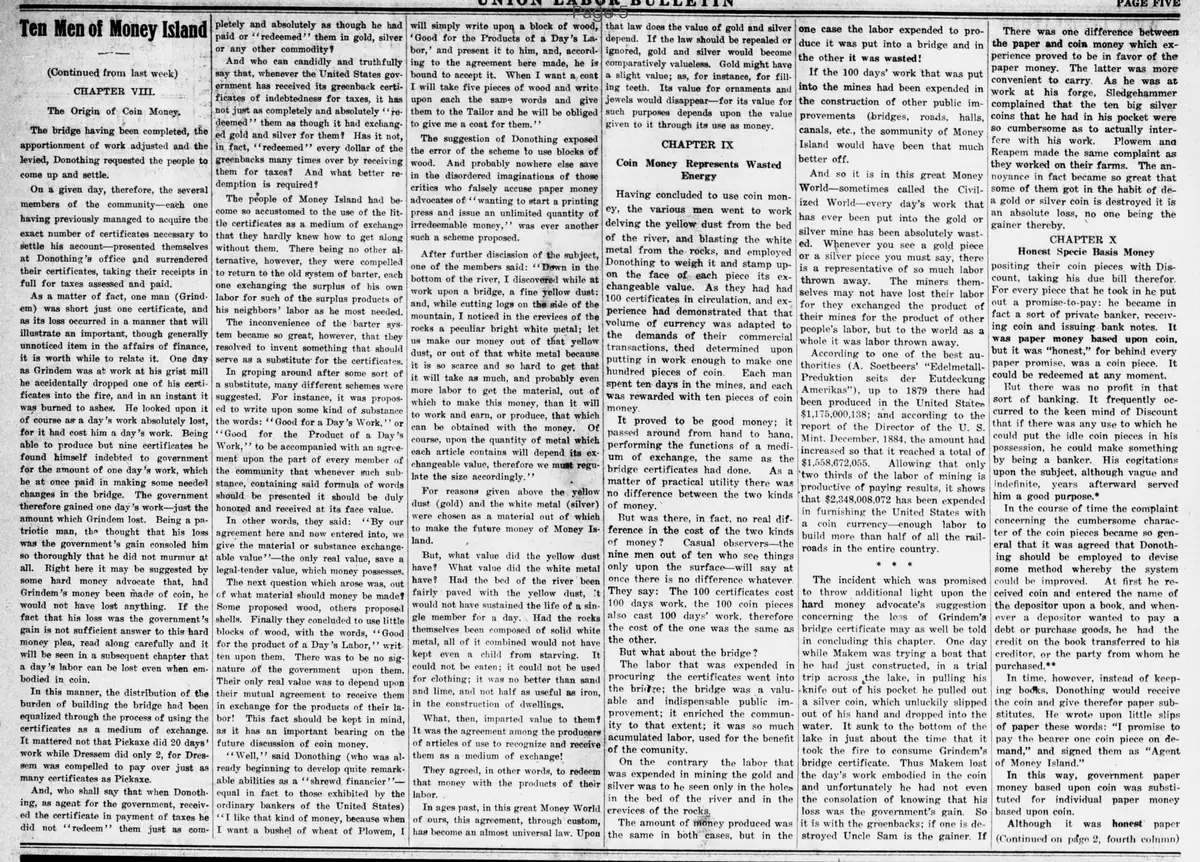
(Continued from last week)
CHAPTER VIII.
The Origin of Coin Money.
The bridge having been completed, the apportionment of work adjusted and the levied, Donothing requested the people to come up and settle.
On a given day, therefore, the several members of the community—each one having previously managed to acquire the exact number of certificates necessary to settle his account—presented themselves at Donothing's office and surrendered their certificates, taking their receipts in full for taxes assessed and paid.
As a matter of fact, one man (Grindem) was short just one certificate, and as its loss occurred in a manner that will illustrate an important, though generally unnoticed item in the affairs of finance, it is worth while to relate it. One day as Grindem was at work at his grist mill he accidentally dropped one of his certificates into the fire, and in an instant it was burned to ashes. He looked upon it of course as a day's work absolutely lost, for it had cost him a day's work. Being able to produce but nine certificates he found himself indebted to government for the amount of one day's work, which he at once paid in making some needed changes in the bridge. The government therefore gained one day's work—just the amount which Grindem lost. Being a patriotic man, the thought that his loss was the government's gain consoled him so thoroughly that he did not murmur at all. Right here it may be suggested by some hard money advocate that, had Grindem's money been made of coin, he would not have lost anything. If the fact that his loss was the government's gain is not sufficient answer to this hard money plea, read along carefully and it will be seen in a subsequent chapter that a day's labor can be lost even when embodied in coin.
In this manner, the distribution of the burden of building the bridge had been equalized through the process of using the certificates as a medium of exchange.
It mattered not that Pickaxe did 20 days' work while Dressem did only 2, for Dressem was compelled to pay over just as many certificates as Pickaxe.
And, who shall say that when Donothing, as agent for the government, received the certificate in payment of taxes he did not redeem them just as completely and absolutely as though he had paid or "redeemed" them in gold, silver or any other commodity
And who can candidly and truthfully say that, whenever the United States government has received its greenback certificates of indebtedness for taxes, it has not just as completely and absolutely "redeemed" them as though it had exchanged gold and silver for them? Has it not, in fact, "redeemed" every dollar of the greenbacks many times over by receiving them for taxes? And what better redemption is required?
The people of Money Island had become so accustomed to the use of the little certificates as a medium of exchange that they hardly knew how to get along without them. There being no other alternative, however, they were compelled to return to the old system of barter, each one exchanging the surplus of his own labor for such of the surplus products of his neighbors' labor as he most needed.
The inconvenience of the barter system became so great, however, that they resolved to invent something that should serve as a substitute for the certificates.
In groping around after some sort of a substitute, many different schemes were suggested. For instance, it was proposed to write upon some kind of substance the words: "Good for a Day's Work," or "Good for the Product of a Day's Work," to be accompanied with an agreement upon the part of every member of the community that whenever such substance, containing said formula of words should be presented it should be duly honored and received at its face value.
In other words, they said: "By our agreement here and now entered into, we give the material or substance exchangeable value"—the only real value, save a legal-tender value, which money possesses.
The next question which arose was, out of what material should money be made Some proposed wood, others proposed shells. Finally they concluded to use little blocks of wood, with the words, "Good for the product of a Day's Labor," written upon them. There was to be no signature of the government upon them.
Their only real value was to depend upon their mutual agreement to receive them in exchange for the products of their labor! This fact should be kept in mind, as it has an important bearing on the future discussion of coin money.
"Well," said Donothing (who was already beginning to develop quite remarkable abilities as a "shrewd financier equal in fact to those exhibited by the ordinary bankers of the United States) "I like that kind of money, because when I want a bushel of wheat of Plowem, I will simply write upon a block of wood, 'Good for the Products of a Day's Labor,' and present it to him, and, according to the agreement here made, he is bound to accept it. When I want a coat I will take five pieces of wood and write upon each the same words and give them to the Tailor and he will be obliged to give me a coat for them."
The suggestion of Donothing exposed the error of the scheme to use blocks of wood. And probably nowhere else save in the disordered imaginations of those critics who falsely accuse paper money advocates of wanting to start a printing press and issue an unlimited quantity of irredeemable money, was such a scheme proposed.
After further discussion of the subject, one of the members said: 'Down in the bottom of the river I discovered while at work upon a bridge, a fine yellow dust; and, while cutting logs on the side of the mountain, I noticed in the crevices of the rocks a peculiar bright white metal: let us make our money out of that yellow dust, or out of that white metal because it is so scarce and so hard to get that it will take as much, and probably even more labor to get the material, out of which to make this money, than it will to work and earn, or produce, that which can be obtained with the money. Of course, upon the quantity of metal which each article contains will depend its exchangeable value, therefore we must regulate the size accordingly.'
For reasons given above the yellow dust (gold) and the white metal (silver) were chosen as a material out of which to make the future money of Money Island.
But, what value did the yellow dust have? What value did the white metal have? Had the bed of the river been fairly paved with the yellow dust, it would not have sustained the life of a single member for a day. Had the rocks themselves been composed of solid white metal, all of it combined would not have kept even a child from starving.
It could not be eaten; it could not be used for clothing: it was no better than sand and lime, and not half as useful as iron, in the construction of dwellings.
What, then, imparted value to them It was the agreement among the producers of articles of use to recognize and receive them as a medium of exchange!
They agreed, in other words, to redeem that money with the products of their labor.
In ages past, in this great Money World of ours, this agreement, through custom, has become an almost universal law. Upon that law does the value of gold and silver depend. If the law should be repealed or ignored, gold and silver would become comparatively valueless. Gold might have a slight value; as, for instance, for filling teeth. Its value for ornaments and jewels would disappear—for its value for such purposes depends upon the value given to it through its use as money.
CHAPTER IX
Coin Money Represents Wasted Energy
Having concluded to use coin money, the various men went to work delving the yellow dust from the bed of the river. and blasting the white metal from the rocks, and employed Donothing to weigh it and stamp upon the face of each piece its exchangeable value. As they had had 100 certificates in circulation, and experience had demonstrated that that volume of currency was adapted to the demands of their commercial transactions. they determined upon putting in work enough to make one hundred pieces of coin.
Each man spent ten days in the mines, and each was rewarded with ten pieces of coin money.
It proved to be good money; it passed around from hand to hand, performing the functions of a medium of exchange, the same as the bridge certificates had done.
As a matter of practical utility there was no difference between the two kinds of money.
But was there, in fact. no real difference in the cost of the two kinds of money? Casual observers—the nine men out of ten who see things only upon the surface will say at once there is no difference whatever They say: The 100 certificates cost 100 days work. the 100 coin pieces also cost 100 days' work, therefore the cost of the one was the same as the other.
But what about the bridge?
The labor that was expended in procuring the certificates went into the bridge: the bridge was a valuable and indispensable public improvement; it enriched the community to that extent: it was so much accumulated labor, used for the benefit of the community.
On the contrary the labor that was expended in mining the gold and silver was to be seen only in the holes in the bed of the river and in the crevices of the rocks
The amount of money produced was the same in both cases, but in the one case the labor expended to produce it was put into a bridge and in the other it was wasted!
If the 100 days' work that was put into the mines had been expended in the construction of other public improvements (bridges, roads, halls, canals, etc., the community of Money Island would have been that much better off.
And so it is in this great Money World—sometimes called the Civilized World—every day's work that has ever been put into the gold or silver mine has been absolutely wasted. Whenever you see a gold piece or a silver piece you must say, there is a representative of so much labor thrown away.
The miners themselves may not have lost their labor for they exchanged the product of their mines for the product of other people's labor, but to the world as a whole it was labor thrown away.
According to one of the best authorities (A. Soetbeer's "Edelmetall-Produktion seits der Entdeckung Amerikas"), up to 1879 there had been produced in the United States $1,175,000,138; and according to the report of the Director of the U. S. Mint. December. 1884. the amount had increased so that it reached a total of $1,558.672.055.
Allowing that only two thirds of the labor of mining is productive of paying results, it shows that $2,348,008,072 has been expended in furnishing the United States with a coin currency—enough labor to build more than half of all the railroads in the entire country.
The incident which was promised to throw additional light upon the hard money advocate's suggestion concerning the loss of Grindem's bridge certificate may as well be told in concluding this chapter. One day while Makem was trying a boat that he had just constructed. in a trial trip across the lake, in pulling his knife out of his pocket he pulled out a silver coin, which unluckily slipped out of his hand and dropped into the water. It sunk to the bottom of the lake in just about the time that it took the fire to consume Grindem's bridge certificate. Thus Makem lost the day's work embodied in the coin and unfortunately he had not even the consolation of knowing that his loss was the government's gain. So it is with the greenbacks: if one is destroyed Uncle Sam is the gainer. If a gold or silver coin is destroyed it is an absolute loss, no one being the gainer thereby.
There was one difference between the paper and coin money which experience proved to be in favor of the paper money. The latter was more convenient to carry. As he was at work at his forge, Sledgehammer complained that the ten big silver coins that he had in his pocket were so cumbersome as to actually interfere with his work.
Plowem and Reapem made the same complaint as they worked on their farms. The annoyance in fact became so great that some of them got in the habit of depositing their coin pieces with Discount, taking his due bill therefor.
For every piece that he took in he put out a promise-to-pay: he became in fact a sort of private banker. receiving coin and issuing bank notes. It was paper money based upon coin, but it was "honest," for behind every paper promise, was a coin piece. It could be redeemed at any moment.
But there was no profit in that sort of banking. It frequently occurred to the keen mind of Discount that if there was any use to which he could put the idle coin pieces in his possession, he could make something by being a banker. His cogitations upon the subject, although vague and indefinite, years afterward served him a good purpose.*
In the course of time the complaint concerning the cumbersome character of the coin pieces became so general that it was agreed that Donothing should be employed to devise some method whereby the system could be improved. At first he received coin and entered the name of the depositor upon a book. and whenever a depositor wanted to pay a debt or purchase goods, he had the credit on the book transferred to his creditor, or the party from whom he purchased.**
In time. however. instead of keeping books. Donothing would receive the coin and give therefor paper substitutes. He wrote upon little slips of paper these words: "I promise to pay the bearer one coin piece on demand," and signed them as "Agent of Money Island."
In this way, government paper money based upon coin was substituted for individual paper money based upon coin.
Although it was honest' paper (Continued on page 2, fourth column)
CHAPTER VIII.
The Origin of Coin Money.
The bridge having been completed, the apportionment of work adjusted and the levied, Donothing requested the people to come up and settle.
On a given day, therefore, the several members of the community—each one having previously managed to acquire the exact number of certificates necessary to settle his account—presented themselves at Donothing's office and surrendered their certificates, taking their receipts in full for taxes assessed and paid.
As a matter of fact, one man (Grindem) was short just one certificate, and as its loss occurred in a manner that will illustrate an important, though generally unnoticed item in the affairs of finance, it is worth while to relate it. One day as Grindem was at work at his grist mill he accidentally dropped one of his certificates into the fire, and in an instant it was burned to ashes. He looked upon it of course as a day's work absolutely lost, for it had cost him a day's work. Being able to produce but nine certificates he found himself indebted to government for the amount of one day's work, which he at once paid in making some needed changes in the bridge. The government therefore gained one day's work—just the amount which Grindem lost. Being a patriotic man, the thought that his loss was the government's gain consoled him so thoroughly that he did not murmur at all. Right here it may be suggested by some hard money advocate that, had Grindem's money been made of coin, he would not have lost anything. If the fact that his loss was the government's gain is not sufficient answer to this hard money plea, read along carefully and it will be seen in a subsequent chapter that a day's labor can be lost even when embodied in coin.
In this manner, the distribution of the burden of building the bridge had been equalized through the process of using the certificates as a medium of exchange.
It mattered not that Pickaxe did 20 days' work while Dressem did only 2, for Dressem was compelled to pay over just as many certificates as Pickaxe.
And, who shall say that when Donothing, as agent for the government, received the certificate in payment of taxes he did not redeem them just as completely and absolutely as though he had paid or "redeemed" them in gold, silver or any other commodity
And who can candidly and truthfully say that, whenever the United States government has received its greenback certificates of indebtedness for taxes, it has not just as completely and absolutely "redeemed" them as though it had exchanged gold and silver for them? Has it not, in fact, "redeemed" every dollar of the greenbacks many times over by receiving them for taxes? And what better redemption is required?
The people of Money Island had become so accustomed to the use of the little certificates as a medium of exchange that they hardly knew how to get along without them. There being no other alternative, however, they were compelled to return to the old system of barter, each one exchanging the surplus of his own labor for such of the surplus products of his neighbors' labor as he most needed.
The inconvenience of the barter system became so great, however, that they resolved to invent something that should serve as a substitute for the certificates.
In groping around after some sort of a substitute, many different schemes were suggested. For instance, it was proposed to write upon some kind of substance the words: "Good for a Day's Work," or "Good for the Product of a Day's Work," to be accompanied with an agreement upon the part of every member of the community that whenever such substance, containing said formula of words should be presented it should be duly honored and received at its face value.
In other words, they said: "By our agreement here and now entered into, we give the material or substance exchangeable value"—the only real value, save a legal-tender value, which money possesses.
The next question which arose was, out of what material should money be made Some proposed wood, others proposed shells. Finally they concluded to use little blocks of wood, with the words, "Good for the product of a Day's Labor," written upon them. There was to be no signature of the government upon them.
Their only real value was to depend upon their mutual agreement to receive them in exchange for the products of their labor! This fact should be kept in mind, as it has an important bearing on the future discussion of coin money.
"Well," said Donothing (who was already beginning to develop quite remarkable abilities as a "shrewd financier equal in fact to those exhibited by the ordinary bankers of the United States) "I like that kind of money, because when I want a bushel of wheat of Plowem, I will simply write upon a block of wood, 'Good for the Products of a Day's Labor,' and present it to him, and, according to the agreement here made, he is bound to accept it. When I want a coat I will take five pieces of wood and write upon each the same words and give them to the Tailor and he will be obliged to give me a coat for them."
The suggestion of Donothing exposed the error of the scheme to use blocks of wood. And probably nowhere else save in the disordered imaginations of those critics who falsely accuse paper money advocates of wanting to start a printing press and issue an unlimited quantity of irredeemable money, was such a scheme proposed.
After further discussion of the subject, one of the members said: 'Down in the bottom of the river I discovered while at work upon a bridge, a fine yellow dust; and, while cutting logs on the side of the mountain, I noticed in the crevices of the rocks a peculiar bright white metal: let us make our money out of that yellow dust, or out of that white metal because it is so scarce and so hard to get that it will take as much, and probably even more labor to get the material, out of which to make this money, than it will to work and earn, or produce, that which can be obtained with the money. Of course, upon the quantity of metal which each article contains will depend its exchangeable value, therefore we must regulate the size accordingly.'
For reasons given above the yellow dust (gold) and the white metal (silver) were chosen as a material out of which to make the future money of Money Island.
But, what value did the yellow dust have? What value did the white metal have? Had the bed of the river been fairly paved with the yellow dust, it would not have sustained the life of a single member for a day. Had the rocks themselves been composed of solid white metal, all of it combined would not have kept even a child from starving.
It could not be eaten; it could not be used for clothing: it was no better than sand and lime, and not half as useful as iron, in the construction of dwellings.
What, then, imparted value to them It was the agreement among the producers of articles of use to recognize and receive them as a medium of exchange!
They agreed, in other words, to redeem that money with the products of their labor.
In ages past, in this great Money World of ours, this agreement, through custom, has become an almost universal law. Upon that law does the value of gold and silver depend. If the law should be repealed or ignored, gold and silver would become comparatively valueless. Gold might have a slight value; as, for instance, for filling teeth. Its value for ornaments and jewels would disappear—for its value for such purposes depends upon the value given to it through its use as money.
CHAPTER IX
Coin Money Represents Wasted Energy
Having concluded to use coin money, the various men went to work delving the yellow dust from the bed of the river. and blasting the white metal from the rocks, and employed Donothing to weigh it and stamp upon the face of each piece its exchangeable value. As they had had 100 certificates in circulation, and experience had demonstrated that that volume of currency was adapted to the demands of their commercial transactions. they determined upon putting in work enough to make one hundred pieces of coin.
Each man spent ten days in the mines, and each was rewarded with ten pieces of coin money.
It proved to be good money; it passed around from hand to hand, performing the functions of a medium of exchange, the same as the bridge certificates had done.
As a matter of practical utility there was no difference between the two kinds of money.
But was there, in fact. no real difference in the cost of the two kinds of money? Casual observers—the nine men out of ten who see things only upon the surface will say at once there is no difference whatever They say: The 100 certificates cost 100 days work. the 100 coin pieces also cost 100 days' work, therefore the cost of the one was the same as the other.
But what about the bridge?
The labor that was expended in procuring the certificates went into the bridge: the bridge was a valuable and indispensable public improvement; it enriched the community to that extent: it was so much accumulated labor, used for the benefit of the community.
On the contrary the labor that was expended in mining the gold and silver was to be seen only in the holes in the bed of the river and in the crevices of the rocks
The amount of money produced was the same in both cases, but in the one case the labor expended to produce it was put into a bridge and in the other it was wasted!
If the 100 days' work that was put into the mines had been expended in the construction of other public improvements (bridges, roads, halls, canals, etc., the community of Money Island would have been that much better off.
And so it is in this great Money World—sometimes called the Civilized World—every day's work that has ever been put into the gold or silver mine has been absolutely wasted. Whenever you see a gold piece or a silver piece you must say, there is a representative of so much labor thrown away.
The miners themselves may not have lost their labor for they exchanged the product of their mines for the product of other people's labor, but to the world as a whole it was labor thrown away.
According to one of the best authorities (A. Soetbeer's "Edelmetall-Produktion seits der Entdeckung Amerikas"), up to 1879 there had been produced in the United States $1,175,000,138; and according to the report of the Director of the U. S. Mint. December. 1884. the amount had increased so that it reached a total of $1,558.672.055.
Allowing that only two thirds of the labor of mining is productive of paying results, it shows that $2,348,008,072 has been expended in furnishing the United States with a coin currency—enough labor to build more than half of all the railroads in the entire country.
The incident which was promised to throw additional light upon the hard money advocate's suggestion concerning the loss of Grindem's bridge certificate may as well be told in concluding this chapter. One day while Makem was trying a boat that he had just constructed. in a trial trip across the lake, in pulling his knife out of his pocket he pulled out a silver coin, which unluckily slipped out of his hand and dropped into the water. It sunk to the bottom of the lake in just about the time that it took the fire to consume Grindem's bridge certificate. Thus Makem lost the day's work embodied in the coin and unfortunately he had not even the consolation of knowing that his loss was the government's gain. So it is with the greenbacks: if one is destroyed Uncle Sam is the gainer. If a gold or silver coin is destroyed it is an absolute loss, no one being the gainer thereby.
There was one difference between the paper and coin money which experience proved to be in favor of the paper money. The latter was more convenient to carry. As he was at work at his forge, Sledgehammer complained that the ten big silver coins that he had in his pocket were so cumbersome as to actually interfere with his work.
Plowem and Reapem made the same complaint as they worked on their farms. The annoyance in fact became so great that some of them got in the habit of depositing their coin pieces with Discount, taking his due bill therefor.
For every piece that he took in he put out a promise-to-pay: he became in fact a sort of private banker. receiving coin and issuing bank notes. It was paper money based upon coin, but it was "honest," for behind every paper promise, was a coin piece. It could be redeemed at any moment.
But there was no profit in that sort of banking. It frequently occurred to the keen mind of Discount that if there was any use to which he could put the idle coin pieces in his possession, he could make something by being a banker. His cogitations upon the subject, although vague and indefinite, years afterward served him a good purpose.*
In the course of time the complaint concerning the cumbersome character of the coin pieces became so general that it was agreed that Donothing should be employed to devise some method whereby the system could be improved. At first he received coin and entered the name of the depositor upon a book. and whenever a depositor wanted to pay a debt or purchase goods, he had the credit on the book transferred to his creditor, or the party from whom he purchased.**
In time. however. instead of keeping books. Donothing would receive the coin and give therefor paper substitutes. He wrote upon little slips of paper these words: "I promise to pay the bearer one coin piece on demand," and signed them as "Agent of Money Island."
In this way, government paper money based upon coin was substituted for individual paper money based upon coin.
Although it was honest' paper (Continued on page 2, fourth column)
What sub-type of article is it?
Allegory
Prose Fiction
Satire
What themes does it cover?
Commerce Trade
Political
Moral Virtue
What keywords are associated?
Coin Money
Labor Certificates
Gold Silver
Wasted Labor
Medium Exchange
Paper Money
Money Island
Bridge Building
Literary Details
Title
Chapter Viii. The Origin Of Coin Money. Chapter Ix Coin Money Represents Wasted Energy
Form / Style
Allegorical Narrative Critiquing Coin Money Versus Labor Certificates
Key Lines
"By Our Agreement Here And Now Entered Into, We Give The Material Or Substance Exchangeable Value"—The Only Real Value, Save A Legal Tender Value, Which Money Possesses.
The Labor That Was Expended In Procuring The Certificates Went Into The Bridge: The Bridge Was A Valuable And Indispensable Public Improvement; It Enriched The Community To That Extent: It Was So Much Accumulated Labor, Used For The Benefit Of The Community.
And So It Is In This Great Money World—Sometimes Called The Civilized World—Every Day's Work That Has Ever Been Put Into The Gold Or Silver Mine Has Been Absolutely Wasted.