Thank you for visiting SNEWPapers!
Sign up free
Story
January 1, 1841
The Liberator
Boston, Suffolk County, Massachusetts
What is this article about?
An anti-slavery critique from the National Anti-Slavery Standard examining U.S. Presidents' hypocrisy in professing liberty while most owned slaves, highlighting Washington, Jefferson, Monroe, Jackson, John Adams, and John Quincy Adams.
Clipping
OCR Quality
98%
Excellent
Full Text
From the National Anti-Slavery Standard.
Our National Presidents.
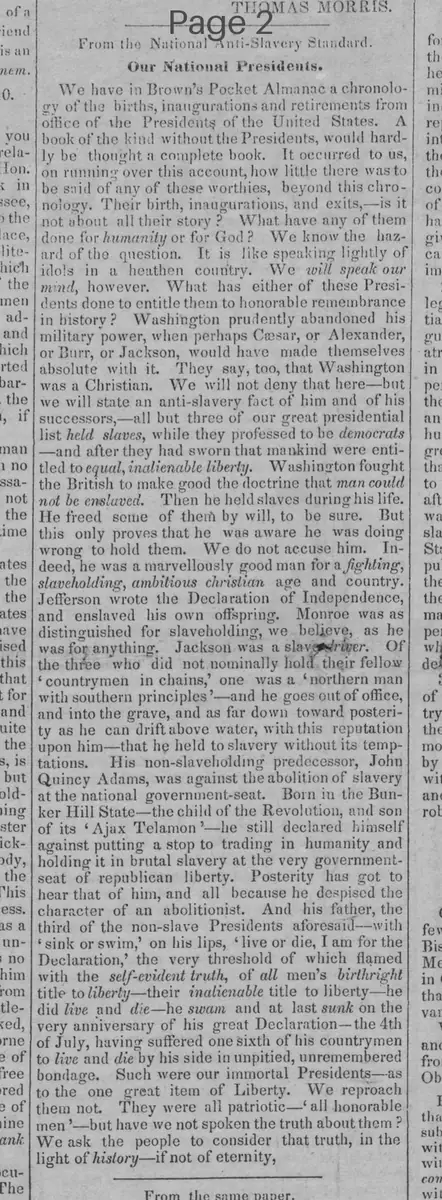
We have in Brown's Pocket Almanac a chronology of the births, inaugurations and retirements from office of the Presidents of the United States. A book of the kind without the Presidents, would hardly be thought a complete book. It occurred to us, on running over this account, how little there was to be said of any of these worthies, beyond this chronology. Their birth, inaugurations, and exits,—is it not about all their story? What have any of them done for humanity or for God? We know the hazard of the question. It is like speaking lightly of idols in a heathen country. We will speak our mind, however. What has either of these Presidents done to entitle them to honorable remembrance in history? Washington prudently abandoned his military power, when perhaps Cæsar, or Alexander, or Burr, or Jackson, would have made themselves absolute with it. They say, too, that Washington was a Christian. We will not deny that here—but we will state an anti-slavery fact of him and of his successors,—all but three of our great presidential list held slaves, while they professed to be democrats—and after they had sworn that mankind were entitled to equal, inalienable liberty. Washington fought the British to make good the doctrine that man could not be enslaved. Then he held slaves during his life. He freed some of them by will, to be sure. But this only proves that he was aware he was doing wrong to hold them. We do not accuse him. Indeed, he was a marvellously good man for a fighting, slaveholding, ambitious christian age and country.
Jefferson wrote the Declaration of Independence, and enslaved his own offspring. Monroe was as distinguished for slaveholding, we believe, as he was for anything. Jackson was a slave driver. Of the three who did not nominally hold their fellow 'countrymen in chains,' one was a 'northern man with southern principles'—and he goes out of office, and into the grave, and as far down toward posterity as he can drift above water, with this reputation upon him—that he held to slavery without its temptations. His non-slaveholding predecessor, John Quincy Adams, was against the abolition of slavery at the national government-seat. Born in the Bunker Hill State—the child of the Revolution, and son of its 'Ajax Telamon'—he still declared himself against putting a stop to trading in humanity and holding it in brutal slavery at the very government-seat of republican liberty. Posterity has got to hear that of him, and all because he despised the character of an abolitionist. And his father, the third of the non-slave Presidents aforesaid—with 'sink or swim,' on his lips, 'live or die, I am for the Declaration,' the very threshold of which flamed with the self-evident truth, of all men's birthright title to liberty—their inalienable title to liberty—he did live and die—he swam and at last sunk on the very anniversary of his great Declaration—the 4th of July, having suffered one sixth of his countrymen to live and die by his side in unpitied, unremembered bondage. Such were our immortal Presidents—as to the one great item of Liberty. We reproach them not. They were all patriotic—'all honorable men'—but have we not spoken the truth about them? We ask the people to consider that truth, in the light of history—if not of eternity.
Our National Presidents.
We have in Brown's Pocket Almanac a chronology of the births, inaugurations and retirements from office of the Presidents of the United States. A book of the kind without the Presidents, would hardly be thought a complete book. It occurred to us, on running over this account, how little there was to be said of any of these worthies, beyond this chronology. Their birth, inaugurations, and exits,—is it not about all their story? What have any of them done for humanity or for God? We know the hazard of the question. It is like speaking lightly of idols in a heathen country. We will speak our mind, however. What has either of these Presidents done to entitle them to honorable remembrance in history? Washington prudently abandoned his military power, when perhaps Cæsar, or Alexander, or Burr, or Jackson, would have made themselves absolute with it. They say, too, that Washington was a Christian. We will not deny that here—but we will state an anti-slavery fact of him and of his successors,—all but three of our great presidential list held slaves, while they professed to be democrats—and after they had sworn that mankind were entitled to equal, inalienable liberty. Washington fought the British to make good the doctrine that man could not be enslaved. Then he held slaves during his life. He freed some of them by will, to be sure. But this only proves that he was aware he was doing wrong to hold them. We do not accuse him. Indeed, he was a marvellously good man for a fighting, slaveholding, ambitious christian age and country.
Jefferson wrote the Declaration of Independence, and enslaved his own offspring. Monroe was as distinguished for slaveholding, we believe, as he was for anything. Jackson was a slave driver. Of the three who did not nominally hold their fellow 'countrymen in chains,' one was a 'northern man with southern principles'—and he goes out of office, and into the grave, and as far down toward posterity as he can drift above water, with this reputation upon him—that he held to slavery without its temptations. His non-slaveholding predecessor, John Quincy Adams, was against the abolition of slavery at the national government-seat. Born in the Bunker Hill State—the child of the Revolution, and son of its 'Ajax Telamon'—he still declared himself against putting a stop to trading in humanity and holding it in brutal slavery at the very government-seat of republican liberty. Posterity has got to hear that of him, and all because he despised the character of an abolitionist. And his father, the third of the non-slave Presidents aforesaid—with 'sink or swim,' on his lips, 'live or die, I am for the Declaration,' the very threshold of which flamed with the self-evident truth, of all men's birthright title to liberty—their inalienable title to liberty—he did live and die—he swam and at last sunk on the very anniversary of his great Declaration—the 4th of July, having suffered one sixth of his countrymen to live and die by his side in unpitied, unremembered bondage. Such were our immortal Presidents—as to the one great item of Liberty. We reproach them not. They were all patriotic—'all honorable men'—but have we not spoken the truth about them? We ask the people to consider that truth, in the light of history—if not of eternity.
What sub-type of article is it?
Biography
Historical Event
What themes does it cover?
Moral Virtue
Deception
Justice
What keywords are associated?
Presidents
Slavery
Hypocrisy
Liberty
Abolition
Declaration Of Independence
What entities or persons were involved?
Washington
Jefferson
Monroe
Jackson
John Quincy Adams
John Adams
Where did it happen?
United States
Story Details
Key Persons
Washington
Jefferson
Monroe
Jackson
John Quincy Adams
John Adams
Location
United States
Story Details
Critique of U.S. Presidents for holding slaves despite oaths to liberty; most owned slaves, three did not but supported or tolerated slavery; highlights hypocrisy in founders like Washington and Jefferson.