Thank you for visiting SNEWPapers!
Sign up free
Story
March 24, 1877
Orangeburg News And Times
Orangeburg, Orangeburg County, South Carolina
What is this article about?
Account of Apache Indian courtship customs, where suitors offer horses, and acceptance is shown by the woman caring for the horse over four days, as described in Col. John C. Cremony's lecture.
Clipping
OCR Quality
98%
Excellent
Full Text
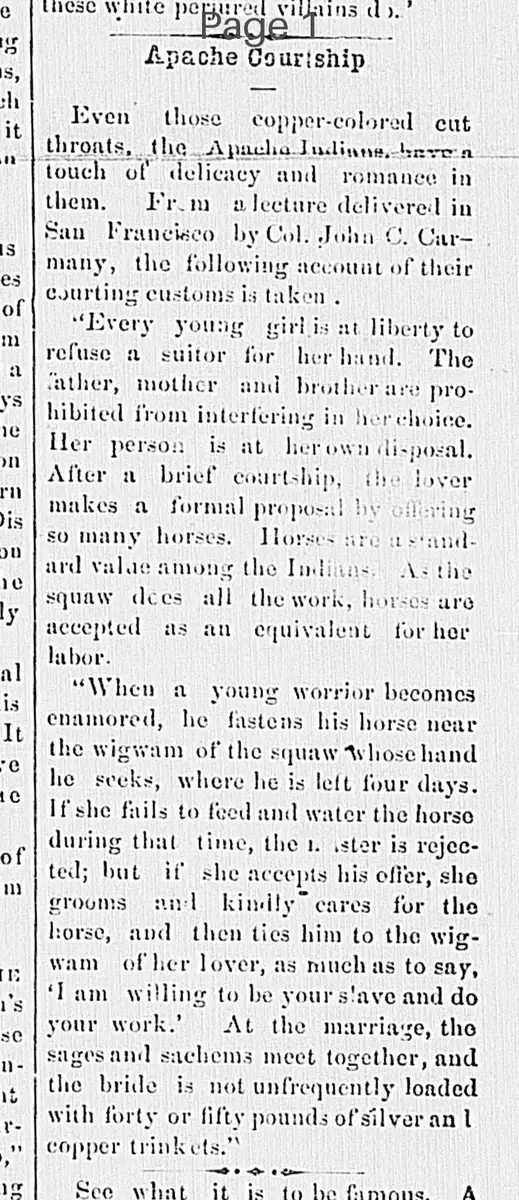
Apache Courtship
Even those copper-colored cut throats, the Apache Indians, have a touch of delicacy and romance in them. In a lecture delivered in San Francisco by Col. John C. Cremony, the following account of their courting customs is taken.
Every young girl is at liberty to refuse a suitor for her hand. The father, mother and brother are prohibited from interfering in her choice. Her person is at her own disposal.
After a brief courtship, the lover makes a formal proposal by offering so many horses. Horses are the standard value among the Indians. As the squaw does all the work, horses are accepted as an equivalent for her labor.
"When a young warrior becomes enamored, he fastens his horse near the wigwam of the squaw whose hand he seeks, where he is left four days. If she fails to feed and water the horse during that time, the suitor is rejected; but if she accepts his offer, she grooms and kindly cares for the horse, and then ties him to the wigwam of her lover, as much as to say, 'I am willing to be your slave and do your work.' At the marriage, the sages and sachems meet together, and the bride is not unfrequently loaded with forty or fifty pounds of silver and copper trinkets."
Even those copper-colored cut throats, the Apache Indians, have a touch of delicacy and romance in them. In a lecture delivered in San Francisco by Col. John C. Cremony, the following account of their courting customs is taken.
Every young girl is at liberty to refuse a suitor for her hand. The father, mother and brother are prohibited from interfering in her choice. Her person is at her own disposal.
After a brief courtship, the lover makes a formal proposal by offering so many horses. Horses are the standard value among the Indians. As the squaw does all the work, horses are accepted as an equivalent for her labor.
"When a young warrior becomes enamored, he fastens his horse near the wigwam of the squaw whose hand he seeks, where he is left four days. If she fails to feed and water the horse during that time, the suitor is rejected; but if she accepts his offer, she grooms and kindly cares for the horse, and then ties him to the wigwam of her lover, as much as to say, 'I am willing to be your slave and do your work.' At the marriage, the sages and sachems meet together, and the bride is not unfrequently loaded with forty or fifty pounds of silver and copper trinkets."
What sub-type of article is it?
Curiosity
Romance
What themes does it cover?
Love
Social Manners
What keywords are associated?
Apache Courtship
Indian Customs
Horse Offering
Marriage Rituals
Squaw Labor
What entities or persons were involved?
Col. John C. Cremony
Where did it happen?
San Francisco (Lecture); Apache Wigwams
Story Details
Key Persons
Col. John C. Cremony
Location
San Francisco (Lecture); Apache Wigwams
Story Details
Apache courtship involves a suitor tying his horse near the woman's wigwam for four days; if she cares for it, she accepts by tying it to his wigwam, symbolizing willingness to work for him. Horses represent value, and marriages include trinkets for the bride.