Thank you for visiting SNEWPapers!
Sign up free
The Rhode Island American, And General Advertiser
Providence, Providence County, Rhode Island
What is this article about?
London papers report Paris capitulated to 180,000 allied troops on March 1, 1814, led by Russian Emperor and Prussian King; Bonaparte's forces defeated; peace negotiations shift to Bourbons; revolts in French ports like Bordeaux for Louis XVIII; Wellington wounded battling Soult; prospects for US-UK peace in summer.
Clipping
OCR Quality
Full Text
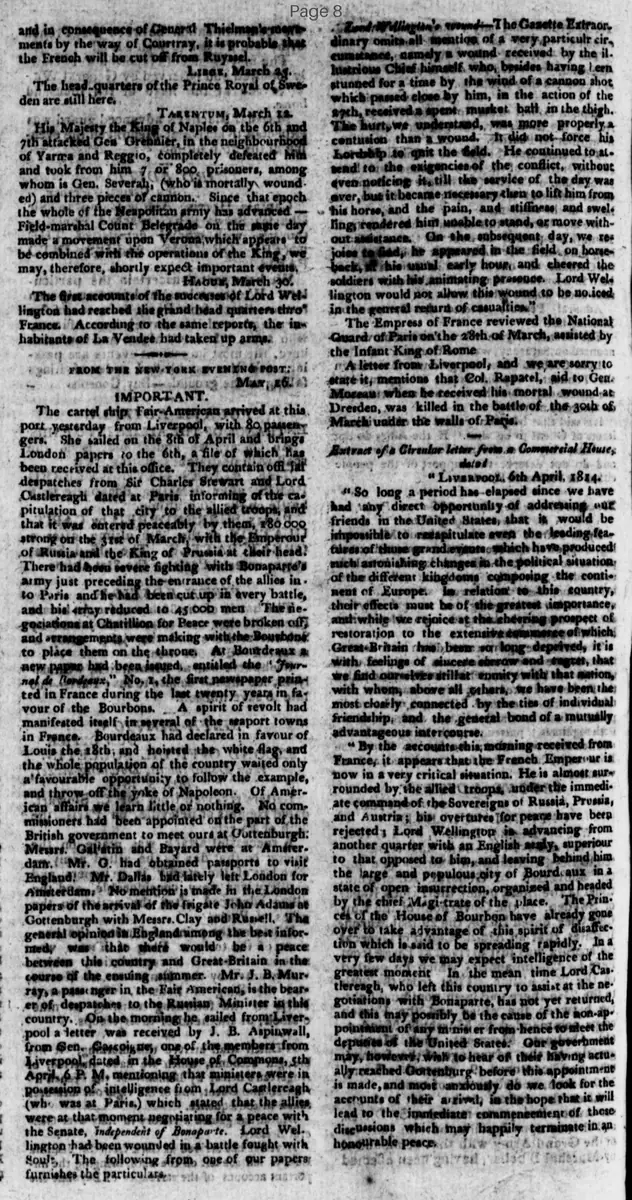
IMPORTANT.
The cartel ship Fair American arrived at this port yesterday from Liverpool, with 80 passengers. She sailed on the 8th of April and brings London papers to the 6th, a file of which has been received at this office. They contain official despatches from Sir Charles Stewart and Lord Castlereagh dated at Paris, informing of the capitulation of that city to the allied troops, and that it was entered peaceably by them, 180,000 strong on the 1st of March, with the Emperor of Russia and the King of Prussia at their head.
There had been severe fighting with Bonaparte's army just preceding the entrance of the allies into Paris and he had been cut up in every battle and his rear reduced to 15,000 men. The negotiations at Chatillon for Peace were broken off and arrangements were making with the Bourbons to place them on the throne. At Bordeaux a new paper had been issued, entitled the Journal de Bordeaux, No. 1, the first newspaper printed in France during the last twenty years in favour of the Bourbons. A spirit of revolt had manifested itself in several of the seaport towns in France. Bordeaux had declared in favour of Louis XVIII; and hoisted the white flag, and the whole population of the country waited only a favourable opportunity to follow the example, and throw off the yoke of Napoleon. Of American affairs we learn little or nothing. No commissioners had been appointed on the part of the British government to meet ours at Gottenburgh: Messrs. Gallatin and Bayard were at Amsterdam. Mr. Adams had obtained passports to visit England. Mr. Dallas had lately left London for Amsterdam. No mention is made in the London papers of the arrival of the frigate John Adams at Gottenburgh with Messrs. Clay and Russell. The general opinion in England among the best informed was that there would be a peace between this country and Great Britain in the course of the ensuing summer. Mr. J. B. Murray, a passenger in the Fair American is the bearer of despatches to the Russian Minister in this country. On the morning he sailed from Liverpool a letter was received by J. B. Aspinwall, from Gen. Gascoyne, one of the members from Liverpool, dated in the House of Commons, 8th April, 6 P. M. mentioning that ministers were in possession of intelligence from Lord Castlereagh (who was at Paris.) which stated that the allies were at that moment negotiating for a peace with the Senate, independent of Bonaparte. Lord Wellington had been wounded in a battle fought with Soult.
The following from one of our papers furnishes the particulars of his wound. The Gazette Extraordinary omits all mention of a very particular circumstance, namely, a wound received by the illustrious Chief himself who, besides having been stunned for a time by the wind of a cannon shot which passed close by him, in the action of the 8th, received a spent musket ball in the thigh. The hurt we understand, was more properly a contusion than a wound. It did not force his Lordship to quit the field. He continued to attend to the exigencies of the conflict, without even noticing it, till the service of the day was over, but it became necessary then to lift him from his horse, and the pain, and stiffness and swelling rendered him unable to stand, or move without assistance. On the subsequent day, we rejoice to find, he appeared in the field on horseback at his usual early hour and cheered the soldiers with his animating presence. Lord Wellington would not allow this wound to be noticed in the general return of casualties.
What sub-type of article is it?
What keywords are associated?
What entities or persons were involved?
Where did it happen?
Foreign News Details
Primary Location
Paris
Event Date
1st Of March
Key Persons
Outcome
paris capitulated to allied troops; entered peaceably by 180,000 strong; bonaparte's army cut up in battles with rear reduced to 15,000 men; negotiations at chatillon broken off; arrangements making with bourbons to place them on throne; bordeaux declared for louis xviii and hoisted white flag; spirit of revolt in several seaport towns; lord wellington wounded in battle with soult (contusion from spent musket ball in thigh); allies negotiating peace with senate independent of bonaparte
Event Details
Cartel ship Fair American arrived from Liverpool with London papers to 6th April reporting official despatches from Paris on capitulation of city to allied troops who entered peaceably on 1st March led by Emperor of Russia and King of Prussia; severe fighting preceded entrance with Bonaparte's army defeated; negotiations at Chatillon broken off; arrangements with Bourbons; new Bourbon-favoring paper in Bordeaux; revolts in seaports including Bordeaux declaring for Louis XVIII; American affairs: no British commissioners appointed for Gottenburgh; Gallatin and Bayard at Amsterdam; Adams obtained passports to England; Dallas left London for Amsterdam; no mention of John Adams frigate arrival with Clay and Russell; general opinion of peace with Britain in summer; despatches to Russian Minister; intelligence of allies negotiating peace with Senate; Lord Wellington wounded in battle with Soult