Thank you for visiting SNEWPapers!
Sign up free
Letter to Editor
February 9, 1769
The Virginia Gazette
Richmond, Williamsburg, Richmond County, Virginia
What is this article about?
Theological letter by Caledoniensis arguing that humanity's creation in God's image means a trinity of body, soul, and spirit, proven via Bible and nature, persisting post-Fall and countering Deism. Dated Jan. 29, 1769, from Sweet Hall.
Clipping
OCR Quality
98%
Excellent
Full Text
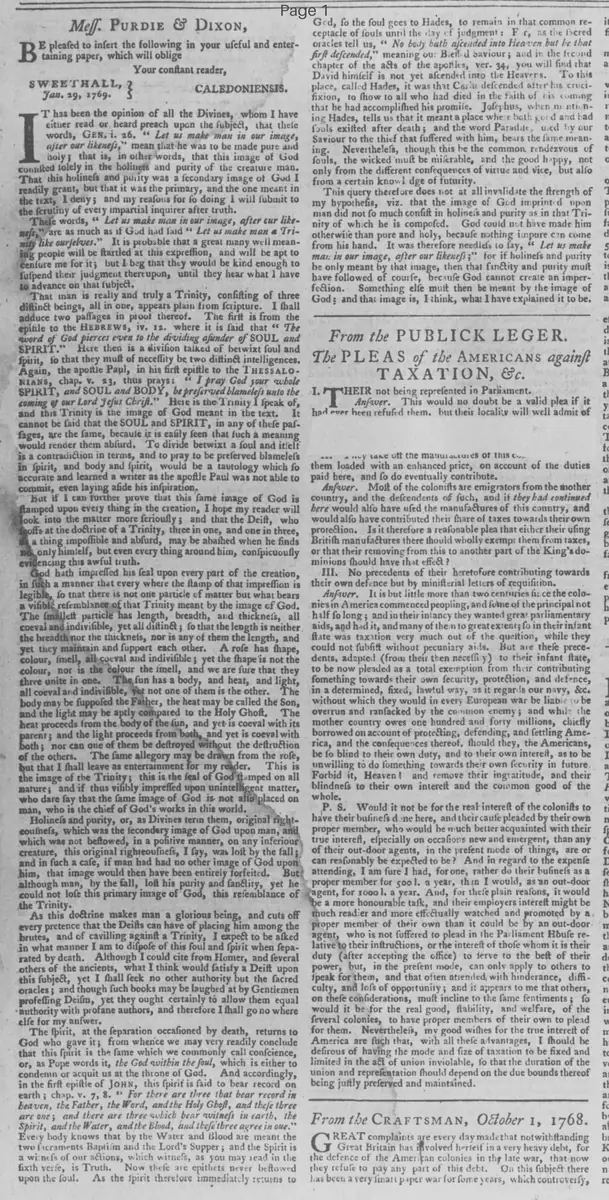
Mess. Purdie & Dixon,
Pleased to insert the following in your useful and entertaining paper, which will oblige
Your constant reader,
SWEETHALL,
Jan. 29, 1769.
CALEDONIENSIS.
It has been the opinion of all the Divines, whom I have either read or heard preach upon the subject, that these words, Gen. i. 26. "Let us make man in our image, after our likeness," mean that he was to be made pure and holy; that is, in other words, that this image of God consisted solely in the holiness and purity of the creature man.
That this holiness and purity was a secondary image of God I readily grant, but that it was the primary, and the one meant in the text, I deny; and my reasons for so doing I will submit to the scrutiny of every impartial inquirer after truth.
These words, "Let us make man in our image, after our likeness," are as much as if God had said "Let us make man a Trinity like ourselves." It is probable that a great many well-meaning people will be startled at this expression, and will be apt to censure me for it; but I beg that they would be kind enough to suspend their judgment thereupon, until they hear what I have to advance on that subject.
That man is really and truly a Trinity, consisting of three distinct beings, all in one, appears plain from scripture. I shall adduce two passages in proof thereof. The first is from the epistle to the Hebrews, iv. 12. where it is said that "The word of God pierces even to the dividing asunder of soul and spirit."
Here then is a division talked of betwixt soul and spirit, so that they must of necessity be two distinct intelligences.
Again, the apostle Paul, in his first epistle to the Thessalonians, chap. v. 23, thus prays: "I pray God your whole spirit, and soul and body, be preserved blameless unto the coming of our Lord Jesus Christ." Here is the Trinity I speak of, and this Trinity is the image of God meant in the text.
It cannot be said that the soul and spirit, in any of these passages, are the same, because it is easily seen that such a meaning would render them absurd. To divide betwixt a soul and itself is a contradiction in terms, and to pray to be preserved blameless in spirit, and body and spirit, would be a tautology which so accurate and learned a writer as the apostle Paul was not able to commit, even laying aside his inspiration.
But if I can further prove that this same image of God is stamped upon every thing in the creation, I hope my reader will look into the matter more seriously; and that the Deist, who scoffs at the doctrine of a Trinity, three in one, and one in three, a thing impossible and absurd, may be abashed when he finds not only himself, but even every thing around him, conspicuously evidencing this awful truth.
God hath impressed his seal upon every part of the creation, in such a manner that every where the stamp of that impression is legible, so that there is not one particle of matter but what bears a visible resemblance of that Trinity meant by the image of God.
The smallest particle has length, breadth, and thickness, all coeval and indivisible, yet all distinct; so that the length is neither the breadth nor the thickness, nor is any of them the length, and yet they maintain and support each other.
A rose has shape, colour, smell, all coeval and indivisible; yet the shape is not the colour, nor is the colour the smell, and we are sure that these three unite in one.
The sun has a body, and heat, and light, all coeval and indivisible, yet not one of them is the other. The body may be supposed the Father, the heat may be called the Son, and the light may be aptly compared to the Holy Ghost.
The heat proceeds from the body of the sun, and yet is coeval with its parent; and the light proceeds from both, and yet is coeval with both; nor can one of them be destroyed without the destruction of the others.
The same allegory may be drawn from the rose, but that I shall leave as entertainment for my reader. This is the image of the Trinity; this is the seal of God stamped on all nature; and if thus visibly impressed upon unintelligent matter, who dare say that the same image of God is not also placed on man, who is the chief of God's works in this world.
Holiness and purity, or, as Divines term them, original righteousness, which was the secondary image of God upon man, and which was not bestowed, in a positive manner, on any inferior creature, this original righteousness, I say, was lost by the fall; and in such a case, if man had had no other image of God upon him, that image would then have been entirely forfeited.
But although man, by the fall, lost his purity and sanctity, yet he could not lose this primary image of God, this resemblance of the Trinity.
As this doctrine makes man a glorious being, and cuts off every pretence that the Deists can have of placing him among the brutes, and of cavilling against a Trinity, I expect to be asked in what manner I am to dispose of this soul and spirit when separated by death.
Although I could cite from Homer, and several others of the ancients, what I think would satisfy a Deist upon this subject, yet I shall seek no other authority but the sacred oracles; and though such books may be laughed at by Gentlemen professing Deism, yet they ought certainly to allow them equal authority with profane authors, and therefore I shall go no where else for my answer.
The spirit, at the separation occasioned by death, returns to God who gave it; from whence we may very readily conclude that this spirit is the same which we commonly call conscience, or, as Pope words it, the God within the soul, which is either to condemn or acquit us at the throne of God.
And accordingly, in the first epistle of John, this spirit is said to bear record on earth; chap. v. 7, 8. "For there are three that bear record in heaven, the Father, the Word, and the Holy Ghost, and these three are one; and there are three which bear witness in earth, the Spirit, and the Water, and the Blood, and these three agree in one."
Every body knows that by the Water and Blood are meant the two sacraments Baptism and the Lord's Supper; and the Spirit is a witness of our actions, which witness, as you may read in the sixth verse, is Truth.
Now these are epithets never bestowed upon the soul. As the spirit therefore immediately returns to God, so the soul goes to Hades, to remain in that common receptacle of souls until the day of judgment.
Pleased to insert the following in your useful and entertaining paper, which will oblige
Your constant reader,
SWEETHALL,
Jan. 29, 1769.
CALEDONIENSIS.
It has been the opinion of all the Divines, whom I have either read or heard preach upon the subject, that these words, Gen. i. 26. "Let us make man in our image, after our likeness," mean that he was to be made pure and holy; that is, in other words, that this image of God consisted solely in the holiness and purity of the creature man.
That this holiness and purity was a secondary image of God I readily grant, but that it was the primary, and the one meant in the text, I deny; and my reasons for so doing I will submit to the scrutiny of every impartial inquirer after truth.
These words, "Let us make man in our image, after our likeness," are as much as if God had said "Let us make man a Trinity like ourselves." It is probable that a great many well-meaning people will be startled at this expression, and will be apt to censure me for it; but I beg that they would be kind enough to suspend their judgment thereupon, until they hear what I have to advance on that subject.
That man is really and truly a Trinity, consisting of three distinct beings, all in one, appears plain from scripture. I shall adduce two passages in proof thereof. The first is from the epistle to the Hebrews, iv. 12. where it is said that "The word of God pierces even to the dividing asunder of soul and spirit."
Here then is a division talked of betwixt soul and spirit, so that they must of necessity be two distinct intelligences.
Again, the apostle Paul, in his first epistle to the Thessalonians, chap. v. 23, thus prays: "I pray God your whole spirit, and soul and body, be preserved blameless unto the coming of our Lord Jesus Christ." Here is the Trinity I speak of, and this Trinity is the image of God meant in the text.
It cannot be said that the soul and spirit, in any of these passages, are the same, because it is easily seen that such a meaning would render them absurd. To divide betwixt a soul and itself is a contradiction in terms, and to pray to be preserved blameless in spirit, and body and spirit, would be a tautology which so accurate and learned a writer as the apostle Paul was not able to commit, even laying aside his inspiration.
But if I can further prove that this same image of God is stamped upon every thing in the creation, I hope my reader will look into the matter more seriously; and that the Deist, who scoffs at the doctrine of a Trinity, three in one, and one in three, a thing impossible and absurd, may be abashed when he finds not only himself, but even every thing around him, conspicuously evidencing this awful truth.
God hath impressed his seal upon every part of the creation, in such a manner that every where the stamp of that impression is legible, so that there is not one particle of matter but what bears a visible resemblance of that Trinity meant by the image of God.
The smallest particle has length, breadth, and thickness, all coeval and indivisible, yet all distinct; so that the length is neither the breadth nor the thickness, nor is any of them the length, and yet they maintain and support each other.
A rose has shape, colour, smell, all coeval and indivisible; yet the shape is not the colour, nor is the colour the smell, and we are sure that these three unite in one.
The sun has a body, and heat, and light, all coeval and indivisible, yet not one of them is the other. The body may be supposed the Father, the heat may be called the Son, and the light may be aptly compared to the Holy Ghost.
The heat proceeds from the body of the sun, and yet is coeval with its parent; and the light proceeds from both, and yet is coeval with both; nor can one of them be destroyed without the destruction of the others.
The same allegory may be drawn from the rose, but that I shall leave as entertainment for my reader. This is the image of the Trinity; this is the seal of God stamped on all nature; and if thus visibly impressed upon unintelligent matter, who dare say that the same image of God is not also placed on man, who is the chief of God's works in this world.
Holiness and purity, or, as Divines term them, original righteousness, which was the secondary image of God upon man, and which was not bestowed, in a positive manner, on any inferior creature, this original righteousness, I say, was lost by the fall; and in such a case, if man had had no other image of God upon him, that image would then have been entirely forfeited.
But although man, by the fall, lost his purity and sanctity, yet he could not lose this primary image of God, this resemblance of the Trinity.
As this doctrine makes man a glorious being, and cuts off every pretence that the Deists can have of placing him among the brutes, and of cavilling against a Trinity, I expect to be asked in what manner I am to dispose of this soul and spirit when separated by death.
Although I could cite from Homer, and several others of the ancients, what I think would satisfy a Deist upon this subject, yet I shall seek no other authority but the sacred oracles; and though such books may be laughed at by Gentlemen professing Deism, yet they ought certainly to allow them equal authority with profane authors, and therefore I shall go no where else for my answer.
The spirit, at the separation occasioned by death, returns to God who gave it; from whence we may very readily conclude that this spirit is the same which we commonly call conscience, or, as Pope words it, the God within the soul, which is either to condemn or acquit us at the throne of God.
And accordingly, in the first epistle of John, this spirit is said to bear record on earth; chap. v. 7, 8. "For there are three that bear record in heaven, the Father, the Word, and the Holy Ghost, and these three are one; and there are three which bear witness in earth, the Spirit, and the Water, and the Blood, and these three agree in one."
Every body knows that by the Water and Blood are meant the two sacraments Baptism and the Lord's Supper; and the Spirit is a witness of our actions, which witness, as you may read in the sixth verse, is Truth.
Now these are epithets never bestowed upon the soul. As the spirit therefore immediately returns to God, so the soul goes to Hades, to remain in that common receptacle of souls until the day of judgment.
What sub-type of article is it?
Philosophical
Religious
Persuasive
What themes does it cover?
Religion
Morality
What keywords are associated?
Trinity In Man
Image Of God
Soul And Spirit
Deist Refutation
Biblical Evidence
Nature Analogies
Theological Doctrine
What entities or persons were involved?
Caledoniensis
Mess. Purdie & Dixon
Letter to Editor Details
Author
Caledoniensis
Recipient
Mess. Purdie & Dixon
Main Argument
the image of god in man from genesis 1:26 refers to man as a trinity of body, soul, and spirit, as evidenced by scripture (hebrews 4:12, 1 thessalonians 5:23, 1 john 5:7-8) and the triune nature of creation, rather than solely holiness and purity, which was lost in the fall; this doctrine refutes deist objections to the trinity.
Notable Details
References Genesis 1:26
Cites Hebrews 4:12 On Dividing Soul And Spirit
Quotes 1 Thessalonians 5:23 On Spirit, Soul, And Body
Discusses 1 John 5:7 8 On Witnesses In Heaven And Earth
Analogies From Nature: Dimensions Of Particles, Rose's Shape/Color/Smell, Sun's Body/Heat/Light
Mentions Deists Scoffing At Trinity
References Homer And Pope Briefly
Spirit Returns To God As Conscience, Soul To Hades