Thank you for visiting SNEWPapers!
Sign up free
Portland Gazette, And Maine Advertiser
Portland, Cumberland County, Maine
What is this article about?
A critical analysis of the Congressional committee's report on U.S. foreign relations with France and England, accusing it of sophistry, bias toward France, and misrepresenting neutral rights violations to justify potential war with England while downplaying French aggressions like the Berlin Decree.
Clipping
OCR Quality
Full Text
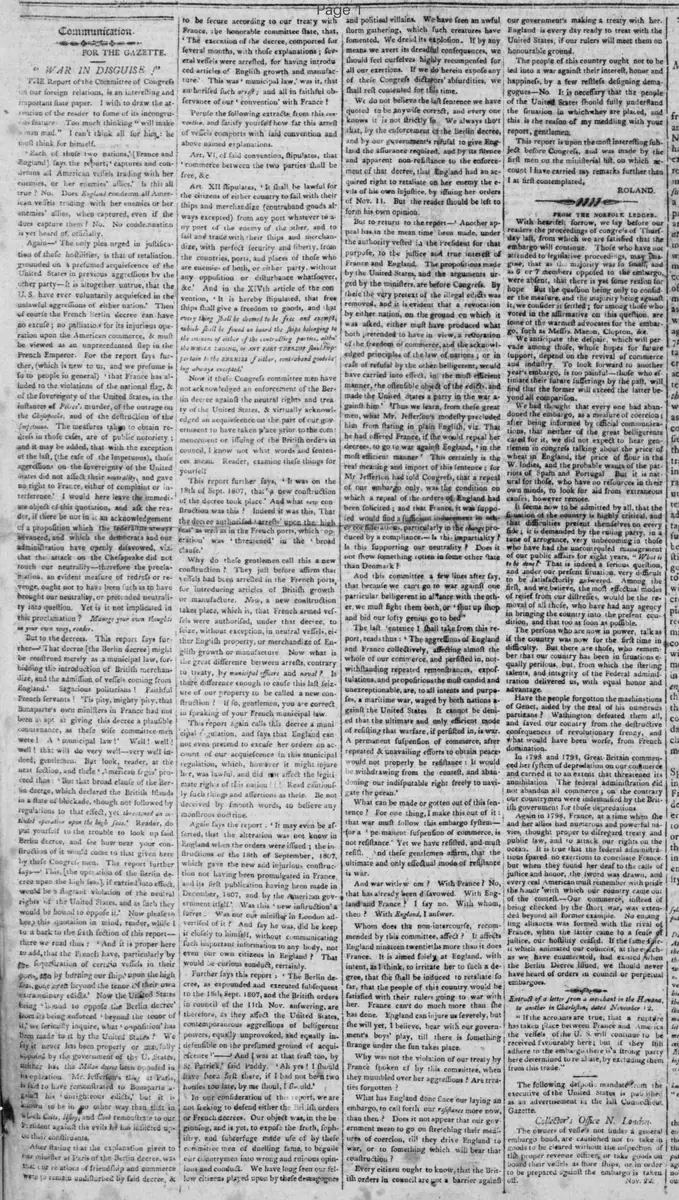
FOR THE GAZETTE.
"WAR IN DISGUISE"
The Report of the Committee of Congress on our foreign relations, is an interesting and important state paper. I wish to draw the attention of the reader to some of its incongruous features. "Too much thinking" will make "man mad." I can't think all for him: he must think for himself.
Each of those two nations, (France and England) says the report, 'captures and condemns all American vessels trading with her enemies, or her enemies' allies.' Is this all true? No. Does England condemn all American vessels trading with her enemies or her enemies' allies, when captured, even if she does capture them? No. No condemnation is yet heard of, officially.
Again--'The only plea urged in justification of those hostilities, is that of retaliation, grounded on a presumed acquiescence of the United States in previous aggressions by the other party--It is altogether untrue, that the U. S. have ever voluntarily acquiesced in the unlawful aggressions of either nation.' Then of course the French Berlin decree can have no excuse; no palliation, for its injurious operation upon the American commerce, & must be viewed as an unprecedented step in the French Emperor. For the report says further, (which is new to us, and we presume is so to people in general) that France has alluded to the violations of the national flag, & of the sovereignty of the United States, in the instances of Pierce's murder, of the outrage on the Chesapeake, and of the destruction of the Impetuous. The measures taken to obtain redress in those cases, are of public notoriety; and it may be added, that with the exception of the last, (the case of the Impetuous), those aggressions on the sovereignty of the United States did not affect their neutrality, and gave no right to France, either of complaint or interference.' I would here leave the immediate object of this quotation, and ask the reader, if there be not in it an acknowledgement of a proposition which the Federalists always advanced, and which the democrats and our administration have openly disavowed, viz. that the attack on the Chesapeake did not touch our neutrality--therefore the proclamation, an evident measure of redress or revenge, ought not to have been such as to have brought our neutrality, or pretended neutrality into question. Yet is it not implicated in this proclamation? Manage your own thoughts in your own way, reader.
But to the decrees. This report says further--'That decree (the Berlin decree) might be construed merely as a municipal law, forbidding the introduction of British merchandise, and the admission of vessels coming from England.' Sagacious politicians! Faithful French servants! 'Tis pity, mighty pity, that Bonaparte's own ministers in France had not been as apt at giving this decree a plausible countenance, as these wise committee-men were! A 'municipal law!' Well! well! well! that will do very well--very well indeed, gentlemen. But look, reader, at the next section, and these 'American sages' proceed thus: But that broad clause of the Berlin decree, which declared the British Islands in a state of blockade, though not followed by regulations to that effect, yet threatened an intended operation upon the high seas.' Reader, do put yourself to the trouble to look up said Berlin decree, and see how near your construction of it would come to that given here by these Congress-men. The report further says--'This, the operation of the Berlin decree upon the high seas, if carried into effect would be a flagrant violation of the neutral rights of the United States, and as such they would be bound to oppose it.' Now please keep this quotation in mind, reader, while I turn back to the sixth section of this report-- there we read thus: And it is proper here to add, that the French have, particularly by the sequestration of certain vessels in their ports and by burning our ships upon the high seas, gone even beyond the tenor of their own extraordinary edicts.' Now the United States being bound to oppose the Berlin decree from it being enforced beyond the tenor of it, we seriously inquire, what 'opposition' has been made to it by the United States? We say it never has been properly or manfully opposed by the government of the U. States, neither has the Milan decree been opposed in its operation. Mr. Jefferson's agent at Paris, is said to have remonstrated to Bonaparte against his unrighteous edicts,' but it is known to be in no other way than that in which Cats, Jersey, and Cook remonstrate to our President against the evils he has inflicted upon their constituents.
After stating that the explanation given to our minister at Paris of the Berlin decree, was that our relations of friendship and commerce were to remain undisturbed by said decree, & to be secure according to our treaty with France, the honorable committee state, that, The execution of the decree, comported for several months, with those explanations; several vessels were arrested, for having introduced articles of English growth and manufacture.' This was 'municipal law,' was it, that authorized such arrest? ; and all in faithful observance of our 'convention' with France!
Peruse the following extracts from this convention, and satisfy yourself how far this arrest of vessels comports with said convention and above named explanations.
Art. VI, of said convention, stipulates, that 'commerce between the two parties shall be free, &c.
Art. XII stipulates, 'It shall be lawful for the citizens of either country to sail with their ships and merchandise (contraband goods always excepted) from any port whatever to any port of the enemy of the other, and to sail and trade with their ships and merchandise, with perfect security and liberty, from the countries, ports, and places of those who are enemies of both, or either party, without any opposition or disturbance whatsoever, &c.' And in the XIVth article of the convention, It is hereby stipulated, that free ships shall give a freedom to goods, and that every thing shall be deemed to be free and exempt which shall be found on board the ships belonging to the citizens of either of the contracting parties, although the whole lading, or any part thereof should pertain to the enemies of either, contraband goods being always excepted.
Now if these Congress committee men have not acknowledged an enforcement of the Berlin decree against the neutral rights and treaty of the United States, & virtually acknowledged an acquiescence on the part of our government to have taken place prior to the commencement or issuing of the British orders in council, I know not what words and sentences mean. Reader, examine these things for yourself.
This report further says, It was on the 18th of Sept. 1807, that a new construction of the decree took place.' And what new construction was this? Indeed it was this, That the decree authorized 'arrests' upon the high seas' as well as in the French ports, which 'operation' was threatened' in the broad clause.'
Why do these gentlemen call this a new construction? They just before affirm that vessels had been arrested in the French ports, for introducing articles of British growth or manufacture. Now, a new construction takes place, which is, that French armed vessels were authorized, under that decree, to seize, without exception, in neutral vessels, either English property, or merchandise of English growth or manufacture. Now what is the great difference between arrests, contrary to treaty, by municipal officers and naval? Is there difference enough to cause this last seizure of our property to be called a new construction? If so, gentlemen, you are correct in speaking of your French municipal law.
This report again calls this decree a municipal regulation, and says that England can not even pretend to excuse her orders on account of our acquiescence in this municipal regulation, which, however it might injure her, was lawful, and did not affect the legitimate rights of this nation!!! Read cautiously such things and assertions as these. Be not deceived by smooth words, to believe any monstrous doctrine.
Again says the report. 'It may even be asserted, that the alteration was not known in England when the orders were issued; the instructions of the 18th of September, 1807, which gave the new and injurious construction not having been promulgated in France, and its first publication having been made in December, 1807, and by the American government itself.' Was this 'new instruction' a secret, Was not our minister in London advertised of it? And say he was, did he keep it closely to himself, without communicating such important information to any body, not even our own citizens in England? That would be curious conduct, certainly.
Further says this report: The Berlin decree, as expounded and executed subsequent to the 18th Sept. 1807, and the British orders in council of the 11th Nov. answering, are therefore, as they affect the United States, contemporaneous aggressions of belligerent powers, equally unprovoked, and equally indefensible on the presumed ground of acquiescence.'-- And I was at that feast too, by St. Patrick' said Paddy. 'Ah yes! I should have been first there, if I had not been two hours too late, by me shoul, I should.'
In our consideration of this report, we are not seeking to defend either the British orders or French decrees. Our object was, in the beginning, and is yet, to expose the froth, sophistry, and subterfuge made use of by these committee men of duelling fame, to beguile our countrymen into wrong and ruinous opinions and conduct. We have long seen our fellow citizens played upon by these demagogues and political villains. We have seen an awful storm gathering, which such creatures have fomented. We dread its explosion. If by any means we avert its dreadful consequences, we should feel ourselves highly recompensed for all our exertions. If we do herein expose any of these Congress dictators' absurdities, we shall rest contented for this time.
We do not believe the last sentence we have quoted to be anywise correct, and every one knows it is not strictly so. We always thought that, by the enforcement of the Berlin decree and by our government's refusal to give England the assurance required, and by its silence and apparent non-resistance to the enforcement of that decree, that England had an acquired right to retaliate on her enemy the evils of his own injustice, by issuing her orders of Nov. 11. But the reader should be left to form his own opinion.
But to return to the report--'Another appeal has in the mean time' been made, under the authority vested in the President for that purpose, to the justice and true interest of France and England. The propositions made by the United States, and the arguments urged by the ministers, are before Congress. By these the very pretext of the illegal edicts was removed, and it is evident that a revocation by either nation, on the ground on which it was asked, either must have produced what both pretended to have in view, a restoration of the freedom of commerce, and the acknowledged principles of the law of nations; or in case of refusal by the other belligerent, would have carried into effect, in the most efficient manner, the ostensible object of the edicts, and made the United States a party in the war against him.' Thus we learn, from these great men, what Mr. Jefferson's modesty precluded him from stating in plain English, viz. That he had offered France, if she would repeal her decrees, to go to war against England, 'in the most efficient manner' This certainly is the real meaning and import of this sentence; for Mr. Jefferson had told Congress, that a repeal of our embargo only, was the condition on which a repeal of the orders of England had been solicited; and that France, it was supposed would find a sufficient inducement in other considerations, particularly in the change produced by a compliance.--Is this impartiality? Is this supporting our neutrality? Does it not show something rotten in some other state than Denmark?
And this committee a few lines after say, that because we can't go to war against one particular belligerent in alliance with the other, we must fight them both, or 'shut up shop and bid our lofty genius go to bed'
The last sentence I shall take from this report, reads thus: 'The aggressions of England and France collectively, affecting almost the whole of our commerce, and persisted in, notwithstanding repeated remonstrances, expostulations, and propositions the most candid and unexceptionable, are, to all intents and purposes, a maritime war, waged by both nations against the United States. It cannot be denied that the ultimate and only efficient mode of resisting that warfare, if persisted in, is war. A permanent suspension of commerce, after repeated & unavailing efforts to obtain peace would not properly be resistance: It would be withdrawing from the contest, and abandoning our indisputable right freely to navigate the ocean.'
What can be made or gotten out of this sentence? For one thing, I make this out of it: that war must follow this embargo system-- for a 'permanent suspension of commerce, is not resistance.' Yet we have resisted, and--must resist. And these gentlemen affirm, that the ultimate and only effectual mode of resistance is war.
And war with whom? With France? No, that has already been disavowed. With England and France? I say no. With whom, then? With England, I answer.
Whom does the non-intercourse, recommended by this committee, affect? It affects England nineteen twentieths more than it does France. It is aimed solely at England, with intent, as I think, to irritate her to such a degree, that she shall be induced to retaliate so far, that the people of this country would be satisfied with their rulers going to war with her. France can't do much more than she has done. England can injure us severely, but she will yet, I believe, bear with our government's boys' play, till there is something strange under the sun takes place.
Why was not the violation of our treaty by France spoken of by this committee, when they mumbled over her aggressions? Are treaties forgotten?
What has England done since our laying an embargo, to call forth our resistance more now, than then? Does it not appear that our government mean to go on stretching their measures of coercion, till they drive England to war, or to something which will bear that construction?
Every citizen ought to know, that the British orders in council are not a barrier against our government's making a treaty with her. England is every day ready to treat with the United States, if our rulers will meet them on honourable ground.
The people of this country ought not to be led into a war against their interest, honor and happiness, by a few restless designing demagogues--No. It is necessary that the people of the United States should fully understand the situation in which they are placed, and this is the reason of my meddling with your report, gentlemen.
This report is upon the most interesting subject before Congress, and was made by the first men on the ministerial list, on which account I have carried my remarks further than I at first contemplated,
ROLAND.
What sub-type of article is it?
What themes does it cover?
What keywords are associated?
What entities or persons were involved?
Letter to Editor Details
Author
Roland
Recipient
For The Gazette
Main Argument
the congressional report on foreign relations employs sophistry to equate unprovoked french and british aggressions against u.s. neutrality, excuses french violations like the berlin decree as municipal law, and subtly pushes for war with england by misrepresenting u.s. policy and treaty obligations.
Notable Details