Thank you for visiting SNEWPapers!
Sign up free
Editorial
October 2, 1863
The Daily Register
Wheeling, Ohio County, West Virginia
What is this article about?
The editorial reflects on the organic growth of national alliances, citing US sympathy for Russia in the Crimean War and reciprocal Russian support during the ongoing US Civil War. It describes friendly exchanges in New York between Russian and American admirals, predicting a potential formal alliance unless influenced by Britain and France.
Clipping
OCR Quality
98%
Excellent
Full Text
Russia and the United States.
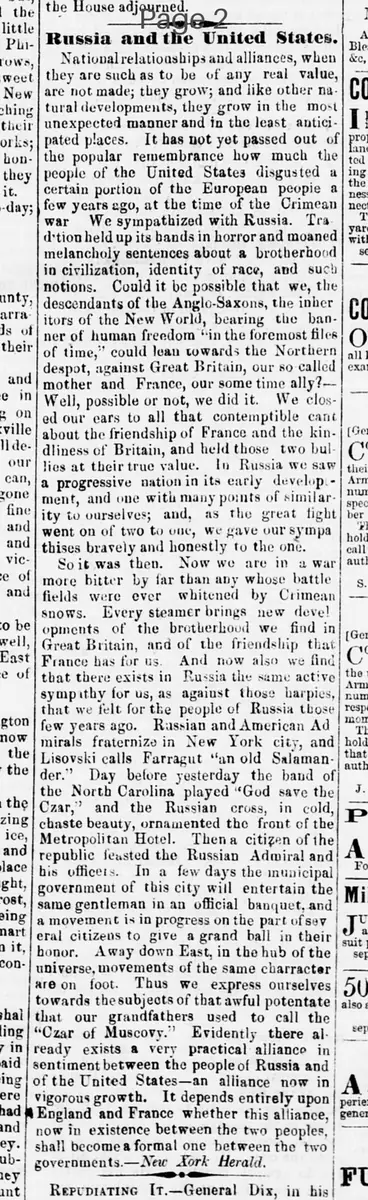
National relationships and alliances, when they are such as to be of any real value, are not made; they grow; and like other natural developments, they grow in the most unexpected manner and in the least anticipated places. It has not yet passed out of the popular remembrance how much the people of the United States disgusted a certain portion of the European people a few years ago, at the time of the Crimean war. We sympathized with Russia. Tradition held up its hands in horror and moaned melancholy sentences about a brotherhood in civilization, identity of race, and such notions. Could it be possible that we, the descendants of the Anglo-Saxons, the inheritors of the New World, bearing the banner of human freedom 'in the foremost files of time,' could lean towards the Northern despot, against Great Britain, our so called mother and France, our some time ally? Well, possible or not, we did it. We closed our ears to all that contemptible cant about the friendship of France and the kindliness of Britain, and held those two bullies at their true value. In Russia we saw a progressive nation in its early development, and one with many points of similarity to ourselves; and, as the great fight went on of two to one, we gave our sympathies bravely and honestly to the one.
So it was then. Now we are in a war more bitter by far than any whose battle fields were ever whitened by Crimean snows. Every steamer brings new developments of the brotherhood we find in Great Britain, and of the friendship that France has for us. And now also we find that there exists in Russia the same active sympathy for us, as against those harpies, that we felt for the people of Russia those few years ago. Russian and American Admirals fraternize in New York city, and Lisovski calls Farragut an old Salamander. Day before yesterday the band of the North Carolina played 'God save the Czar,' and the Russian cross, in cold, chaste beauty, ornamented the front of the Metropolitan Hotel. Then a citizen of the republic feasted the Russian Admiral and his officers. In a few days the municipal government of this city will entertain the same gentleman in an official banquet, and a movement is in progress on the part of several citizens to give a grand ball in their honor. Away down East, in the hub of the universe, movements of the same character are on foot. Thus we express ourselves towards the subjects of that awful potentate that our grandfathers used to call the 'Czar of Muscovy.' Evidently there already exists a very practical alliance in sentiment between the people of Russia and of the United States—an alliance now in vigorous growth. It depends entirely upon England and France whether this alliance, now in existence between the two peoples, shall become a formal one between the two governments.—New York Herald.
National relationships and alliances, when they are such as to be of any real value, are not made; they grow; and like other natural developments, they grow in the most unexpected manner and in the least anticipated places. It has not yet passed out of the popular remembrance how much the people of the United States disgusted a certain portion of the European people a few years ago, at the time of the Crimean war. We sympathized with Russia. Tradition held up its hands in horror and moaned melancholy sentences about a brotherhood in civilization, identity of race, and such notions. Could it be possible that we, the descendants of the Anglo-Saxons, the inheritors of the New World, bearing the banner of human freedom 'in the foremost files of time,' could lean towards the Northern despot, against Great Britain, our so called mother and France, our some time ally? Well, possible or not, we did it. We closed our ears to all that contemptible cant about the friendship of France and the kindliness of Britain, and held those two bullies at their true value. In Russia we saw a progressive nation in its early development, and one with many points of similarity to ourselves; and, as the great fight went on of two to one, we gave our sympathies bravely and honestly to the one.
So it was then. Now we are in a war more bitter by far than any whose battle fields were ever whitened by Crimean snows. Every steamer brings new developments of the brotherhood we find in Great Britain, and of the friendship that France has for us. And now also we find that there exists in Russia the same active sympathy for us, as against those harpies, that we felt for the people of Russia those few years ago. Russian and American Admirals fraternize in New York city, and Lisovski calls Farragut an old Salamander. Day before yesterday the band of the North Carolina played 'God save the Czar,' and the Russian cross, in cold, chaste beauty, ornamented the front of the Metropolitan Hotel. Then a citizen of the republic feasted the Russian Admiral and his officers. In a few days the municipal government of this city will entertain the same gentleman in an official banquet, and a movement is in progress on the part of several citizens to give a grand ball in their honor. Away down East, in the hub of the universe, movements of the same character are on foot. Thus we express ourselves towards the subjects of that awful potentate that our grandfathers used to call the 'Czar of Muscovy.' Evidently there already exists a very practical alliance in sentiment between the people of Russia and of the United States—an alliance now in vigorous growth. It depends entirely upon England and France whether this alliance, now in existence between the two peoples, shall become a formal one between the two governments.—New York Herald.
What sub-type of article is it?
Foreign Affairs
War Or Peace
What keywords are associated?
Russia Us Alliance
Crimean War Sympathy
Civil War Foreign Relations
Naval Fraternization
Anti British French Sentiment
What entities or persons were involved?
Russia
United States
Great Britain
France
Lisovski
Farragut
Czar
Editorial Details
Primary Topic
Growing Alliance Between Russia And The United States During The Civil War
Stance / Tone
Supportive Of Russian American Sympathy Against Britain And France
Key Figures
Russia
United States
Great Britain
France
Lisovski
Farragut
Czar
Key Arguments
Alliances Grow Naturally Rather Than Being Forced
Us Sympathized With Russia During Crimean War Despite Traditions
Russia Now Shows Active Sympathy For Us In Civil War
Friendly Interactions Between Russian And American Admirals In New York
Potential Formal Alliance Depends On England And France