Thank you for visiting SNEWPapers!
Sign up free
Literary
October 8, 1830
Virginia Advocate
Charlottesville, Virginia
What is this article about?
An essay reflecting on the virtue of benevolence, its universal appeal, joys in giving and receiving, societal necessity, distinction from selfishness, encouragement through human condition, and elevation via Christian teachings on spiritual application.
Clipping
OCR Quality
98%
Excellent
Full Text
REFLECTIONS,
"Such as meliorate the heart,
Compose the passions, and exalt the mind."
ON BENEVOLENCE.
"But deep this truth impress'd my mind,
Through all His works abroad,
The heart benevolent and kind
The most resembles God."--Burns.
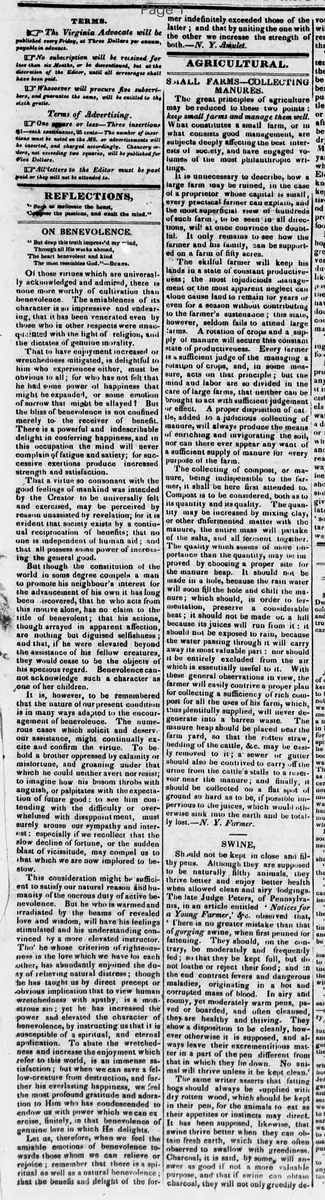
Of those virtues which are universally acknowledged and admired, there is none more worthy of cultivation than benevolence. The amiableness of its character is so impressive and endearing, that it has been venerated even by those who in other respects were unacquainted with the light of religion, and the dictates of genuine morality.
That to have enjoyment increased or wretchedness mitigated, is delightful to him who experiences either, must be obvious to all; for who has not felt that he had some power of happiness that might be expanded, or some emotion of sorrow that might be allayed? But the bliss of benevolence is not confined merely to the receiver of benefit. There is a powerful and indescribable delight in conferring happiness, and in this occupation the mind will never complain of fatigue and satiety; for successive exertions produce increased strength and satisfaction.
That a virtue so consonant with the good feelings of mankind was intended by the Creator to be universally felt and exercised, may be perceived by reason unassisted by revelation; for it is evident that society exists by a continual reciprocation of benefits; that no one is independent of human aid: and that all possess some power of increasing the general good.
But though the constitution of the world in some degree compels a man to promote his neighbour's interest for the advancement of his own it has long been discovered, that he who acts from this motive alone, has no claim to the title of benevolent; that his actions, though arrayed in apparent affection, are nothing but disguised selfishness; and that, if he were elevated beyond the assistance of his fellow creatures, they would cease to be the objects of his specious regard. Benevolence cannot acknowledge such a character as one of her children.
It is, however, to be remembered that the nature of our present condition is in many ways adapted to the encouragement of benevolence. The numerous cases which solicit and deserve our assistance, might continually excite and confirm the virtue. To behold a brother oppressed by calamity or misfortune, and groaning under that which he could neither avert nor resist; to imagine how his bosom throbs with anguish, or palpitates with the expectation of future good: to see him contending with the difficulty or overwhelmed with disappointment, must surely arouse our sympathy and interest: especially if we recollect that the slow decline of fortune, or the sudden blast of vicissitude, may compel us to that which we are now implored to bestow.
This consideration might be sufficient to satisfy our natural reason and humanity of the onerous duty of active benevolence. But he who is warmed and irradiated by the beams of revealed love and wisdom, will have his feelings stimulated and his understanding convinced by a more elevated instructor.
Tho' he whose criterion of righteousness is the love which we have for each other, has abundantly enjoined the duty of relieving natural distress; though he has taught us by direct precept or obvious implication that to view human wretchedness with apathy, is a monstrous sin; yet he has increased the power and elevated the character of benevolence, by instructing us that it is susceptible of a spiritual, and eternal application. To abate the wretchedness and increase the enjoyment which refer to this world, is an immense satisfaction; but when we can save a fellow-creature from destruction, and further his everlasting happiness, we feel the most profound gratitude and adoration to Him who has condescended to endow us with power which we can exercise, finitely, in that benevolence of genuine love in which He delights.
Let us, therefore, when we feel the amiable emotions of benevolence towards those whom we can relieve or rejoice; remember that there is a spiritual as well as a natural benevolence; that the benefit and delight of the former indefinitely exceeded those of the latter; and that by uniting the one with the other we increase the strength of both.-N. Y. Amulet.
"Such as meliorate the heart,
Compose the passions, and exalt the mind."
ON BENEVOLENCE.
"But deep this truth impress'd my mind,
Through all His works abroad,
The heart benevolent and kind
The most resembles God."--Burns.
Of those virtues which are universally acknowledged and admired, there is none more worthy of cultivation than benevolence. The amiableness of its character is so impressive and endearing, that it has been venerated even by those who in other respects were unacquainted with the light of religion, and the dictates of genuine morality.
That to have enjoyment increased or wretchedness mitigated, is delightful to him who experiences either, must be obvious to all; for who has not felt that he had some power of happiness that might be expanded, or some emotion of sorrow that might be allayed? But the bliss of benevolence is not confined merely to the receiver of benefit. There is a powerful and indescribable delight in conferring happiness, and in this occupation the mind will never complain of fatigue and satiety; for successive exertions produce increased strength and satisfaction.
That a virtue so consonant with the good feelings of mankind was intended by the Creator to be universally felt and exercised, may be perceived by reason unassisted by revelation; for it is evident that society exists by a continual reciprocation of benefits; that no one is independent of human aid: and that all possess some power of increasing the general good.
But though the constitution of the world in some degree compels a man to promote his neighbour's interest for the advancement of his own it has long been discovered, that he who acts from this motive alone, has no claim to the title of benevolent; that his actions, though arrayed in apparent affection, are nothing but disguised selfishness; and that, if he were elevated beyond the assistance of his fellow creatures, they would cease to be the objects of his specious regard. Benevolence cannot acknowledge such a character as one of her children.
It is, however, to be remembered that the nature of our present condition is in many ways adapted to the encouragement of benevolence. The numerous cases which solicit and deserve our assistance, might continually excite and confirm the virtue. To behold a brother oppressed by calamity or misfortune, and groaning under that which he could neither avert nor resist; to imagine how his bosom throbs with anguish, or palpitates with the expectation of future good: to see him contending with the difficulty or overwhelmed with disappointment, must surely arouse our sympathy and interest: especially if we recollect that the slow decline of fortune, or the sudden blast of vicissitude, may compel us to that which we are now implored to bestow.
This consideration might be sufficient to satisfy our natural reason and humanity of the onerous duty of active benevolence. But he who is warmed and irradiated by the beams of revealed love and wisdom, will have his feelings stimulated and his understanding convinced by a more elevated instructor.
Tho' he whose criterion of righteousness is the love which we have for each other, has abundantly enjoined the duty of relieving natural distress; though he has taught us by direct precept or obvious implication that to view human wretchedness with apathy, is a monstrous sin; yet he has increased the power and elevated the character of benevolence, by instructing us that it is susceptible of a spiritual, and eternal application. To abate the wretchedness and increase the enjoyment which refer to this world, is an immense satisfaction; but when we can save a fellow-creature from destruction, and further his everlasting happiness, we feel the most profound gratitude and adoration to Him who has condescended to endow us with power which we can exercise, finitely, in that benevolence of genuine love in which He delights.
Let us, therefore, when we feel the amiable emotions of benevolence towards those whom we can relieve or rejoice; remember that there is a spiritual as well as a natural benevolence; that the benefit and delight of the former indefinitely exceeded those of the latter; and that by uniting the one with the other we increase the strength of both.-N. Y. Amulet.
What sub-type of article is it?
Essay
What themes does it cover?
Moral Virtue
Religious
What keywords are associated?
Benevolence
Virtue
Morality
Religion
Sympathy
Charity
Spiritual Benevolence
What entities or persons were involved?
N. Y. Amulet.
Literary Details
Title
Reflections On Benevolence
Author
N. Y. Amulet.
Subject
On Benevolence
Key Lines
"But Deep This Truth Impress'd My Mind,
Through All His Works Abroad,
The Heart Benevolent And Kind
The Most Resembles God." Burns.
Let Us, Therefore, When We Feel The Amiable Emotions Of Benevolence Towards Those Whom We Can Relieve Or Rejoice; Remember That There Is A Spiritual As Well As A Natural Benevolence; That The Benefit And Delight Of The Former Indefinitely Exceeded Those Of The Latter; And That By Uniting The One With The Other We Increase The Strength Of Both.