Thank you for visiting SNEWPapers!
Sign up free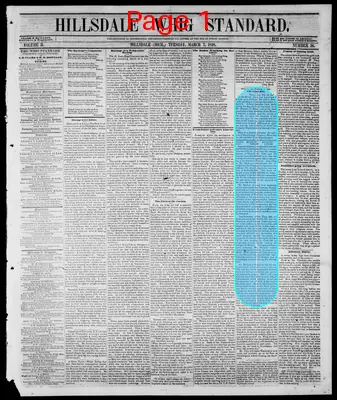
Editorial
March 7, 1848
Hillsdale Whig Standard
Hillsdale, Hillsdale County, Michigan
What is this article about?
In a February 1848 editorial, the Pittsburg Gazette reports on House debate over the Loan Bill for Mexican War funding. Massachusetts Rep. Hudson criticizes Treasury overestimates of receipts ($36M customs vs. probable $25M), concealed expenses, departmental cuts for deception, and warns of $26M loan need and inevitable direct taxation of $50M.
Clipping
OCR Quality
95%
Excellent
Full Text
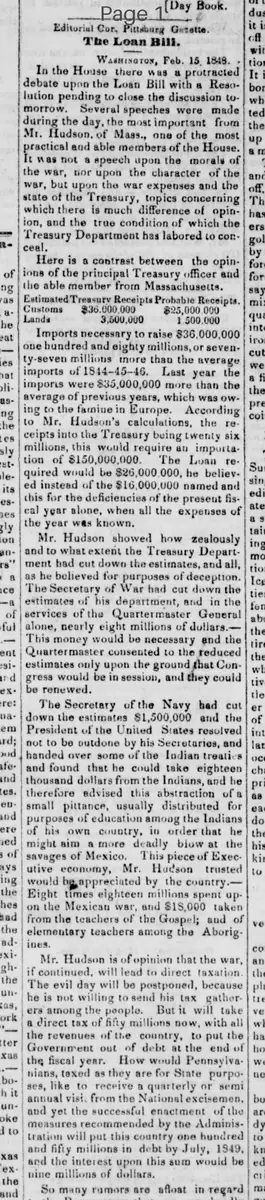
Editorial Cor. Pittsburg Gazette.
The Loan Bill.
WASHINGTON, Feb. 15. 1848.
In the House there was a protracted debate upon the Loan Bill with a Resolution pending to close the discussion tomorrow. Several speeches were made during the day, the most important from Mr. Hudson, of Mass., one of the most practical and able members of the House. It was not a speech upon the morals of the war, nor upon the character of the war, but upon the war expenses and the state of the Treasury, topics concerning which there is much difference of opinion, and the true condition of which the Treasury Department has labored to conceal.
Here is a contrast between the opinions of the principal Treasury officer and the able member from Massachusetts.
Estimated Treasury Receipts Probable Receipts.
Customs
$36,000,000 $25,000,000
Lands
3,500,000 1,500,000
Imports necessary to raise $36,000,000 one hundred and eighty millions, or seventy-seven millions more than the average imports of 1844-45-46. Last year the imports were $35,000,000 more than the average of previous years, which was owing to the famine in Europe. According to Mr. Hudson's calculations, the receipts into the Treasury being twenty six millions, this would require an importation of $150,000,000. The Loan required would be $26,000,000, he believed instead of the $16,000,000 named and this for the deficiencies of the present fiscal year alone, when all the expenses of the year were known.
Mr. Hudson showed how zealously and to what extent the Treasury Department had cut down the estimates, and all, as he believed for purposes of deception.
The Secretary of War had cut down the estimates of his department, and in the services of the Quartermaster General alone, nearly eight millions of dollars.— This money would be necessary and the Quartermaster consented to the reduced estimates only upon the ground that Congress would be in session, and they could be renewed.
The Secretary of the Navy had cut down the estimates $1,500,000 and the President of the United States resolved not to be outdone by his Secretaries, and handed over some of the Indian treaties and found that he could take eighteen thousand dollars from the Indians, and he therefore advised this abstraction of a small pittance, usually distributed for purposes of education among the Indians of his own country, in order that he might aim a more deadly blow at the savages of Mexico. This piece of Executive economy, Mr. Hudson trusted would be appreciated by the country.— Eight times eighteen millions spent upon the Mexican war, and $18,000 taken from the teachers of the Gospel; and of elementary teachers among the Aborigines.
Mr. Hudson is of opinion that the war, if continued, will lead to direct taxation. The evil day will be postponed, because he is not willing to send his tax gatherers among the people. But it will take a direct tax of fifty millions now, with all the revenues of the country, to put the Government out of debt at the end of the fiscal year. How would Pennsylvanians, taxed as they are for State purposes, like to receive a quarterly or semi annual visit from the National excisemen, and yet the successful enactment of the measures recommended by the Administration will put this country one hundred and fifty millions in debt by July, 1849, and the interest upon this sum would be nine millions of dollars.
The Loan Bill.
WASHINGTON, Feb. 15. 1848.
In the House there was a protracted debate upon the Loan Bill with a Resolution pending to close the discussion tomorrow. Several speeches were made during the day, the most important from Mr. Hudson, of Mass., one of the most practical and able members of the House. It was not a speech upon the morals of the war, nor upon the character of the war, but upon the war expenses and the state of the Treasury, topics concerning which there is much difference of opinion, and the true condition of which the Treasury Department has labored to conceal.
Here is a contrast between the opinions of the principal Treasury officer and the able member from Massachusetts.
Estimated Treasury Receipts Probable Receipts.
Customs
$36,000,000 $25,000,000
Lands
3,500,000 1,500,000
Imports necessary to raise $36,000,000 one hundred and eighty millions, or seventy-seven millions more than the average imports of 1844-45-46. Last year the imports were $35,000,000 more than the average of previous years, which was owing to the famine in Europe. According to Mr. Hudson's calculations, the receipts into the Treasury being twenty six millions, this would require an importation of $150,000,000. The Loan required would be $26,000,000, he believed instead of the $16,000,000 named and this for the deficiencies of the present fiscal year alone, when all the expenses of the year were known.
Mr. Hudson showed how zealously and to what extent the Treasury Department had cut down the estimates, and all, as he believed for purposes of deception.
The Secretary of War had cut down the estimates of his department, and in the services of the Quartermaster General alone, nearly eight millions of dollars.— This money would be necessary and the Quartermaster consented to the reduced estimates only upon the ground that Congress would be in session, and they could be renewed.
The Secretary of the Navy had cut down the estimates $1,500,000 and the President of the United States resolved not to be outdone by his Secretaries, and handed over some of the Indian treaties and found that he could take eighteen thousand dollars from the Indians, and he therefore advised this abstraction of a small pittance, usually distributed for purposes of education among the Indians of his own country, in order that he might aim a more deadly blow at the savages of Mexico. This piece of Executive economy, Mr. Hudson trusted would be appreciated by the country.— Eight times eighteen millions spent upon the Mexican war, and $18,000 taken from the teachers of the Gospel; and of elementary teachers among the Aborigines.
Mr. Hudson is of opinion that the war, if continued, will lead to direct taxation. The evil day will be postponed, because he is not willing to send his tax gatherers among the people. But it will take a direct tax of fifty millions now, with all the revenues of the country, to put the Government out of debt at the end of the fiscal year. How would Pennsylvanians, taxed as they are for State purposes, like to receive a quarterly or semi annual visit from the National excisemen, and yet the successful enactment of the measures recommended by the Administration will put this country one hundred and fifty millions in debt by July, 1849, and the interest upon this sum would be nine millions of dollars.
What sub-type of article is it?
Economic Policy
Military Affairs
Partisan Politics
What keywords are associated?
Loan Bill
Mexican War
Treasury Estimates
War Expenses
Direct Taxation
Indian Treaties
What entities or persons were involved?
Mr. Hudson
Treasury Department
Secretary Of War
Quartermaster General
Secretary Of The Navy
President Of The United States
Indians
Editorial Details
Primary Topic
Critique Of Loan Bill And Mexican War Finances
Stance / Tone
Critical Of Administration's Deceptive Financial Estimates
Key Figures
Mr. Hudson
Treasury Department
Secretary Of War
Quartermaster General
Secretary Of The Navy
President Of The United States
Indians
Key Arguments
Treasury Overestimates Receipts From Customs And Lands
War Expenses Concealed Through Reduced Departmental Estimates
Loan Need Is $26m Not $16m For Current Fiscal Year
Executive Cuts Include $18,000 From Indian Education For War Funding
Continued War Will Require $50m Direct Taxation
Administration Policies Will Lead To $150m Debt By July 1849