Thank you for visiting SNEWPapers!
Sign up free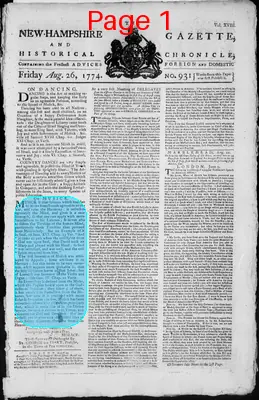
Literary
August 26, 1774
The New Hampshire Gazette And Historical Chronicle
Portsmouth, Greenland, Rockingham County, New Hampshire
What is this article about?
This prose essay defines music as a science that creates agreeable sounds and harmony, refreshing the mind, aiding labor, and soothing melancholy, with biblical examples from Saul and Jubal as inventor of violin and organ. It traces origins to Apollo or Mercury, etymology from Muses, Hebrew perfection, and universal esteem, especially in divine service for virtue and devotion.
Clipping
OCR Quality
95%
Excellent
Full Text
On MUSICK.
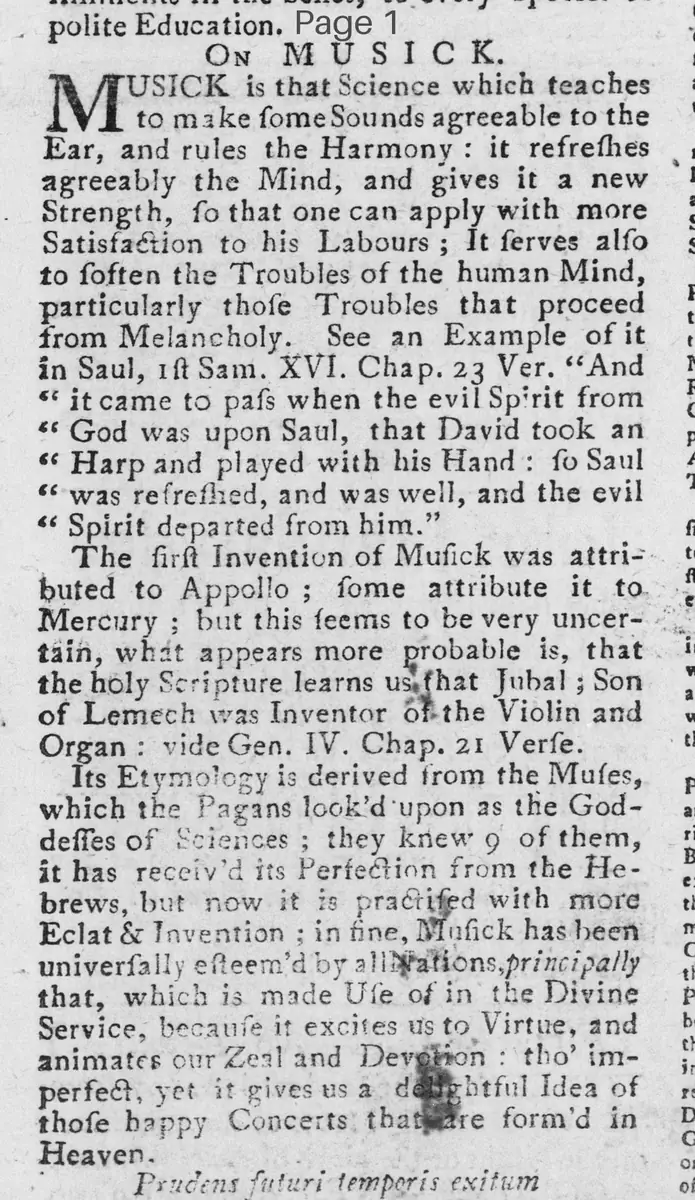
MUSICK is that Science which teaches to make some Sounds agreeable to the Ear, and rules the Harmony: it refreshes agreeably the Mind, and gives it a new Strength, so that one can apply with more Satisfaction to his Labours: It serves also to soften the Troubles of the human Mind. particularly those Troubles that proceed from Melancholy. See an Example of it in Saul, 1st Sam. XVI. Chap. 23 Ver. "And it came to pass when the evil Spirit from God was upon Saul, that David took an Harp and played with his Hand: so Saul was refreshed, and was well, and the evil Spirit departed from him."
The first Invention of Musick was attributed to Apollo; some attribute it to Mercury: but this seems to be very uncertain, what appears more probable is, that the holy Scripture learns us that Jubal: Son of Lamech was Inventor of the Violin and Organ: vide Gen. IV. Chap. 21 Verse.
Its Etymology is derived from the Muses, which the Pagans look'd upon as the Goddesses of Sciences; they knew 9 of them, it has received its Perfection from the Hebrews. but now it is practised with more Eclat & Invention; in fine, Musick has been universally esteem'd by all Nations, principally that. which is made Use of in the Divine Service. because it excites us to Virtue, and animates our Zeal and Devotion: tho' imperfect, yet it gives us a delightful Idea of those happy Concerts that are form'd in Heaven.
MUSICK is that Science which teaches to make some Sounds agreeable to the Ear, and rules the Harmony: it refreshes agreeably the Mind, and gives it a new Strength, so that one can apply with more Satisfaction to his Labours: It serves also to soften the Troubles of the human Mind. particularly those Troubles that proceed from Melancholy. See an Example of it in Saul, 1st Sam. XVI. Chap. 23 Ver. "And it came to pass when the evil Spirit from God was upon Saul, that David took an Harp and played with his Hand: so Saul was refreshed, and was well, and the evil Spirit departed from him."
The first Invention of Musick was attributed to Apollo; some attribute it to Mercury: but this seems to be very uncertain, what appears more probable is, that the holy Scripture learns us that Jubal: Son of Lamech was Inventor of the Violin and Organ: vide Gen. IV. Chap. 21 Verse.
Its Etymology is derived from the Muses, which the Pagans look'd upon as the Goddesses of Sciences; they knew 9 of them, it has received its Perfection from the Hebrews. but now it is practised with more Eclat & Invention; in fine, Musick has been universally esteem'd by all Nations, principally that. which is made Use of in the Divine Service. because it excites us to Virtue, and animates our Zeal and Devotion: tho' imperfect, yet it gives us a delightful Idea of those happy Concerts that are form'd in Heaven.
What sub-type of article is it?
Essay
What themes does it cover?
Religious
Moral Virtue
What keywords are associated?
Music
Harmony
Melancholy
Bible
Invention
Muses
Divine Service
Virtue
Literary Details
Title
On Musick.
Subject
The Science, Invention, And Effects Of Music
Key Lines
And It Came To Pass When The Evil Spirit From God Was Upon Saul, That David Took An Harp And Played With His Hand: So Saul Was Refreshed, And Was Well, And The Evil Spirit Departed From Him.
Jubal: Son Of Lamech Was Inventor Of The Violin And Organ: Vide Gen. Iv. Chap. 21 Verse.
Its Etymology Is Derived From The Muses, Which The Pagans Look'd Upon As The Goddesses Of Sciences; They Knew 9 Of Them, It Has Received Its Perfection From The Hebrews.