Thank you for visiting SNEWPapers!
Sign up free
Virginia Free Press & Farmers' Repository
Charles Town, Jefferson County, West Virginia
What is this article about?
John R. Cooke defends the Virginia constitutional convention's apportionment of representation as nearly equivalent to the 'white basis' for 1830 population, estimating western gains and eastern alliances, urging acceptance despite lacking future provisions.
Merged-components note: Merging the continuation of John R. Cooke's letter on the new constitution across pages, including embedded tables on population estimates and representation distribution.
Clippings
1 of 2
OCR Quality
Full Text
| To the west, | 69 |
| To the east, | 74 |
| Total, | 134 |
| The actual distribution made, is as follows: | |
| To the west, | 56 |
| To the east, | 78 |
| Total, | 134 |
THE NEW CONSTITUTION.
John R. Cooke to his late Constituents.
CONCLUSION OF LETTER II.
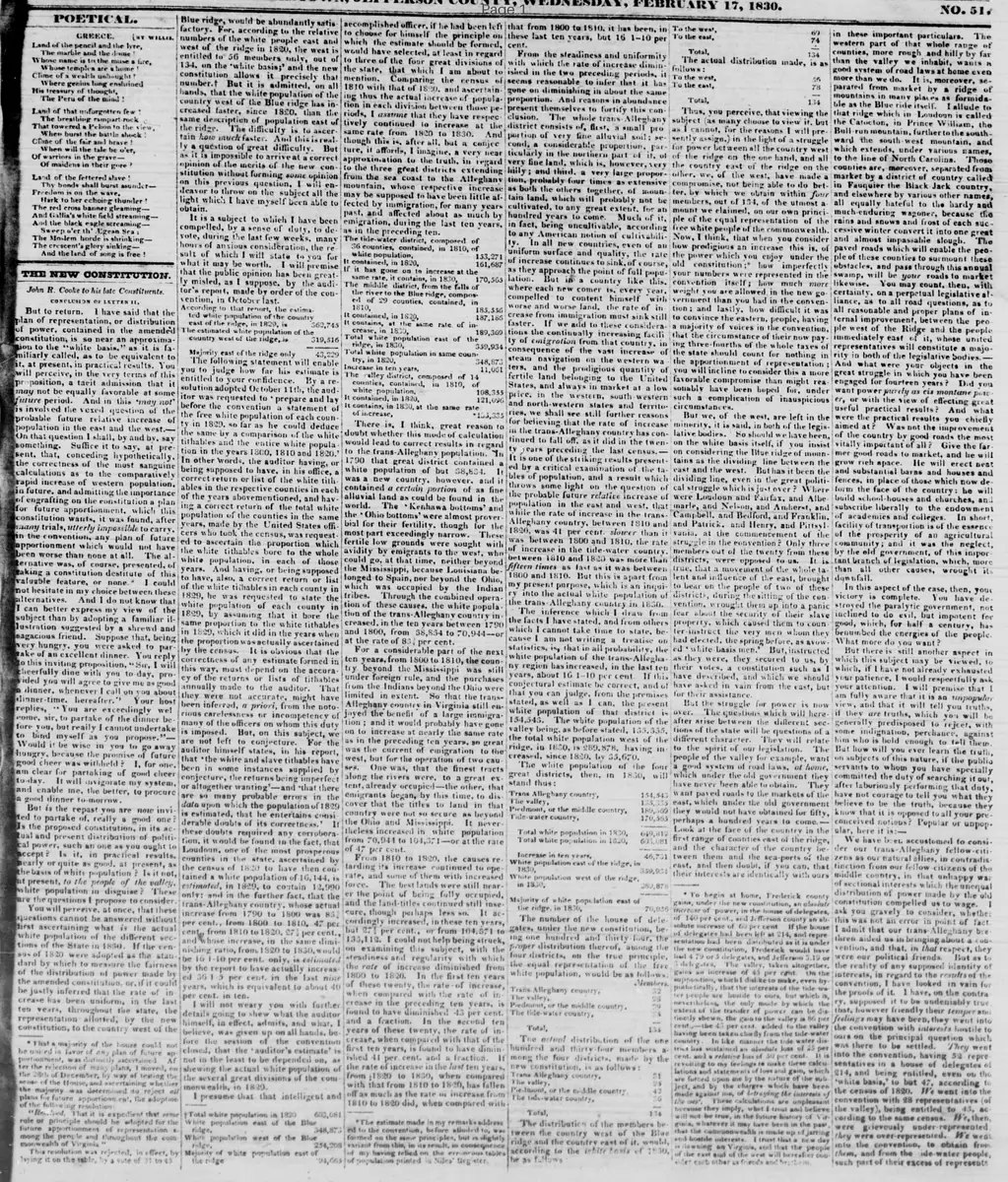
But to return. I have said that the plan of representation, or distribution of power, contained in the amended constitution, is so near an approximation to the "white basis," as it is familiarly called, as to be equivalent to it, at present, in practical results. You will perceive, in the very terms of this proposition, a tacit admission that it may not be equally favorable at some future period. And in this is involved the vexed question of the probable future relative increase of population in the east and the west. On that question I shall, by and by, say something. Suffice it to say, at present, that, conceding hypothetically the correctness of the most sanguine calculations as to the comparatively rapid increase of western population, in future, and admitting the importance of engrafting on the constitution a plan for future apportionment, which this constitution wants, it was found, after many trials, utterly impossible to carry, in the convention, any plan of future apportionment which would not have been worse than none at all. The alternative was, of course, presented, of making a constitution destitute of this valuable feature, or none. I could not hesitate in my choice between these alternatives. And I do not know that I can better express my view of the subject than by adopting a familiar illustration suggested by a shrewd and sagacious friend. Suppose that, being very hungry, you were asked to partake of an excellent dinner. You reply to this inviting proposition, "Sir, I will cheerfully dine with you to-day, provided you will agree to give me as good a dinner, whenever I call on you about dinner-time, hereafter." Your host replies, "You are exceedingly welcome, sir, to partake of the dinner before you, but really I cannot undertake to bind myself as you propose."—Would it be wise in you to go away hungry, because the promise of future good cheer was withheld? I, for one, am clear for partaking of good cheer to-day. It will invigorate my system, and enable me, the better, to procure a good dinner to-morrow.
But is the repast you are now invited to partake of, really a good one? Is the proposed constitution, in its actual and present distribution of political power, such an one as you ought to accept? Is it, in practical results, nearly or quite as good, at present, as the basis of white population? Is it not, at present, to the people of the valley, white population in disguise? These are the questions I propose to consider. You will perceive, at once, that these questions cannot be answered without first ascertaining what is the actual white population of the different sections of the State in 1830. If the census of 1820 were adopted as the standard by which to measure the fairness of the distribution of power made by the amended constitution, or, if it could be justly inferred that the rate of increase has been uniform, in the last ten years, throughout the state, the representation allotted, by the new Constitution, to the country west of the Blue ridge, would be abundantly satisfactory. For, according to the relative numbers of the white people east and west of the ridge in 1820, the west is entitled to 56 members only, out of 134, on the white basis; and the new constitution allows it precisely that number. But it is admitted, on all hands, that the white population of the country west of the Blue ridge has increased faster, since 1820, than the same description of population east of the ridge. The difficulty is to ascertain how much faster. And this is really a question of great difficulty. But as it is impossible to arrive at a correct opinion of the merits of the new constitution without forming some opinion on this previous question, I will endeavor to throw on the subject all the light which I have myself been able to obtain.
It is a subject to which I have been compelled, by a sense of duty, to devote, during the last few weeks, many hours of anxious consideration, the results of which I will state to you for what it may be worth. I will premise that the public opinion has been greatly misled, as I suppose, by the auditor's report, made by order of the convention, in October last. According to that report, the estimated white population of the country east of the ridge, in 1829, is 362,745. The estimated white population of the country west of the ridge, is 319,516. Majority east of the ridge only 43,229.
The following statement will enable you to judge how far his estimate is entitled to your confidence. By a resolution adopted October 11th, the auditor was requested to prepare and lay before the convention a statement of the free white population of each county in 1829, so far as he could deduce the same by a comparison of the white tithables and the entire white population in the years 1800, 1810 and 1820. In other words, the auditor having, or being supposed to have, in his office, a correct return or list of the white tithables in the respective counties in each of the years above mentioned, and having a correct return of the total white population of the counties in the same years, made by the United States officers who took the census, was requested to ascertain the proportion which the white tithables bore to the whole white population, in each of those years. And having, or being supposed to have, also, a correct return or list of the white tithables in each county in 1829, he was requested to state the white population of each county in 1829, by assuming that it bore the same proportion to the white tithables in 1829, which it did in the years when the proportion was actually ascertained by the census. It is obvious that the correctness of any estimate formed in this way, must depend on the accuracy of the returns or lists of tithables annually made to the auditor. That they were not accurate, might have been inferred, a priori, from the notorious carelessness or incompetency of many of the officers on whom this duty is imposed. But, on this subject, we are not left to conjecture. For the auditor himself states, in his report, that 'the white and slave tithables have been in some instances supplied by conjecture, the returns being imperfect or altogether wanting'—and that there are so many probable errors in the data upon which the population of 1829 is estimated, that he entertains considerable doubts of its correctness.' If these doubts required any corroboration, it would be found in the fact, that Loudoun, one of the most prosperous counties in the state, ascertained by the census of 1820 to have then contained a white population of 16,144, is estimated, in 1829, to contain 12,990 only: and in the further fact, that the trans-Alleghany country, whose actual increase from 1790 to 1800 was 83 per cent., from 1800 to 1810, 47 per cent., from 1810 to 1820, 27 per cent., and whose increase, in the same diminishing ratio, from 1820 to 1830, would be 16 1-10 per cent. only, is estimated by the report to have actually increased 36 1-5 per cent. in the last nine years, which is equivalent to about 40 per cent. in ten.
I will not weary you with further details going to show what the auditor himself, in effect, admits, and what, I believe, was given up on all hands, before the session of the convention closed, that the 'auditor's estimate' is not in the least to be depended on, as showing the actual white population of the several great divisions of the commonwealth, in 1829.
I presume that that intelligent and accomplished officer, if he had been left to choose for himself the principle on which the estimate should be formed, would have selected, at least in regard to three of the four great divisions of the state, that which I am about to mention. Comparing the census of 1810 with that of 1820, and ascertaining thus the actual increase of population in each division between those periods, I assume that they have respectively continued to increase at the same rate from 1820 to 1830. And though this is, after all, but a conjecture, it affords, I imagine, a very near approximation to the truth, in regard to the three great districts extending from the sea coast to the Alleghany mountain, whose respective increase may be supposed to have been little affected by immigration, for many years past, and affected about as much by emigration, during the last ten years, as in the preceding ten.
The tide-water district, composed of 36 counties, contained, in 1810, of white population, 153,271. It contained, in 1820, 161,687. If it has gone on to increase at the same rate, it contains, in 1830, 170,565.
The middle district, from the falls of the river to the Blue ridge, composed of 29 counties, contained, in 1810, 185,556. It contained, in 1820, 187,186. It contains, at the same rate of increase, in 1830, 189,369.
Total white population east of the ridge, in 1830, 359,934. Total white population in same country, in 1820, 348,873. Increase in ten years, 11,061.
The valley district, composed of 14 counties, contained, in 1810, of white population, 108,355. It contained, in 1820, 121,096. It contains, in 1830, at the same rate of increase, 135,335.
There is, I think, great reason to doubt whether this mode of calculation would lead to correct results in regard to the trans-Alleghany population. In 1790 that great district contained a white population of but 38,834. It was a new country, however, and it contained a certain portion of as fine alluvial land as could be found in the world. The Kanawha bottoms and the Ohio bottoms were almost proverbial for their fertility, though for the most part exceedingly narrow. These fertile low grounds were sought with avidity by emigrants to the west, who could go, at that time, neither beyond the Mississippi, because Louisiana belonged to Spain, nor beyond the Ohio, which was occupied by the Indian tribes. Through the combined operation of these causes, the white population of the trans-Alleghany country increased, in the ten years between 1790 and 1800, from 38,834 to 70,944—or at the rate of 83 per cent.
For a considerable part of the next ten years, from 1800 to 1810, the country beyond the Mississippi was still under foreign rule, and the purchases from the Indians beyond the Ohio were limited in extent. So that the trans-Alleghany country in Virginia still enjoyed the benefit of a large immigration; and it would probably have gone on to increase at nearly the same rate as in the preceding ten years, so great was the current of emigration to the west, but for the operation of two causes. One was, that the finest tracts along the rivers were, to a great extent, already occupied—the other, that emigrants began, by this time, to discover that the titles to land in that country were not so secure as beyond the Ohio and Mississippi. It nevertheless increased in white population from 70,944 to 104,071—or at the rate of 47 per cent.
From 1810 to 1820, the causes retarding its increase continued to operate, and some of them with increased force. The best lands were still nearer the point of being fully occupied, and the land-titles continued still insecure, though perhaps less so. It accordingly increased, in these ten years, but 27 1/2 per cent., or from 104,071 to 133,112. I could not help being struck, on examining this subject, with the steadiness and regularity with which the rate of increase diminished from 1800 to 1820. In the first ten years of these twenty, the rate of increase, when compared with the rate of increase in the preceding ten years, is found to have diminished 43 per cent. and a fraction. In the second ten years of these twenty, the rate of increase, when compared with that of the first ten years, is found to have diminished 41 per cent. and a fraction. If the rate of increase in the last ten years, from 1820 to 1830, when compared with that from 1810 to 1820, has fallen off as much as the rate of increase from 1810 to 1820 did, when compared with that from 1800 to 1810, it has been, in these last ten years, but 16 1-10 per cent.
From the steadiness and uniformity with which the rate of increase diminished in the two preceding periods, it seems reasonable to infer that it has gone on diminishing in about the same proportion. And reasons in abundance present themselves to fortify this conclusion. The whole trans-Alleghany district consists of, first, a small proportion of very fine alluvial soil; second, a considerable proportion, particularly in the northern part of it, of very fine land, which is, however, very hilly; and third, a very large proportion, probably four times as extensive as both the others together, of mountain land, which will probably not be cultivated, to any great extent, for a hundred years to come. Much of it, in fact, being uncultivable, according to any American notion of cultivability. In all new countries, even of a uniform surface and quality, the rate of increase continues to sink, of course, as they approach the point of full population. But in a country like this, where each new comer is, every year, compelled to content himself with worse and worse land, the rate of increase from immigration must sink still faster. If we add to these considerations the continually increasing facility of emigration from that country, in consequence of the vast increase of steam navigation on the western waters, and the prodigious quantity of fertile land belonging to the United States, and always in market at a low price, in the western, south-western and north-western states and territories, we shall see still further reasons for believing that the rate of increase in the trans-Alleghany country has continued to fall off, as it did in the twenty years preceding the last census.
It is one of the striking results presented by a critical examination of the tables of population, and a result which throws some light on the question of the probable future relative increase of population in the east and west, that while the rate of increase in the trans-Alleghany country, between 1810 and 1820, was 41 per cent. slower than it was between 1800 and 1810, the rate of increase in the tide-water country, between 1810 and 1820 was more than fifteen times as fast as it was between 1800 and 1810. But this is apart from my present purpose, which is an inquiry into the actual white population of the trans-Alleghany country in 1830.
The inference which I draw from the facts I have stated, and from others which I cannot take time to state, because I am not writing a treatise on statistics, is, that in all probability, the white population of the trans-Alleghany region has increased, in the last ten years, about 16 1-10 per cent. If this conjectural estimate be correct, and of that you can judge, from the premises stated, as well as I can, the present white population of that district is 154,548. The white population of the valley being, as before stated, 135,335, the total white population west of the ridge, in 1830, is 289,878, having increased, since 1820, by 35,670.
The white population of the four great districts, then, in 1830, will stand thus:
Total white population in 1820, 603,081.
Total white population in 1830, 649,812.
Increase in ten years, 46,701.
White population east of the ridge, in 1830, 359,934.
White population west of the ridge, in 1830, 289,878.
Majority of white population east of the ridge, in 1830, 70,056.
The number of the house of delegates, under the new constitution, being one hundred and thirty four, the proper distribution thereof, among the four districts, on the true principle, the equal representation of the free white population, would be as follows:
Total, 134.
The actual distribution of the one hundred and thirty-four members among the four districts, made by the new constitution, is as follows:
Trans Alleghany country 31
The valley, 25
Piedmont, or the middle country 42
The tide-water country 36
Total, 134.
The distribution of the members between the country west of the Blue ridge and the country east of it, would, according to the true polls of 1830, be as follows:
Thus, you perceive, that viewing the subject (as many choose to view it, but as I cannot, for the reasons I will presently assign,) in the light of a struggle for power between all the country west of the ridge on the one hand, and all the country east of the ridge on the other, we, of the west, have made a compromise, not being able to do better, by which we obtain within four members, out of 134, of the utmost amount we claimed, on our own principle of the equal representation of the free white people of the commonwealth.
Now, I think, that when you consider how prodigious an increase this is, of the power which you enjoy under the old constitution; how imperfectly your numbers were represented in the convention itself; how much more weight you are allowed, in the new government than you had in the convention: and lastly, how difficult it was to convince the eastern people, having a majority of voices in the convention, that the circumstance of their now paying three-fourths of the whole taxes of the state should count for nothing in the apportionment of representation; you will incline to consider this a more favorable compromise than might reasonably have been hoped for, under such a complication of inauspicious circumstances.
But we, of the west, are left in the minority, it is said, in both of the legislative bodies. So should we have been, on the white basis itself, if you insist on considering the Blue ridge of mountains as the dividing line between the east and the west. But has it been the dividing line, even in the great political struggle which is just over? Where were Loudoun and Fairfax, and Albemarle, and Nelson, and Amherst, and Campbell, and Bedford, and Franklin, and Patrick, and Henry, and Pittsylvania, at the commencement of the struggle in the convention? Only three members out of the twenty from these districts, were opposed to us. It is true, that a movement of the whole talent and influence of the east, brought to bear on the people of two of these districts, during the sitting of the convention, wrought them up into a panic fear about the security of their slave property, which caused them to counter-instruct the very men whom they had elected, the spring before, as avowed white basis men. But, instructed as they were, they secured to us, by their votes, a constitution such as I have described, and which we should have asked in vain from the east, but for their assistance.
But the struggle for power is now over. The questions which will hereafter arise between the different sections of the state will be questions of a different character. They will relate to the spirit of our legislation. The people of the valley for example, want a good system of road laws, at home, which under the old government they have never been able to obtain. They want paved roads to the markets of the east, which under the old government they would not have obtained for fifty, perhaps a hundred years to come. Look at the face of the country in the first range of counties east of the ridge, and the character of the country between them and the sea-ports of the east, and then doubt, if you can, that their interests are identically with ours. To begin at home, Frederick county gains, under the new constitution, an absolute increase of power, in the house of delegates, of 140 per cent., and Jefferson county an absolute increase of 60 per cent. If the house of delegates had been left at 214, and representation had been distributed as it is under the new constitution, Frederick would have had 4 or 5 delegates, and Jefferson 3 or 4. The valley, taken altogether, gains an increase of 40 per cent. On the supposition, which I dislike to make, even hypothetically, that the interests of the tide water people are hostile to ours, but which is, nevertheless, the only mode by which the extent of the transfer of power can be distinctly shown, the gain to the valley is 56 per cent. the 16 per cent. added to the valley having been taken chiefly from the tide-water country. In like manner the tide water district has sustained an absolute loss of 25 per cent. and a relative loss of 50 per cent. It is revolting to my feelings to make these calculations and statements of loss and gain, which are forced upon me by the nature of the subject, and by the charges which have been made against me, of betraying the interests of the west. These calculations are unpleasant because they imply, what I trust and believe will not be true, in the future history of Virginia, whatever it may have been in the past, that the commonwealth is made up of jarring and hostile interests. I trust that a new day is dawning on Virginia, and that the people of the east and of the west will hereafter consider each other as friends and help them.
* That a majority of the house could not be united in favor of any plan of future apportionment, was distinctly ascertained. After the rejection of many plans, I moved, on the 23rd of December, by way of testing the sense of the House, and ascertaining whether the majority was determined to reject all plans for future apportionment, the adoption of the following resolution:
"Resolved, That it is expedient that some rule or principle should be adopted for the future apportionment of representation among the people and throughout the commonwealth of Virginia."
This resolution was rejected, in effect, by lying it on the table, by a vote of 91 to 43.
in these important particulars. The western part of that whole range of counties, more rough and hilly by far than the valley we inhabit, wants a good system of road laws at home even more than we do. It is, moreover, separated from market by a ridge of mountains in many places as formidable as the Blue ridge itself. I allude to that ridge which in Loudoun is called the Catoctin, in Prince William, the Bull-run mountain, further to the southward the south-west mountain, and which extends, under various names, to the line of North Carolina. Those counties are, moreover, separated from market by a district of country called in Fauquier the Black Jack country, and elsewhere by various other names, all equally hateful to the hardy and much-enduring wagoner, because the rains and snows and frost of each successive winter convert it into one great and almost impassable slough. The paved roads which will enable the people of these counties to surmount these obstacles, and pass through this annual swamp, will be your roads to market likewise. You may count, then, with certainty, on a perpetual legislative alliance, as to all road questions, as to all reasonable and proper plans of internal improvement, between the people west of the Ridge and the people immediately east of it, whose united representatives will constitute a majority in both of the legislative bodies.
And what were your objects in the great struggle in which you have been engaged for fourteen years? Did you want power purely as an sinecure power, or with the view of effecting great useful practical results? And what were the practical results you chiefly aimed at? Was not the improvement of the country by good roads the most vitally important of all? Give the farmer good roads to market, and he will grow rich apace. He will erect neat and substantial barns and houses and fences, in place of those which now deform the face of the country: he will build school-houses and churches, and subscribe liberally to the endowment of academies and colleges. In short, facility of transportation is of the essence of the prosperity of an agricultural community; and it was the neglect, by the old government, of this important branch of legislation, which, more than all other causes, wrought its downfall.
In this aspect of the case, then, your victory is complete. You have destroyed the paralytic government, not inclined to do evil, but impotent for good, which, for half a century, has benumbed the energies of the people. What more do you want?
But there is still another aspect in which this subject may be viewed, to which, if I have not already exhausted your patience, I would respectfully ask your attention. I will premise that I am fully aware that it is an unpopular view, and that it will tell you truths, if they are truths, which you will be generally predisposed to reject, with some indignation, perchance, against him who is bold enough to tell them. But how will you ever learn the truth, on subjects of this nature, if the public servants to whom you have specially committed the duty of searching it out, after laboriously performing that duty, have not courage to tell you what they believe to be the truth, because they know that it is opposed to all your preconceived notions? Popular or unpopular, here it is:-
We have both accustomed to consider our trans-Alleghany fellow-citizens as our natural allies, in contradistinction from our fellow citizens of the middle country, in that unhappy war of sectional interests which the unequal distribution of power made by the old constitution compelled us to wage. I ask you gravely to consider, whether this was not an error in point of fact. I admit that our trans-Alleghany brethren aided us in bringing about a convention, and that, in that respect, they were our political friends. But as to the reality of any supposed identity of interests, in regard to the results of the convention, I have looked in vain for the proofs of it. I have, on the contrary, supposed it to be undeniably true that, however friendly their temper and feelings may have been, they went into the convention with interests hostile to ours on the principal question which was there to be settled. They went into the convention, having 52 representatives in a house of delegates of 214, and being entitled, even on the 'white basis,' to but 47, according to the census of 1820. We went into the convention with 28 representatives (of the valley), being entitled to 43, according to the same census. We, then, were grievously under-represented they were over-represented. We went into the convention, to obtain from them, and from the tide-water people, such part of their excess of representation as would bring us up to our just rights. They went into the convention to retain as much as possible of their excess, and to keep us down as much as they could.
| Trans Alleghany country, | 154,543 |
| The valley, | 135,355 |
| Piedmont, or the middle country, | 189,569 |
| Tide-water country, | 170,565 |
| Trans-Alleghany country, | 32 |
| The valley, | 28 |
| Piedmont, or the middle country, | 39 |
| The tide-water country, | 35 |
tion as would place us on fair and equal grounds. They went into the convention interested in retaining what they had, on the score of representation, and obtaining what they could, in respect to other matters. And however true and faithful they may have been, in feeling and in fact, to the white basis, and to our interests, at the commencement of the session, it cannot be denied that, when the white basis had received its death-blow, they pretty clearly indicated that they were neither ignorant nor regardless of the advantages which they enjoyed, under the old constitution, on the score of representation. I do not know that we have any right to censure them for doing what men have, in all ages, been prone to do—I mean, for taking care of themselves, and leaving us to take care of ourselves. But it cannot be denied that they did, in fact, pursue this old and beaten road. I will not say that they deserted us. But, after fighting by our sides, during the greater part of the session, they certainly made a proposition, towards the close of it, which, had it proved successful, would have kept us, and perhaps our children after us, in a state of political vassalage. I allude to a proposition made by Judge Summers, a prominent trans-Alleghany delegate, on the 8th of January, to leave the distribution of power among the people of Virginia as it stands, with the exception of some trivial modifications, which the resolution itself will show. This resolution, on the very face of it, was a proposition made by the extreme west, having 52 members, to the extreme east, having 76, to unite, in the future government of the commonwealth, against the midland and valley districts, containing one half of the white population of the state, and having, both together, but 86 members. It was a proposition to perpetuate this inequality—a proposition, tempting to the eastern people, but odious and hateful to us of the valley, and equally so to our neighbors at the eastern foot of the Ridge. But the people of the east were either too just to accede to a proposition so fatal to our just pretensions, or too wise to adopt a course of policy, which would have convulsed the state, from the falls of the rivers to the base of the Alleghany. The proposition, though sustained by a plausible and ingenious argument, was therefore rejected. You cannot fail to perceive, in this memorable fact alone, abundant evidence, that on the great and principal question of a new distribution of political power, the people of the middle country were our natural allies. But the war of political interests is happily at an end, and I, for one, am heartily disposed to forget this little political faux pas of our trans-Alleghany fellow-citizens, and to greet them as friends and brethren. They will not, however, have any right to complain, if we, of the valley, draw an inference of practical wisdom from the transaction alluded to. And it is this: that in making our calculations, in future, as to the probability of obtaining assistance, in the prosecution of our views, from this or that quarter of the state, we should never forget to inquire which section is likely to have the greatest interest in promoting them. A proper application of this maxim may throw some light on the inquiry at which I have already glanced, who are likely to be our staunchest friends and supporters in the legislative bodies, on those particular questions of internal improvement in which we shall be most immediately and deeply interested. We are separated from our trans-Alleghany brethren by a wide extent of sterile and mountainous country: we do not trade with them: we do not pass through their country to our market, and vice versa, they do not pass through our country to theirs. There is, therefore, and it is much to be lamented, little identity of interest between us. The contrary is the fact, in all these particulars, in regard to our eastern neighbors, inhabiting the region between the falls of the rivers and the Blue Ridge of mountains. They are connected with us by proximity, by family alliances, by constant trade and intercourse, by a great common want, the want of good roads to market—their road to the seaboard being ours. The rivers which gush from our mountains wind their way through the hills of that region, which have ventured... [continuing with extract from Journal] Extract from the Journal of the Convention, January 8, 1830. "Mr. Summers then moved to strike out the third section." (of the draft of a constitution, as reported by the select committee) "and insert, in lieu thereof, the following: One of which shall be called the House of Delegates, and shall consist of one delegate to be chosen annually, for and by each of the counties of the commonwealth: one delegate to be chosen for and by the city of Richmond: one delegate to be chosen for and by the borough of Norfolk; and one delegate to be chosen for and by each of the towns of Petersburg, Lynchburg, Winchester and Wheeling. That whenever the general assembly shall create a new county, such county shall elect and choose one delegate: but no new county shall be hereafter created of less territorial extent than 500 square miles, or of less population than 1500 persons." The question was not taken directly on this resolution, the House having refused to strike out the third section to make way for it. It is proper to add, by way of explanation, that many of the gentlemen who voted in favor of striking out the third section, or Gen. Gordon's apportionment, voted in that manner, not with a view of inserting in lieu of it Judge Summer's plan, but one which they thought preferable to Gen. Gordon's. on the authority of one of its talented sons, to call Piedmont, or 'the country at the foot of the mountain.' They point out the course of trade, and are the ligaments that connect us with the east. If it be true, then, that the middle region is more intimately connected with us, in interest, than that beyond the Alleghany, why should we, in estimating the power which we acquire, under the new constitution, count our delegation with that of the trans-Alleghany region, and say that the west has this or that number of votes in the House of Delegates or the Senate? Why not count our votes with those of the middle region, if we would ascertain, correctly, the strength we are likely to have, in any emergency, in the legislative bodies? These calculations, I repeat, are not pleasant, and I trust that a spirit of comprehensive patriotism, rather than one of sectional combination, will rule the future counsels of Virginia. But, if these sectional calculations are made against the new constitution, it is but fair that they should be made in its favor. And if they must be made, I, for one, am thoroughly persuaded that the view I have just taken is sound and correct. How, then, does the question stand in this new aspect of the case? What amount of representation has this united middle country in the House of Delegates, under the new or amended constitution? The answer is, the same quantity of power which would have been assigned to it by the white basis co nomine. By the white basis, not of 1820, but of 1830. The proof consists in the mere collation of a few figures. The white population of the state in 1830, I have estimated at 619,816. The half of the white population is therefore 324,908. The united middle country contains just one-half, as thus: The valley contains, in 1830, 135,335. Piedmont, or the middle country, 189,369. Amount of both 324,704. The united middle country is therefore entitled, on the principle of the equal representation of the free white people, to one-half of the representation in the House of Delegates, or sixty-seven members. And it has what it is entitled to—thus: The new constitution assigns to the valley 25. To Piedmont, or the middle country, 42. Amount of both 67. I owe you an apology for the prolixity of this letter. The subject is a copious one, and fraught with great interest to you as well as myself. January 31, 1830. JOHN R. COOKE.
What sub-type of article is it?
What themes does it cover?
What keywords are associated?
What entities or persons were involved?
Letter to Editor Details
Author
John R. Cooke
Recipient
His Late Constituents
Main Argument
the amended virginia constitution's apportionment approximates the 'white basis' for 1830 population, providing fair current representation to the west despite no future plan; valley interests align more with piedmont than trans-alleghany for internal improvements like roads.
Notable Details