Thank you for visiting SNEWPapers!
Sign up free
Hattiesburg Daily Progress
Hattiesburg, Forrest County, Mississippi
What is this article about?
H. Walter Featherstun defends prohibition laws in response to the editor's claim that they do not reduce liquor consumption. He argues using comparisons between saloon towns like Gulfport and prohibition areas like Hattiesburg, personal observations of less drunkenness in dry towns, and analogies to laws against murder and theft, asserting that prohibition lessens the drink curse and is morally superior to licensed saloons.
Clipping
OCR Quality
Full Text
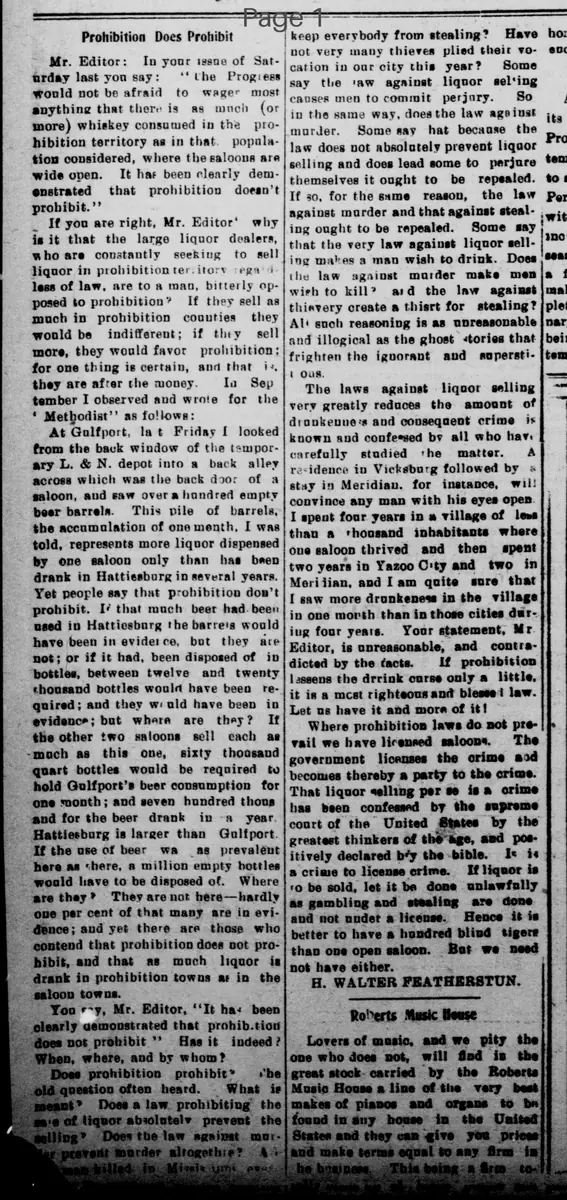
Mr. Editor: In your issue of Saturday last you say: the Progress would not be afraid to wager most anything that there is as much (or more) whiskey consumed in the prohibition territory as in that, population considered, where the saloons are wide open.
It has been clearly demonstrated that prohibition doesn't prohibit.
If you are right, Mr. Editor, why is it that the large liquor dealers, who are constantly seeking to sell liquor in prohibition territory regardless of law, are to a man, bitterly opposed to prohibition? If they sell as much in prohibition counties they would be indifferent; if they sell more, they would favor prohibition; for one thing is certain, and that is, they are after the money. In September I observed and wrote for the Methodist as follows:
At Gulfport, last Friday I looked from the back window of the temporary L. & N. depot into a back alley across which was the back door of a saloon, and saw over a hundred empty beer barrels. This pile of barrels, the accumulation of one month, I was told, represents more liquor dispensed by one saloon only than has been drank in Hattiesburg in several years.
Yet people say that prohibition don't prohibit. If that much beer had been used in Hattiesburg the barrels would have been in evidence, but they are not; or if it had been disposed of in bottles, between twelve and twenty thousand bottles would have been required; and they would have been in evidence; but where are they? If the other two saloons sell each as much as this one, sixty thousand quart bottles would be required to hold Gulfport's beer consumption for one month; and seven hundred thousand for the beer drank in a year.
Hattiesburg is larger than Gulfport. If the use of beer was as prevalent here as there, a million empty bottles would have to be disposed of. Where are they? They are not here—hardly one per cent of that many are in evidence; and yet there are those who contend that prohibition does not prohibit, and that as much liquor is drank in prohibition towns as in the saloon towns.
You say, Mr. Editor, "It has been clearly demonstrated that prohibition does not prohibit." Has it indeed? When, where, and by whom?
Does prohibition prohibit the old question often heard. What is meant? Does a law prohibiting the sale of liquor absolutely prevent the selling? Does the law against murder prevent murder altogether? A law against stealing keep everybody from stealing?
Have not very many thieves plied their vocation in our city this year?
Some say the law against liquor selling causes men to commit perjury.
So in the same way, does the law against murder. Some say that because the law does not absolutely prevent liquor selling and does lead some to perjure themselves it ought to be repealed.
If so, for the same reason, the law against murder and that against stealing ought to be repealed. Some say that the very law against liquor selling makes a man wish to drink. Does the law against murder make men wish to kill? And the law against thievery create a thirst for stealing?
All such reasoning is as unreasonable and illogical as the ghost stories that frighten the ignorant and superstitious.
The laws against liquor selling very greatly reduces the amount of drunkenness and consequent crime is known and confessed by all who have carefully studied the matter.
A residence in Vicksburg followed by a stay in Meridian, for instance, will convince any man with his eyes open.
I spent four years in a village of less than a thousand inhabitants where one saloon thrived and then spent two years in Yazoo City and two in Meridian, and I am quite sure that I saw more drunkenness in the village in one month than in those cities during four years.
Your statement, Mr. Editor, is unreasonable, and contradicted by the facts. If prohibition lessens the drink curse only a little, it is a most righteous and blessed law.
Let us have it and more of it!
Where prohibition laws do not prevail we have licensed saloons. The government licenses the crime and becomes thereby a party to the crime.
That liquor selling per se is a crime has been confessed by the supreme court of the United States by the greatest thinkers of the age, and positively declared by the bible. It is a crime to license crime. If liquor is to be sold, let it be done unlawfully as gambling and stealing are done and not under a license. Hence it is better to have a hundred blind tigers than one open saloon. But we need not have either.
H. WALTER FEATHERSTUN.
What sub-type of article is it?
What themes does it cover?
What keywords are associated?
What entities or persons were involved?
Letter to Editor Details
Author
H. Walter Featherstun
Recipient
Mr. Editor
Main Argument
prohibition effectively reduces liquor consumption and drunkenness compared to areas with open saloons, as shown by observations in gulfport versus hattiesburg and personal experiences; it is a moral imperative superior to licensing saloons, which implicates the government in crime.
Notable Details