Thank you for visiting SNEWPapers!
Sign up free
Story
August 14, 1895
The Anaconda Standard
Anaconda, Deer Lodge County, Montana
What is this article about?
A Boston architect's attempt to mail a sealed roll to Ottawa as a letter is rejected, leading to a joint US-Canadian postal ruling that letters must be flat envelopes, not rolls, for international mail.
Clipping
OCR Quality
98%
Excellent
Full Text
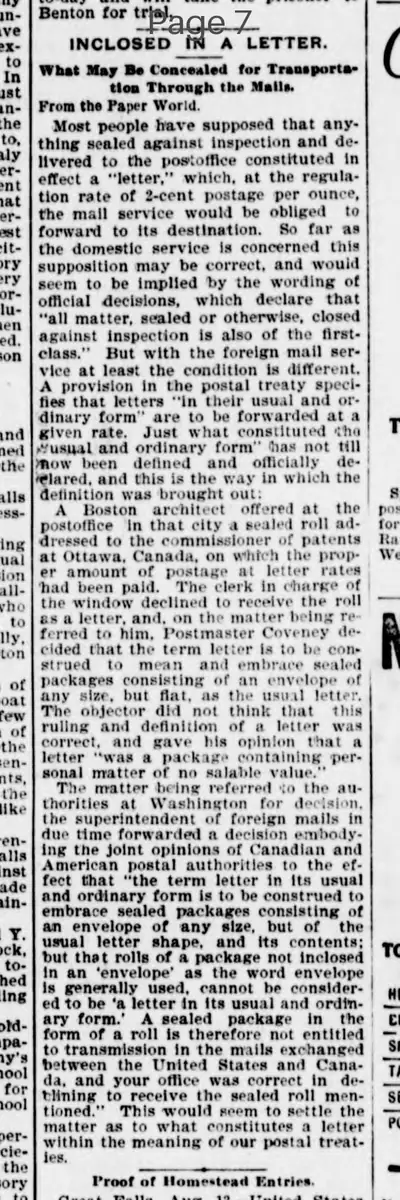
IN CLOSED IN A LETTER.
What May Be Concealed for Transportation Through the Mails.
From the Paper World.
Most people have supposed that anything sealed against inspection and delivered to the postoffice constituted in effect a "letter," which, at the regulation rate of 2-cent postage per ounce, the mail service would be obliged to forward to its destination. So far as the domestic service is concerned this supposition may be correct, and would seem to be implied by the wording of official decisions, which declare that "all matter, sealed or otherwise, closed against inspection is also of the first-class." But with the foreign mail service at least the condition is different.
A provision in the postal treaty specifies that letters in their "usual and ordinary form" are to be forwarded at a given rate. Just what constituted the "usual and ordinary form" has not till now been defined and officially declared, and this is the way in which the definition was brought out:
A Boston architect offered at the postoffice in that city a sealed roll addressed to the commissioner of patents at Ottawa, Canada, on which the proper amount of postage at letter rates had been paid. The clerk in charge of the window declined to receive the roll as a letter, and, on the matter being referred to him, Postmaster Coveney decided that the term letter is to be construed to mean and embrace sealed packages consisting of an envelope of any size, but flat, as the usual letter.
The objector did not think that this ruling and definition of a letter was correct, and gave his opinion that a letter "was a package containing personal matter of no salable value."
The matter being referred to the authorities at Washington for decision, the superintendent of foreign mails in due time forwarded a decision embodying the joint opinions of Canadian and American postal authorities to the effect that "the term letter in its usual and ordinary form is to be construed to embrace sealed packages consisting of an envelope of any size, but of the usual letter shape, and its contents; but that rolls or a package not inclosed in an 'envelope' as the word envelope is generally used, cannot be considered to be 'a letter in its usual and ordinary form.' A sealed package in the form of a roll is therefore not entitled to transmission in the mails exchanged between the United States and Canada, and your office was correct in declining to receive the sealed roll mentioned." This would seem to settle the matter as to what constitutes a letter within the meaning of our postal treaties.
What May Be Concealed for Transportation Through the Mails.
From the Paper World.
Most people have supposed that anything sealed against inspection and delivered to the postoffice constituted in effect a "letter," which, at the regulation rate of 2-cent postage per ounce, the mail service would be obliged to forward to its destination. So far as the domestic service is concerned this supposition may be correct, and would seem to be implied by the wording of official decisions, which declare that "all matter, sealed or otherwise, closed against inspection is also of the first-class." But with the foreign mail service at least the condition is different.
A provision in the postal treaty specifies that letters in their "usual and ordinary form" are to be forwarded at a given rate. Just what constituted the "usual and ordinary form" has not till now been defined and officially declared, and this is the way in which the definition was brought out:
A Boston architect offered at the postoffice in that city a sealed roll addressed to the commissioner of patents at Ottawa, Canada, on which the proper amount of postage at letter rates had been paid. The clerk in charge of the window declined to receive the roll as a letter, and, on the matter being referred to him, Postmaster Coveney decided that the term letter is to be construed to mean and embrace sealed packages consisting of an envelope of any size, but flat, as the usual letter.
The objector did not think that this ruling and definition of a letter was correct, and gave his opinion that a letter "was a package containing personal matter of no salable value."
The matter being referred to the authorities at Washington for decision, the superintendent of foreign mails in due time forwarded a decision embodying the joint opinions of Canadian and American postal authorities to the effect that "the term letter in its usual and ordinary form is to be construed to embrace sealed packages consisting of an envelope of any size, but of the usual letter shape, and its contents; but that rolls or a package not inclosed in an 'envelope' as the word envelope is generally used, cannot be considered to be 'a letter in its usual and ordinary form.' A sealed package in the form of a roll is therefore not entitled to transmission in the mails exchanged between the United States and Canada, and your office was correct in declining to receive the sealed roll mentioned." This would seem to settle the matter as to what constitutes a letter within the meaning of our postal treaties.
What sub-type of article is it?
Curiosity
Historical Event
What themes does it cover?
Justice
What keywords are associated?
Postal Ruling
Letter Definition
Sealed Roll
Us Canada Mail
Postmaster Decision
What entities or persons were involved?
Postmaster Coveney
Where did it happen?
Boston, Ottawa, Canada
Story Details
Key Persons
Postmaster Coveney
Location
Boston, Ottawa, Canada
Story Details
A Boston architect tries to mail a sealed roll to Ottawa as a letter but is refused; Postmaster Coveney rules it must be flat like an envelope. Washington authorities confirm with Canada that rolls do not qualify as letters under postal treaty.