Thank you for visiting SNEWPapers!
Sign up free
Rhode Island American And Providence Gazette
Providence, Providence County, Rhode Island
What is this article about?
Translation and analysis of the 1826 Treaty of Federation between Peru and Bolivia, establishing the Bolivian Federation under Simon Bolivar as lifelong Supreme Chief. Includes committee report with proposed modifications and critical reflections on its implications for South American politics.
Merged-components note: Continuation of the article on the 'Treaty of Federation' between Peru and Bolivia across pages, as the text flows directly from one component to the next.
Clippings
1 of 2
OCR Quality
Full Text
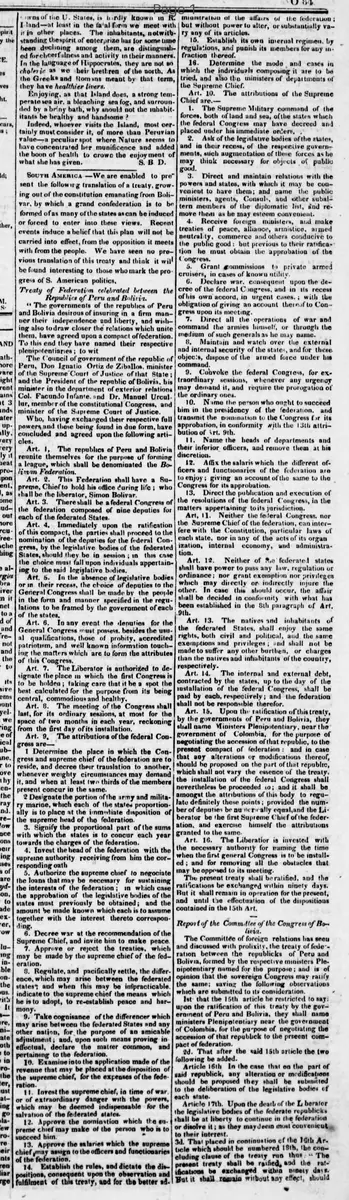
Treaty of Federation celebrated between the Republics of Peru and Bolivia.
"The governments of the republics of Peru and Bolivia desirous of insuring in a firm manner their independence and liberty, and wishing also to draw closer the relations which unite them, have agreed upon a compact of federation.
To this end they have named their respective plenipotentiaries: to wit The Council of government of the republic of Peru, Don Ignacio Ortiz de Zevallos, minister of the Supreme Court of Justice of that State: and the President of the republic of Bolivia, his minister in the department of exterior relations Col. Facundo Infante, and Dr. Manuel Urcullu, member of the constitutional Congress, and minister of the Supreme Court of Justice.
Who, having exchanged their respective full powers and these being found in due form, have concluded and agreed upon the following articles.
Art. I, The republics of Peru and Bolivia reunite themselves for the purpose of forming a league, which shall be denominated the Bolivian Federation.
Art. 2. This Federation shall have a Supreme, Chief to hold his office during life; who shall be the liberator, Simon Bolivar.
Art.3. There shall be a federal Congress of the federation composed of nine deputies for each of the federated States.
Art. 4. Immediately upon the ratification of this compact, the parties shall proceed to the nomination of the deputies for the federal Congress, by the legislative bodies of the federated States, should they be in session; in this case the choice must fall upon individuals appertaining to the said legislative bodies.
Art. 5. In the absence of legislative bodies or in their recess, the choice of deputies to the General Congress shall be made by the people in the form and manner specified in the regulations to be framed by the government of each of the states.
Art. 6. In any event the deputies for the General Congress must possess, besides the usual qualifications, those of probity, accredited patriotism, and well known information touching the matters which are to form the attributes of this Congress.
Art. 7. The Liberator is authorized to designate the place in which the first Congress is to be holden: taking care that it be a spot the best calculated for the purpose from its being central, commodious and healthy.
Art. 8. The meeting of the Congress shall last, for its ordinary sessions, at most for the space of two months in each year, reckoning from the 1st day of its installation
Art. 9. The attributions of the federal Congress are
1 Determine the place in which the Congress and supreme chief of the federation are to reside, and decree their translation to another, whenever weighty circumstances may demand it, and when at least two thirds of the members present concur in the same.
2 Designate the portion of the army and military marine, which each of the states proportionally is to place at the immediate disposition of the supreme head of the federation
3. Signify the proportional part of the sums with which the states is to concur each year towards the charges of the federation.
4. Invest the head of the federation with the supreme authority receiving from him the corresponding oath
5. Authorize the supreme chief to negotiate the loans that may be necessary for sustaining the interests of the federation; in which case the approbation of the legislative bodies of the states must previously be obtained: and the amount be made known which each is to assume together with the interest thereto corresponding.
6. Decree war at the recommendation of the Supreme Chief, and invite him to make peace.
7. Approve or reject the treaties, which may be made by the supreme chief of the federation.
8. Regulate, and pacifically settle, the difference, which may arise between the federated states; and when this may be impracticable, indicate to the supreme chief the means which he is to adopt, to re-establish peace and harmony.
9. Take cognisance of the differences which may arise between the federated States and any other nation, for the purpose of an amicable adjustment: and upon such means proving ineffectual, declare the matter common, and pertaining to the federation.
10. Examine into the application made of the revenue that may be placed at the disposition of the supreme chief, for the expenses of the federation.
11. Invest the supreme chief, in time of war, or of extraordinary danger with the powers, which may be deemed indispensable for the salvation of the federated states.
12. Approve the nomination which the supreme chief may make of the person who is to succeed him.
13. Approve the salaries which the supreme chief may assign to the officers and functionaries of the federation.
14. Establish the rules, and dictate the dispositions, consequent upon the observation and fulfilment of this treaty, and for the better administration of the affairs of the federation; but without power to alter, or substantially vary any of its articles.
15. Establish its own internal regimen, by regulations, and punish its members for any infraction thereof.
16. Determine the mode and cases in which the individuals composing it are to be tried, and also the ministers of departments of the Supreme Chief.
Art. 10. The attributions of the Supreme Chief are.-
1. The Supreme Military command of the forces, both of land and sea, of the states which the federal Congress may have decreed and placed under his immediate orders.
2. Ask of the legislative bodies of the states, and in their recess, of the respective governments, such augmentation of these forces as he may think necessary for objects of public good.
3. Direct and maintain relations with the powers and states, with which it may be convenient to have them; and name the public ministers, agents, Consuls, and other subordinate members of the diplomatic list, and remove them as he may esteem convenient.
4. Receive foreign ministers, and make treaties of peace, alliance, armistice, armed neutrality, commerce and others conducive to the public good: but previous to their ratification he must obtain the approbation of the Congress.
5. Grant commissions to private armed cruisers, in cases of known utility.
6. Declare war, consequent upon the decree of the federal Congress, and in its recess of his own accord, in urgent cases; with the obligation of giving an account thereof to Congress upon its meeting.
7. Direct all the operations of war and command the armies himself, or through the medium of such generals as he may name.
8. Maintain and watch over the external and internal security of the states, and for these objects, dispose of the armed force under his command
9. Convoke the federal Congress, for extraordinary sessions, whenever any urgency may demand it, and require the prorogation of the ordinary ones.
10. Name the person who ought to succeed him in the presidency of the federation, and transmit the nomination to the Congress for its approbation, in conformity with the 13th attribution of art. 9th.
11. Name the heads of departments and their inferior officers, and remove them at his discretion.
12. Affix the salaries which the different officers and functionaries of the federation are to enjoy; giving an account of the same to the Congress for its approbation.
13. Direct the publication and execution of the resolutions of the federal Congress, in the matters appertaining to its jurisdiction.
Art, 11. Neither the federal Congress, nor the Supreme Chief of the federation, can interfere with the Constitution, particular laws of each state, nor in any of the acts of its organization, internal economy, and administration.
Art. 12. Neither of the federated states shall have power to pass any law, regulation or ordinance; nor grant exemption nor privileges which may directly or indirectly injure the other. In case this should occur, the affair shall be decided in conformity with what has been established in the 8th paragraph of Art. 9th.
Art. 13. The natives and inhabitants of the federated States, shall enjoy the same rights, both civil and political, and the same exemptions and privileges; and shall not be made to suffer any other burden, or charges than the natives and inhabitants of the country, respectively.
Art. 14. The internal and external debt, contracted by the states, up to the day of the installation of the federal Congress, shall be paid by each, respectively; and the federation shall not be responsible therefor.
Art. 15. Upon the ratification of this treaty, by the governments of Peru and Bolivia, they shall name Ministers Plenipotentiary, near the government of Colombia, for the purpose of negotiating the accession of that republic, to the present compact of federation: and in case that any alterations or modifications thereof should be proposed on the part of that republic, which shall not vary the essence of the treaty, the installation of the federal Congress shall nevertheless be proceeded to: and it shall be amongst the attributions of this body to regulate definitely these points; provided the number of deputies be numerically equal, and the Liberator be the first Supreme Chief of the federation, and exercise himself the attributions granted to the same.
Art. 16. The Liberator is invested with the necessary authority for naming the time when the first general Congress is to be installed: and for removing all the obstacles that may be opposed to its meeting.
The present treaty shall be ratified, and the ratifications be exchanged within ninety days. But it shall remain in operation for the present, and until the effectuation of the dispositions contained in the 15th Art
Report of the Committee of the Congress of Bolivia.
The Committee of foreign relations has seen and discussed with prolixity, the treaty of federation between the republicks of Peru and Bolivia, formed by the respective ministers Plenipotentiary named for the purpose; and is of opinion that the sovereign Congress may ratify the same; saving the following observations which are submitted to its consideration.
1st—that the 15th article be restricted to say: upon the ratification of this treaty by the government of Peru and Bolivia, they shall name ministers Plenipotentiary near the government of Colombia, for the purpose of negotiating the accession of that republick to the present compact of federation.
2d. That after the said 15th article the two following be added.
Article 16th In the case that on the part of said republick, any alteration or modifications should be proposed they shall be submitted to the deliberation of the legislative bodies of each state.
Article 17th. Upon the death of the Liberator the legislative bodies of the federate republicks shall be at liberty to continue in the federation or dissolve it; as they may deem most convenient to their interest.
3d. That placed in continuation of the 16th Article which should be numbered 18th, the concluding clause of the treaty run thus: "The present treaty shall be ratified and the ratifications be exchanged within ninety days. But it shall remain without any effect, should
The republic of Colombia not entering into that federation, those of Peru and Bolivia reserving to themselves the liberty of celebrating any other treaties. In which understanding the Committee opines that this Sovereign Congress may take order in the matter, agreeably to the following minute of communication to the Executive.
MINUTE,
The Congress has examined minutely the treaty of federation between our government and that of Peru. The modifications that have been made are indispensable to the welfare of the country, and in conformity with them yields its sanction to the treaty alluded to. Chuqui-Collijo.-A. V. Serane.-M. Molina.-M. Guzman. Lima, November 27th, 1826. (Signed) C. Olane-ta.--I. I. de San Gines.-P. Romero.
Remarks.--The foregoing treaty is the result of the instructions given by the Congress of Peru to the minister Ortiz Zeballos. The report of the Committee on the same gives rise to very curious reflections highly worthy of attention. Every article of it betrays the master hand that put the machine in motion, and shows the policy that dictated it, and the extensive plan that is to be put in execution. After this one must be wilfully blind or stupid indeed not to see the motives in which it had its origin, and the end to which it leads. There is here nothing supposititious, nothing hypothetical, the parties speak for themselves.
One of the first considerations that this treaty gives rise to, is that it originated not in motives of public good, as set forth, but in deference to a single person; else, why make it a condition that this person, and none other, shall exercise the supreme functions? and that after his death the contracting parties shall be at liberty to annul the compact? If not, does it not show a conviction that there was no other guarantee against the abuse of these immense powers, than the peculiar qualities of the person to whom alone they were to be entrusted? And can it ever be wise or prudent to place the liberties of the people, and even the independent existence of the nation upon so frail a tenure? Can the public good ever demand a course so hazardous? Can true political integrity and disinterestedness ever consent to be the depository of such dangerous, such odious powers; much less to wring them from a reluctant people? What confidence can justly be had in a person who shall have lent himself to such measures? Can it have been done with views other than the most unwarrantable, and dangerous to the public liberties? or from motives not highly derogatory to his moral and intellectual character.
The next reflection that suggests itself is that upon ratification of this treaty, the contracting parties cease to be in their separate capacity, independent nations: they will be wanting in some of the most essential attributes of sovereignty, having by that instrument granted them to a common government thereby created. Their policy and their measures will be controlled by a superior power, extrinsic from themselves, nor should the contingent duration of the general government, proposed by the Committee of foreign relations, be adopted, will that of the federation offer the necessary security and permanency to enable foreign nations to treat with it in safety: for in this case the duration of the treaties might only be co-extensive with the existence of a single individual--the head of the federation. There would be no permanent contracting power.
It will be seen that the powers granted to the federal government are very extensive, much more so than those granted to that of the United States, and that, consequently these states retain less of sovereignty than do those of our own government. The general Congress would consist of only 18 members, should Colombia not accede to the compact, and 27, should that be the case, a number much too limited to withstand the influence of the Executive in possession of such immense attributes as are granted to him by the treaty; to which it may be added that the time allotted for their sessions is so short as to preclude the necessary deliberation. The operation of the 9th and 12th articles will eventually annihilate the state Governments, or reduce their functions to those purely municipal:--and, as the executive, for the reasons first mentioned and others of great weight, incidental to the individual character of the incumbent,--will control the deliberations of the Congress, nearly all power will finally center in the supreme head of the federation, and this without any very great stretch of the formidable prerogatives granted him;--but should he be inclined to abuse them, there is no barrier that could offer the smallest resistance.
This treaty and the constitution of Bolivia (as first adopted in Peru, and it is feared about to be forced upon Colombia) are concentric circles, of which the first is the larger. It is only a more extensive application of the principles, and an enlargement of the same pretensions exhibited in that great American code.
Such are a few of the reflections to which a consideration of this singular and ominous treaty gives rise. They have been confined to its internal structure, and to its bearing and probable effect upon the states, for which it has been framed. But what will be its aspect when received in connexion with the neighboring republics of South America? what its external operation, in relation to those states? should Colombia accede to this treaty, we should see three nations amongst the most powerful of South America consolidated as it were, into one, with a general government, essentially monarchical, and a common Chief, holding his office during life, at its head: the armed force and the resources of the consolidated states at his disposal: such is the aspect which this treaty presents in its relation to the adjacent free states. What then will be its probable operation in reference to them? What but to compel them to enter into the views and submit to the dictation of the ambitious Chief?
What sub-type of article is it?
What keywords are associated?
What entities or persons were involved?
Where did it happen?
Foreign News Details
Primary Location
Peru And Bolivia
Event Date
November 27th, 1826
Key Persons
Outcome
treaty establishes bolivian federation with bolivar as lifelong supreme chief; bolivian congress proposes modifications including contingencies for colombia's accession and dissolution upon bolivar's death; critical analysis highlights risks to sovereignty and potential for authoritarianism.
Event Details
Translation of the Treaty of Federation between Peru and Bolivia, forming the Bolivian Federation under Simon Bolivar. Details powers of federal Congress and Supreme Chief. Includes Bolivian Congress committee report recommending ratification with modifications, and editorial remarks critiquing the treaty's implications for South American independence and politics.