Thank you for visiting SNEWPapers!
Sign up free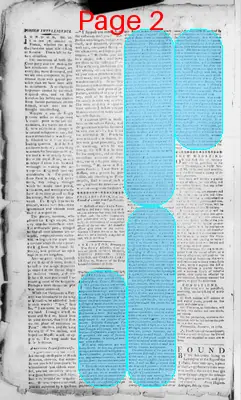
The Kentucky Gazette
Lexington, Fayette County, Kentucky
What is this article about?
Speech by M. Moreau de St. Merry to Paris electors on July 29, 1789, celebrating the fall of the Bastille, denouncing despotism, and urging unity, justice, and liberty in the French Revolution.
Clipping
OCR Quality
Full Text
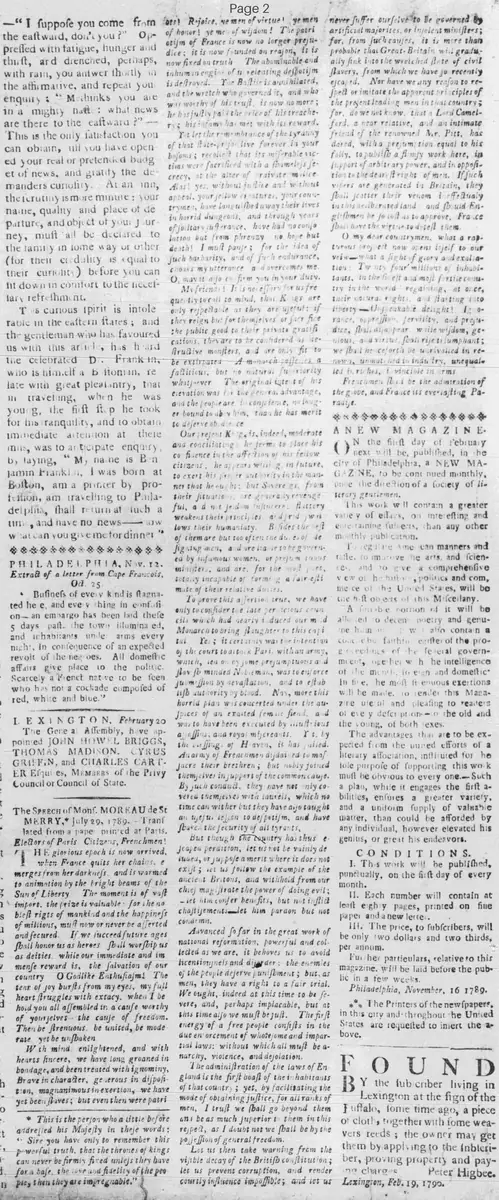
Electors of Paris! Citizens! Frenchmen!
The glorious epoch is now arrived, when France quits her chains, emerges from her darkness, and is warmed to animation by the bright beams of the Sun of Liberty. The moment is of vast import, the prize is valuable: for the noblest rights of mankind and the happiness of millions, must now or never be asserted and secured. If we succeed future ages shall honor us as heroes, shall worship us as deities, while our immediate and immense reward is, the salvation of our country. O Godlike Enthusiasm! The tear of joy bursts from my eyes, my full heart struggles with ecstasy, when I behold you all assembled in a cause worthy of yourselves—the cause of freedom.
Then be strenuous, be united, be moderate yet be unshaken. With minds enlightened, and with hearts sincere, we have long groaned in bondage, and been treated with ignominy. Brave in character, generous in disposition, magnanimous in exertion, we have yet been slaves; but even then were patriots.
This is the person who a little before addressed his Majesty in these words: Sire you have only to remember this powerful truth, that the thrones of kings can never be firmly seated unless they have for a base, the love and fidelity of the people, then they are impregnable.
Rejoice! Rejoice, ye men of virtue! ye men of honor! ye men of wisdom! The patriotism of France is now no longer prejudice; it is now founded on reason, it is now fired on truth. The abominable and inhuman engine of unrelenting despotism is destroyed. The Bastile is annihilated, and the wretch who governed it, and who was worthy of his trust, is now no more; he has justly paid the price of his treason. His infamy has met with its reward.
Yet let the remembrance of the tyranny of that state-prison live forever in your bosoms; recollect that its miserable victims were sacrificed with a shameful secrecy, at the altar of rapacious avarice. Alas! yes. without justice and without appeal, your fellow creatures, your countrymen, have languished away their lives in horrid dungeons, and through years of solitude and France, have had no consolation but from phrensy no hope but death! I must pause; for the idea of such barbarity, and of such endurance, choaks my utterance and overcomes me.
O, my friends! It is necessary for us to call to mind, that Kings are only respectable as they are useful; if they reign but for themselves or sacrifice the public good to their private gratifications, they are to be considered as destructive monsters, and are only fit to be extirpated. A monarch possesses a factitious, but no natural superiority whatever. The original right of his elevation was for the general advantage, and the people are consequently, no longer bound to obey him, than he has merit to deserve obedience.
Our present King is, indeed, moderate and conciliating in terms to place his confidence in the affection of his fellow citizens, he appears willing in future, to exert his power only in the manner that he ought; but were kings, from their situation, generally revengeful, and not judged sincere. Flattery weakens their principles and drowns their humanity. Besides the best of them are but too often the dupes of designing men, and are liable to be governed by infamous women, or presumptuous ministers, and are, for the most part, totally incapable of forming a fair estimate of their relative duties.
To prove this assertion true, we have only to consider the late serious councils which had nearly induced our mild Monarch to bring slaughter to this capital. Yes; it certainly was the intention of the court to attack Paris, with an army, which, sent on some presumptuous and bad errand, was to enforce submission by devastation, and to establish authority by blood. Nay, more this horrid plan was concerted under the auspices of an exalted female fiend, and was to have been executed by unjust assassins, and royal miscreants. Luckily the ceiling of Heaven, it has failed.
An army of Frenchmen died to massacre their brethren; but nobly joined themselves in support of the common cause. By such conduct, they have not only covered themselves with laurels, which no time can wither but they have also taught an useful lesson to despotism, and have shewn the insecurity of all tyrants.
But though the country has thus escaped perdition, let us not be vainly seduced, or suppose a merit where it does not exist; let us follow the example of the ancient Britons, and withhold from our chief magistrate the power of doing evil; let him confer benefits, but not inflict chastisements; let him pardon but not condemn.
Advanced so far in the great work of national reformation, powerful and collected as we are, it behoves us to avoid licentiousness and disorder: the enemies of the people deserve punishment; but, as men, they have a right to a fair trial. We ought, indeed at this time to be severe, and, perhaps implacable, but at this time also we must be just. The first energy of a free people consists in the due enforcement of wholesome and impartial laws; without which all must be anarchy, violence, and desolation.
The administration of the laws of England is the first boast of the inhabitants of that country; yet, by facilitating the mode of obtaining justice, for all ranks of men, I trust we shall go beyond them and be as much superior to them in this respect, as I doubt not we shall be by the possession of general freedom.
Let us then take warning from the visible decay of the British constitution; let us prevent corruption, and render courtly influence impossible; and let us never suffer ourselves to be governed by artificial majorities, or insolent ministers; for, from such causes, it is more than probable that Great-Britain will gradually sink into the wretched state of civil slavery, from which we have so recently escaped. Nor have we any reason to respect or imitate the apparent principles of the present leading men in that country; for, do we not know, that a Lord Camelford, a near relative, and an intimate friend of the renowned Mr. Pitt, has dared, with a presumption equal to his folly, to publish a seditious work here, in support of arbitrary power, and in opposition to the dear rights of men. If such vipers are generated in Britain, they shall scatter their venom ineffectually into this deliberated land and build Englishmen be so sottish as to approve. France shall have the virtue to tell them.
O my dear countrymen, what a rapturous prospect now opens itself to our view! what a bright scene of glory awaits us! Twenty four millions of inhabitants, in the most opulent and fertile country in the world regaining, at once, their natural rights, and starting into liberty—unbounded delight! Ignorance, oppression, servitude, and prejudice, blindfolded in fear with wisdom, generous and virtuous patriotism triumphant; we shall henceforward, be unrivalled in renown, unmatchless in industry, unequalled in riches, invincible in arms. Free cumbe, hit be the admiration of the globe, and France its everlasting paradise.
What sub-type of article is it?
What keywords are associated?
What entities or persons were involved?
Where did it happen?
Foreign News Details
Primary Location
Paris
Event Date
July 29, 1789
Key Persons
Outcome
the bastille is annihilated; its governor executed for treason; planned attack on paris by army failed as troops joined the cause.
Event Details
M. Moreau de St. Merry addresses Paris electors, celebrating the destruction of the Bastille and emergence from despotism, urging unity, moderation, justice, and enforcement of impartial laws while warning against kings' potential tyranny and drawing lessons from British politics.