Thank you for visiting SNEWPapers!
Sign up free
Story
July 25, 1930
The Butler County Press
Hamilton, Butler County, Ohio
What is this article about?
At the governors' conference in Salt Lake City, Connecticut Governor Trumbull calls for shorter workdays to address unemployment driven by mass production, noting one worker now produces as much as 32 did 75 years ago, and four-hour days could suffice for all needs.
Clipping
OCR Quality
95%
Excellent
Full Text
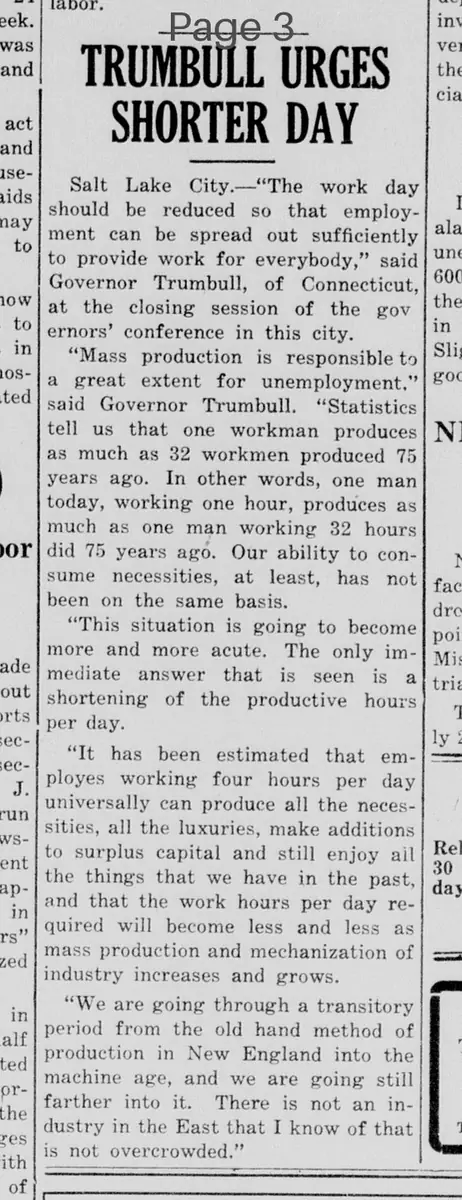
TRUMBULL URGES
SHORTER DAY
Salt Lake City.-"The work day
should be reduced so that employ-
ment can be spread out sufficiently
to provide work for everybody," said
Governor Trumbull, of Connecticut,
at the closing session of the gov-
ors' conference in this city.
"Mass production is responsible to
a great extent for unemployment,"
said Governor Trumbull. "Statistics
tell us that one workman produces
as much as 32 workmen produced 75
years ago. In other words, one man
today, working one hour, produces as
much as one man working 32 hours
did 75 years ago. Our ability to con-
sume necessities, at least, has not
been on the same basis.
"This situation is going to become
more and more acute. The only im-
mediate answer that is seen is a
shortening of the productive hours
per day.
"It has been estimated that em-
ployes working four hours per day
universally can produce all the neces-
sities, all the luxuries, make additions
to surplus capital and still enjoy all
the things that we have in the past,
and that the work hours per day re-
quired will become less and less as
mass production and mechanization of
industry increases and grows.
"We are going through a transitory
period from the old hand method of
production in New England into the
machine age, and we are going still
farther into it. There is not an in-
dustry in the East that I know of that
is not overcrowded."
SHORTER DAY
Salt Lake City.-"The work day
should be reduced so that employ-
ment can be spread out sufficiently
to provide work for everybody," said
Governor Trumbull, of Connecticut,
at the closing session of the gov-
ors' conference in this city.
"Mass production is responsible to
a great extent for unemployment,"
said Governor Trumbull. "Statistics
tell us that one workman produces
as much as 32 workmen produced 75
years ago. In other words, one man
today, working one hour, produces as
much as one man working 32 hours
did 75 years ago. Our ability to con-
sume necessities, at least, has not
been on the same basis.
"This situation is going to become
more and more acute. The only im-
mediate answer that is seen is a
shortening of the productive hours
per day.
"It has been estimated that em-
ployes working four hours per day
universally can produce all the neces-
sities, all the luxuries, make additions
to surplus capital and still enjoy all
the things that we have in the past,
and that the work hours per day re-
quired will become less and less as
mass production and mechanization of
industry increases and grows.
"We are going through a transitory
period from the old hand method of
production in New England into the
machine age, and we are going still
farther into it. There is not an in-
dustry in the East that I know of that
is not overcrowded."
What sub-type of article is it?
Historical Event
What keywords are associated?
Shorter Workday
Unemployment
Mass Production
Governor Trumbull
Governors Conference
What entities or persons were involved?
Governor Trumbull
Where did it happen?
Salt Lake City
Story Details
Key Persons
Governor Trumbull
Location
Salt Lake City
Story Details
Governor Trumbull argues that mass production causes unemployment by increasing productivity dramatically, suggesting shorter workdays to spread employment and meet production needs with fewer hours.