Thank you for visiting SNEWPapers!
Sign up free
Editorial
December 14, 1837
The Madisonian
Washington, District Of Columbia
What is this article about?
In this third installment of a series, 'Valerius Publicus' critiques the Sub-Treasury and Special Deposite schemes for managing U.S. public revenues. He argues both plans mandate specie handling, risk economic chaos, favor government over people with unequal currencies, and threaten republican principles by separating fiscal affairs from institutions. He warns they will lead to demands for a National Bank. Dated Dec. 12, 1837.
Clipping
OCR Quality
95%
Excellent
Full Text
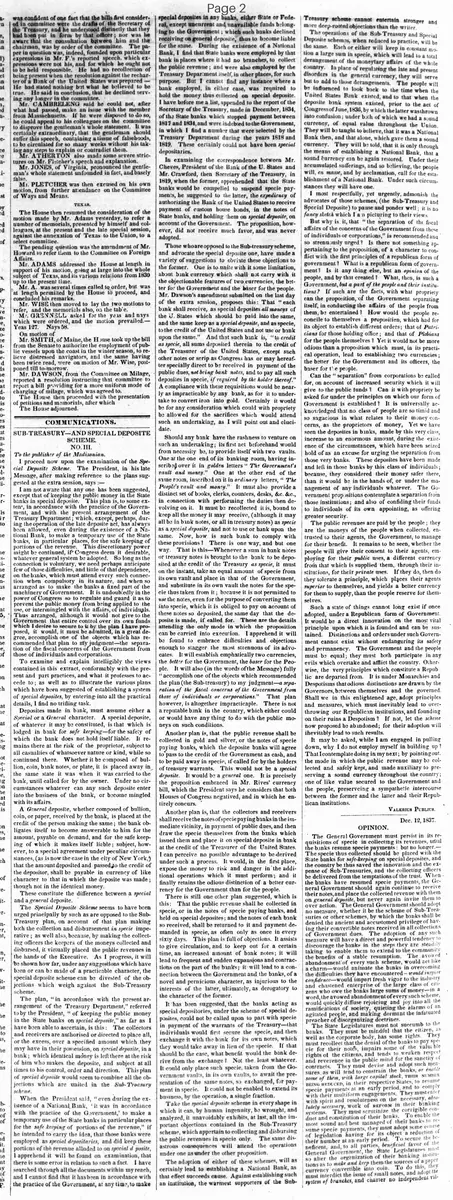
COMMUNICATIONS.
SUB-TREASURY—AND SPECIAL DEPOSITE SCHEME.
NO. III.
To the publisher of the Madisonian.
I proceed now upon the examination of the Special Deposite Scheme. The President, in his late Message, after making reference to the plans suggested at the extra session, says:—
I am not aware that any one has been suggested except that of keeping the public money in the State banks in special deposite. This plan is, to some extent, in accordance with the practice of the Government, and with the present arrangement of the Treasury Department; which, except, perhaps, during the operation of the late deposite act, has always been allowed, even during the existence of a National Bank, to make a temporary use of the State banks, in particular places, for the safe keeping of portions of the revenue. This discretionary power might be continued, if Congress deem it desirable, whatever general system be adopted. So long as the connection is voluntary, we need perhaps anticipate few of those difficulties, and little of that dependence, on the banks, which must attend every such connection when compulsory in its nature, and when so arranged as to make the banks a fixed part of the machinery of Government. It is undoubtedly in the power of Congress so to regulate and guard it as to prevent the public money from being applied to the use, or intermingled with the affairs, of individuals. Thus arranged, although it would not give to the Government that entire control over its own funds which I desire to secure to it by the plan I have proposed, it would, it must be admitted, in a great degree, accomplish one of the objects which has recommended that plan to my judgment—the separation of the fiscal concerns of the Government from those of individuals and corporations.
To examine and explain intelligibly the views contained in this extract, conformably with the present and past practices, and what it professes to accede to: as well as to illustrate the various plans which have been suggested of establishing a system of special deposites, by entering into all the practical details, I find no trifling task.
Deposites made in bank, must assume either a Special or a General character. A special deposite, of whatever it may be constituted, is that which is lodged in bank for safe keeping—for the safety of which the bank does not hold itself liable. It remains there at the risk of the proprietor, subject to all casualties of whatsoever nature or kind, while so continued there. Whether it be composed of bullion, coin, bank notes, or plate, it is placed away in the same state it was when it was carried to the bank, until called for by the owner. Under no circumstances whatever can any such deposite enter into the business of the bank, or become mingled with its affairs.
A General deposite, whether composed of bullion, coin, or paper, received by the bank, is placed at the credit of the person making the same; the bank obligates itself to become answerable to him for the amount, payable on demand, and for the safe keeping of which it makes itself liable; subject, however, to a special agreement under peculiar circumstances, (as is now the case in the city of New York,) that the amount deposited and passed to the credit of the depositor, shall be payable in currency of like character to that in which the deposite was made; though not in the identical money.
These constitute the difference between a special and a general deposite.
The Special Deposite Scheme seems to have been urged principally by such as are opposed to the Sub-Treasury plan, on account of that plan making both the collection and disbursement in specie imperative; as well also, because, by making the collecting officers the keepers of the moneys collected and disbursed, it virtually placed the public revenues in the hands of the Executive. As I progress, it will be shown how far, under any suggestions which have been or can be made of a practicable character, the special deposite scheme can be divested of the objections which weigh against the Sub-Treasury scheme.
The plan, "in accordance with the present arrangement of the Treasury Department," referred to by the President, "of keeping the public money in the State banks on special deposite," as far as I have been able to ascertain, is this: The collectors and receivers are authorised or directed to place all, or the excess, over a specified amount which they may have in their possession, on special deposites, in a bank; which identical money is left there at the risk of him who makes the deposite, and subject at all times to his control, order and direction. This plan of special deposite would seem to combine all the objections which are united in the Sub-Treasury scheme.
When the President said, "even during the existence of a National Bank, it was in accordance with the practice of the Government," to make a temporary use of the State banks in particular places for the safe keeping of portions of the revenue," if he intended to carry the idea, that those banks were employed as special depositaries, and did keep these portions of the revenue alluded to on special deposite, I apprehend it will be found on examination, that there is some error in relation to such a fact. I have searched through all the documents within my reach, and I cannot find that it has been in accordance with the practice of the Government, at any time, to make special deposites in any banks, either State or Federal, except uncurrent and unavailable funds belonging to the Government; which such banks declined receiving on general deposite, thus to become liable for the same. During the existence of a National Bank, I find that State banks were employed by that bank in places where it had no branches, to collect the public revenue; and were also employed by the Treasury Department itself, in other places, for such purpose. But I cannot find any instance where a bank employed, in either case, was required to hold the money thus collected on special deposite.
I have before me a list, appended to the report of the Secretary of the Treasury, made in December, 1834, of the State banks which stopped payment between 1817 and 1834, and were indebted to the Government, in which I find a number that were selected by the Treasury Department during the years 1818 and 1819. These certainly could not have been special depositaries.
In examining the correspondence between Mr. Cheves, President of the Bank of the U. States and Mr. Crawford, then Secretary of the Treasury, in 1819, when the former, apprehended that the State banks would be compelled to suspend specie payments, he suggested to the latter, the expediency of authorizing the Bank of the United States to receive payment of custom house bonds, in the notes of State banks, and holding them on special deposite, on account of the Government. The proposition, however, did not receive much favor, and was never adopted.
Those who are opposed to the Sub-treasury scheme, and advocate the special deposite one, have made a variety of suggestions to obviate these objections to the former. One is to unite with it some limitation, about bank currency which shall not carry with it the objectionable features of two currencies, the better for the Government and the baser for the people.
Mr. Dawson's amendment submitted on the last day of the extra session, proposes this: That "each bank shall receive, as special deposites all moneys of the U. States which should be paid into the same and the same keep as a special deposite, and as specie, to the credit of the United States and not use or bank upon the same." And that such bank is, "to credit as specie, all sums deposited therein to the credit of the Treasurer of the United States, except such other notes or scrip as Congress has or may hereafter specially direct to be received in payment of the public dues, not being bank notes, and to pay all such deposites in specie, if required by the holder thereof."
A compliance with these requisitions would be nearly as impracticable by any bank, as for it to undertake to convert iron into gold. Certainly it would be for any consideration which could with propriety be allowed for the sacrifices which would attend such an undertaking, as I will point out and elucidate.
Should any bank have the rashness to venture on such an undertaking: its first act beforehand would from necessity be, to provide itself with two vaults. One at the one end of its banking room, having inscribed over it in golden letters "The Government's vault and money." One at the other end of the same room, inscribed on it in ordinary letters, "The People's vault and money." It must also provide a distinct set of books, clerks, counters, desks, &c. &c., in connection with performing the duties then devolving on it. It must be recollected it is, bound to keep all the money it may receive, (although it may all be in bank notes, or all in treasury notes) as specie as a special deposite, and not to use or bank upon the same. Now, how is such bank to comply with these provisions? There is one way, and but one way. That is this—Whenever a sum in bank notes or treasury notes is brought to the bank to be deposited at the credit of the Treasury as specie, it must on the instant, take an equal amount of specie from its own vault and place in that of the Government, and substitute in its own vault the notes for the specie thus taken from it; because it is not permitted to use the notes, even for the purpose of converting them into specie, which it is obliged to pay on account of these notes so deposited, the same day that the deposite is made, if called for. These are the details attending the only mode in which the proposition can be carried into execution. I apprehend it will be found to embrace difficulties and objections enough to stagger the most strenuous of its advocates. It will establish emphatically two currencies, the better for the Government, the baser for the People. It will also (in the words of the Message) fully "accomplish one of the objects which recommended the plan (the Sub-treasury) to my judgment—a separation of the fiscal concerns of the Government from those of individuals or corporations." That plan however, is altogether impracticable. There is not a reputable bank in the country, which either could or would have any thing to do with the public moneys on such conditions.
Another plan is, that the public revenue shall be collected in gold and silver, or the notes of specie paying banks, which the deposite banks will agree to pass to the credit of the Government as cash, and to be paid away in specie, if called for by the holders of treasury warrants. This would not be a special deposite. It would be a general one. It is precisely the proposition embraced in Mr. Rives' currency bill, which the President says he considers that both Houses of Congress negatived, and in which he entirely concurs.
Another plan is, that the collectors and receivers shall receive the notes of specie paying banks in the immediate vicinity, in payment of public dues, and then draw the specie themselves from the banks which issued them and place it on special deposite in bank at the credit of the Treasurer of the United States.
I can perceive no possible advantage to be derived under such a process. It would, in the first place expose the money to risk and danger in the additional operations which it must perform; and it finally retains the odious distinction of a better currency for the Government than for the people.
There is still one other plan suggested, which is this: That the public revenue shall be collected in specie, or in the notes of specie paying banks, and held on special deposites; and the notes of each bank so received, shall be returned to it and payment demanded in specie, as often only as once in every sixty days. This plan is full of objections. It assists to give circulation, and to keep out for a certain time, an increased amount of bank notes; it will lead to frequent and sudden expansions and contractions on the part of the banks; it will lead to a connection between the Government and the banks, of a novel and pernicious character, as injurious to the interests, of the latter, ultimately, as derogatory to the character of the former.
It has been suggested, that the banks acting as special depositories, under the scheme of special deposites, could not be called upon to part with specie in payment of the warrants of the Treasury—that individuals would first secure the specie, and then exchange it with the bank for its own notes, which they would take away in lieu of the specie. If that should be the case, what benefit would the bank derive from the exchange? Not the least whatever. It could only place such specie, taken from the Government vaults, in its own vaults, to await the presentation of the same notes, so exchanged, for payment in specie. It could not be enabled to extend its business, by the operation, a single fraction.
Take the special deposite scheme in every shape in which it can, by human ingenuity, be wrought, and analyzed, it unavoidably exhibits, at last, all the important objections contained in the Sub-Treasury scheme, which appertain to collecting and disbursing the public revenues in specie only. The same disastrous consequences will attend the operations under one as under the other proposition.
The adoption of either of these schemes, will as certainly lead to establishing a National Bank, as that effect succeeds cause. Against establishing such an institution, the warmest supporters of the Sub-Treasury scheme cannot entertain stronger and more deep-rooted objections than the writer.
The operations of the Sub-Treasury and Special Deposite schemes, when reduced to practice, will be the same. Each or either will keep in constant motion a large sum in specie, which will lead to a total derangement of the monetary affairs of the whole country. In place of regulating the late and present disorders in the general currency, they will serve but to add to those derangements. The people will be influenced to look back to the time when the United States Bank existed, and to that when the deposite bank system existed, prior to the act of Congress of June, 1836, by which the latter was thrown into confusion; under both of which we had a sound currency, of equal value throughout the Union.
They will be taught to believe, that it was a National Bank then, and that alone, which gave them a sound currency. They will be told, that it is only through the means of establishing a National Bank, that a sound currency can be again restored. Under their accumulated sufferings, and so believing, the people will, en masse, and by acclamation, call for the establishment of a National Bank. Under such circumstances they will have one.
I most respectfully, yet urgently, admonish the advocates of those schemes, (the Sub-Treasury and Special Deposite) to pause and ponder well; it is no fancy sketch which I am picturing to their views.
But why is it, that "the separation of the fiscal affairs of the concerns of the Government from these of individuals or corporations," is recommended and so strenuously urged? Is there not something appertaining to the proposition, of a character to conflict with the first principles of a republican form of government? What is a republican form of government? Is it any thing else, but an opinion of the people, and by that created? What, then, is such a Government, but a part of the people and their institutions? If such are the facts, with what propriety can the proposition, 'of the Government separating itself, in conducting the affairs of the people from them, be entertained? How would the people reconcile to themselves a proposition, which had for its object to establish different orders; that of Patricians for those holding office; and that of Plebeians for the people themselves? Yet it would not be more odious than a proposition which must, in its practical operation, lead to establishing two currencies; the better for the Government and its officers, the baser for the people.
Can the "separation" from corporations be called for, on account of increased security which it will give to the public funds? Can it with propriety be asked for under the principles on which our form of Government is established? It is universally acknowledged that no class of people are so timid and so sagacious in what relates to their money concerns, as the proprietors of money. Yet we have seen the deposites in banks, made by this very class, increase to an enormous amount, during the existence of the circumstances, which have been seized hold of as an excuse for urging the separation from those very banks. These deposites have been made and left in those banks by this class of individuals because, they considered their money safer there, than it would be in the hands of, or under the management of any individuals whatever. The Government propositions contemplate a separation from those institutions; and also of confiding their funds to individuals of its own appointing, as offering greater security.
The public revenues are paid by the people; they are the moneys of the people when collected, entrusted to their agents, the Government, to manage for their benefit. It remains to be seen, whether the people will give their consent to their agents, employing for their public uses, a different currency from that which is supplied them, through their institutions, for their private uses. If they do, then do they tolerate a principle, which places their agents superior to themselves, and yields a better currency for them to supply, than the people reserve for themselves.
Such a state of things cannot long exist if once adopted, under a Republican form of Government. It would be a direct innovation on the most vital principle upon which it is founded and can be sustained. Distinctions and orders under such Government cannot exist without endangering its safety and permanency. The Government and the people must be equal; they must both participate in any evils which overtake and afflict the country. Otherwise, the very principles which constitute a Republic are departed from. It is under Monarchies and Despotisms that odious distinctions are drawn by the Governors between themselves and the governed.
Shall we in this enlightened age, adopt principles and measures, which must inevitably lead to overthrowing our Republican institutions, and founding on their ruins a Despotism? If not, let the scheme now proposed be abandoned; for their adoption will inevitably lead to such results.
It may be asked, while I am engaged in pulling down, why I do not employ myself in building up. That I contemplate doing in my next; by pointing out, the mode in which the public revenue may be collected and safely kept, and made auxiliary to preserving a sound currency throughout the country; one of like value secured to the Government and the people, preserving a sympathetic intercourse between the former and the latter and their Republican institutions.
Valerius Publicus.
Dec. 12, 1837.
SUB-TREASURY—AND SPECIAL DEPOSITE SCHEME.
NO. III.
To the publisher of the Madisonian.
I proceed now upon the examination of the Special Deposite Scheme. The President, in his late Message, after making reference to the plans suggested at the extra session, says:—
I am not aware that any one has been suggested except that of keeping the public money in the State banks in special deposite. This plan is, to some extent, in accordance with the practice of the Government, and with the present arrangement of the Treasury Department; which, except, perhaps, during the operation of the late deposite act, has always been allowed, even during the existence of a National Bank, to make a temporary use of the State banks, in particular places, for the safe keeping of portions of the revenue. This discretionary power might be continued, if Congress deem it desirable, whatever general system be adopted. So long as the connection is voluntary, we need perhaps anticipate few of those difficulties, and little of that dependence, on the banks, which must attend every such connection when compulsory in its nature, and when so arranged as to make the banks a fixed part of the machinery of Government. It is undoubtedly in the power of Congress so to regulate and guard it as to prevent the public money from being applied to the use, or intermingled with the affairs, of individuals. Thus arranged, although it would not give to the Government that entire control over its own funds which I desire to secure to it by the plan I have proposed, it would, it must be admitted, in a great degree, accomplish one of the objects which has recommended that plan to my judgment—the separation of the fiscal concerns of the Government from those of individuals and corporations.
To examine and explain intelligibly the views contained in this extract, conformably with the present and past practices, and what it professes to accede to: as well as to illustrate the various plans which have been suggested of establishing a system of special deposites, by entering into all the practical details, I find no trifling task.
Deposites made in bank, must assume either a Special or a General character. A special deposite, of whatever it may be constituted, is that which is lodged in bank for safe keeping—for the safety of which the bank does not hold itself liable. It remains there at the risk of the proprietor, subject to all casualties of whatsoever nature or kind, while so continued there. Whether it be composed of bullion, coin, bank notes, or plate, it is placed away in the same state it was when it was carried to the bank, until called for by the owner. Under no circumstances whatever can any such deposite enter into the business of the bank, or become mingled with its affairs.
A General deposite, whether composed of bullion, coin, or paper, received by the bank, is placed at the credit of the person making the same; the bank obligates itself to become answerable to him for the amount, payable on demand, and for the safe keeping of which it makes itself liable; subject, however, to a special agreement under peculiar circumstances, (as is now the case in the city of New York,) that the amount deposited and passed to the credit of the depositor, shall be payable in currency of like character to that in which the deposite was made; though not in the identical money.
These constitute the difference between a special and a general deposite.
The Special Deposite Scheme seems to have been urged principally by such as are opposed to the Sub-Treasury plan, on account of that plan making both the collection and disbursement in specie imperative; as well also, because, by making the collecting officers the keepers of the moneys collected and disbursed, it virtually placed the public revenues in the hands of the Executive. As I progress, it will be shown how far, under any suggestions which have been or can be made of a practicable character, the special deposite scheme can be divested of the objections which weigh against the Sub-Treasury scheme.
The plan, "in accordance with the present arrangement of the Treasury Department," referred to by the President, "of keeping the public money in the State banks on special deposite," as far as I have been able to ascertain, is this: The collectors and receivers are authorised or directed to place all, or the excess, over a specified amount which they may have in their possession, on special deposites, in a bank; which identical money is left there at the risk of him who makes the deposite, and subject at all times to his control, order and direction. This plan of special deposite would seem to combine all the objections which are united in the Sub-Treasury scheme.
When the President said, "even during the existence of a National Bank, it was in accordance with the practice of the Government," to make a temporary use of the State banks in particular places for the safe keeping of portions of the revenue," if he intended to carry the idea, that those banks were employed as special depositaries, and did keep these portions of the revenue alluded to on special deposite, I apprehend it will be found on examination, that there is some error in relation to such a fact. I have searched through all the documents within my reach, and I cannot find that it has been in accordance with the practice of the Government, at any time, to make special deposites in any banks, either State or Federal, except uncurrent and unavailable funds belonging to the Government; which such banks declined receiving on general deposite, thus to become liable for the same. During the existence of a National Bank, I find that State banks were employed by that bank in places where it had no branches, to collect the public revenue; and were also employed by the Treasury Department itself, in other places, for such purpose. But I cannot find any instance where a bank employed, in either case, was required to hold the money thus collected on special deposite.
I have before me a list, appended to the report of the Secretary of the Treasury, made in December, 1834, of the State banks which stopped payment between 1817 and 1834, and were indebted to the Government, in which I find a number that were selected by the Treasury Department during the years 1818 and 1819. These certainly could not have been special depositaries.
In examining the correspondence between Mr. Cheves, President of the Bank of the U. States and Mr. Crawford, then Secretary of the Treasury, in 1819, when the former, apprehended that the State banks would be compelled to suspend specie payments, he suggested to the latter, the expediency of authorizing the Bank of the United States to receive payment of custom house bonds, in the notes of State banks, and holding them on special deposite, on account of the Government. The proposition, however, did not receive much favor, and was never adopted.
Those who are opposed to the Sub-treasury scheme, and advocate the special deposite one, have made a variety of suggestions to obviate these objections to the former. One is to unite with it some limitation, about bank currency which shall not carry with it the objectionable features of two currencies, the better for the Government and the baser for the people.
Mr. Dawson's amendment submitted on the last day of the extra session, proposes this: That "each bank shall receive, as special deposites all moneys of the U. States which should be paid into the same and the same keep as a special deposite, and as specie, to the credit of the United States and not use or bank upon the same." And that such bank is, "to credit as specie, all sums deposited therein to the credit of the Treasurer of the United States, except such other notes or scrip as Congress has or may hereafter specially direct to be received in payment of the public dues, not being bank notes, and to pay all such deposites in specie, if required by the holder thereof."
A compliance with these requisitions would be nearly as impracticable by any bank, as for it to undertake to convert iron into gold. Certainly it would be for any consideration which could with propriety be allowed for the sacrifices which would attend such an undertaking, as I will point out and elucidate.
Should any bank have the rashness to venture on such an undertaking: its first act beforehand would from necessity be, to provide itself with two vaults. One at the one end of its banking room, having inscribed over it in golden letters "The Government's vault and money." One at the other end of the same room, inscribed on it in ordinary letters, "The People's vault and money." It must also provide a distinct set of books, clerks, counters, desks, &c. &c., in connection with performing the duties then devolving on it. It must be recollected it is, bound to keep all the money it may receive, (although it may all be in bank notes, or all in treasury notes) as specie as a special deposite, and not to use or bank upon the same. Now, how is such bank to comply with these provisions? There is one way, and but one way. That is this—Whenever a sum in bank notes or treasury notes is brought to the bank to be deposited at the credit of the Treasury as specie, it must on the instant, take an equal amount of specie from its own vault and place in that of the Government, and substitute in its own vault the notes for the specie thus taken from it; because it is not permitted to use the notes, even for the purpose of converting them into specie, which it is obliged to pay on account of these notes so deposited, the same day that the deposite is made, if called for. These are the details attending the only mode in which the proposition can be carried into execution. I apprehend it will be found to embrace difficulties and objections enough to stagger the most strenuous of its advocates. It will establish emphatically two currencies, the better for the Government, the baser for the People. It will also (in the words of the Message) fully "accomplish one of the objects which recommended the plan (the Sub-treasury) to my judgment—a separation of the fiscal concerns of the Government from those of individuals or corporations." That plan however, is altogether impracticable. There is not a reputable bank in the country, which either could or would have any thing to do with the public moneys on such conditions.
Another plan is, that the public revenue shall be collected in gold and silver, or the notes of specie paying banks, which the deposite banks will agree to pass to the credit of the Government as cash, and to be paid away in specie, if called for by the holders of treasury warrants. This would not be a special deposite. It would be a general one. It is precisely the proposition embraced in Mr. Rives' currency bill, which the President says he considers that both Houses of Congress negatived, and in which he entirely concurs.
Another plan is, that the collectors and receivers shall receive the notes of specie paying banks in the immediate vicinity, in payment of public dues, and then draw the specie themselves from the banks which issued them and place it on special deposite in bank at the credit of the Treasurer of the United States.
I can perceive no possible advantage to be derived under such a process. It would, in the first place expose the money to risk and danger in the additional operations which it must perform; and it finally retains the odious distinction of a better currency for the Government than for the people.
There is still one other plan suggested, which is this: That the public revenue shall be collected in specie, or in the notes of specie paying banks, and held on special deposites; and the notes of each bank so received, shall be returned to it and payment demanded in specie, as often only as once in every sixty days. This plan is full of objections. It assists to give circulation, and to keep out for a certain time, an increased amount of bank notes; it will lead to frequent and sudden expansions and contractions on the part of the banks; it will lead to a connection between the Government and the banks, of a novel and pernicious character, as injurious to the interests, of the latter, ultimately, as derogatory to the character of the former.
It has been suggested, that the banks acting as special depositories, under the scheme of special deposites, could not be called upon to part with specie in payment of the warrants of the Treasury—that individuals would first secure the specie, and then exchange it with the bank for its own notes, which they would take away in lieu of the specie. If that should be the case, what benefit would the bank derive from the exchange? Not the least whatever. It could only place such specie, taken from the Government vaults, in its own vaults, to await the presentation of the same notes, so exchanged, for payment in specie. It could not be enabled to extend its business, by the operation, a single fraction.
Take the special deposite scheme in every shape in which it can, by human ingenuity, be wrought, and analyzed, it unavoidably exhibits, at last, all the important objections contained in the Sub-Treasury scheme, which appertain to collecting and disbursing the public revenues in specie only. The same disastrous consequences will attend the operations under one as under the other proposition.
The adoption of either of these schemes, will as certainly lead to establishing a National Bank, as that effect succeeds cause. Against establishing such an institution, the warmest supporters of the Sub-Treasury scheme cannot entertain stronger and more deep-rooted objections than the writer.
The operations of the Sub-Treasury and Special Deposite schemes, when reduced to practice, will be the same. Each or either will keep in constant motion a large sum in specie, which will lead to a total derangement of the monetary affairs of the whole country. In place of regulating the late and present disorders in the general currency, they will serve but to add to those derangements. The people will be influenced to look back to the time when the United States Bank existed, and to that when the deposite bank system existed, prior to the act of Congress of June, 1836, by which the latter was thrown into confusion; under both of which we had a sound currency, of equal value throughout the Union.
They will be taught to believe, that it was a National Bank then, and that alone, which gave them a sound currency. They will be told, that it is only through the means of establishing a National Bank, that a sound currency can be again restored. Under their accumulated sufferings, and so believing, the people will, en masse, and by acclamation, call for the establishment of a National Bank. Under such circumstances they will have one.
I most respectfully, yet urgently, admonish the advocates of those schemes, (the Sub-Treasury and Special Deposite) to pause and ponder well; it is no fancy sketch which I am picturing to their views.
But why is it, that "the separation of the fiscal affairs of the concerns of the Government from these of individuals or corporations," is recommended and so strenuously urged? Is there not something appertaining to the proposition, of a character to conflict with the first principles of a republican form of government? What is a republican form of government? Is it any thing else, but an opinion of the people, and by that created? What, then, is such a Government, but a part of the people and their institutions? If such are the facts, with what propriety can the proposition, 'of the Government separating itself, in conducting the affairs of the people from them, be entertained? How would the people reconcile to themselves a proposition, which had for its object to establish different orders; that of Patricians for those holding office; and that of Plebeians for the people themselves? Yet it would not be more odious than a proposition which must, in its practical operation, lead to establishing two currencies; the better for the Government and its officers, the baser for the people.
Can the "separation" from corporations be called for, on account of increased security which it will give to the public funds? Can it with propriety be asked for under the principles on which our form of Government is established? It is universally acknowledged that no class of people are so timid and so sagacious in what relates to their money concerns, as the proprietors of money. Yet we have seen the deposites in banks, made by this very class, increase to an enormous amount, during the existence of the circumstances, which have been seized hold of as an excuse for urging the separation from those very banks. These deposites have been made and left in those banks by this class of individuals because, they considered their money safer there, than it would be in the hands of, or under the management of any individuals whatever. The Government propositions contemplate a separation from those institutions; and also of confiding their funds to individuals of its own appointing, as offering greater security.
The public revenues are paid by the people; they are the moneys of the people when collected, entrusted to their agents, the Government, to manage for their benefit. It remains to be seen, whether the people will give their consent to their agents, employing for their public uses, a different currency from that which is supplied them, through their institutions, for their private uses. If they do, then do they tolerate a principle, which places their agents superior to themselves, and yields a better currency for them to supply, than the people reserve for themselves.
Such a state of things cannot long exist if once adopted, under a Republican form of Government. It would be a direct innovation on the most vital principle upon which it is founded and can be sustained. Distinctions and orders under such Government cannot exist without endangering its safety and permanency. The Government and the people must be equal; they must both participate in any evils which overtake and afflict the country. Otherwise, the very principles which constitute a Republic are departed from. It is under Monarchies and Despotisms that odious distinctions are drawn by the Governors between themselves and the governed.
Shall we in this enlightened age, adopt principles and measures, which must inevitably lead to overthrowing our Republican institutions, and founding on their ruins a Despotism? If not, let the scheme now proposed be abandoned; for their adoption will inevitably lead to such results.
It may be asked, while I am engaged in pulling down, why I do not employ myself in building up. That I contemplate doing in my next; by pointing out, the mode in which the public revenue may be collected and safely kept, and made auxiliary to preserving a sound currency throughout the country; one of like value secured to the Government and the people, preserving a sympathetic intercourse between the former and the latter and their Republican institutions.
Valerius Publicus.
Dec. 12, 1837.
What sub-type of article is it?
Economic Policy
Constitutional
What keywords are associated?
Sub Treasury Scheme
Special Deposite
Public Revenues
Specie Payments
National Bank
Republican Government
Currency Separation
State Banks
What entities or persons were involved?
President
Congress
State Banks
National Bank
Mr. Cheves
Mr. Crawford
Mr. Dawson
Mr. Rives
Valerius Publicus
Editorial Details
Primary Topic
Critique Of Sub Treasury And Special Deposite Schemes
Stance / Tone
Opposition To Both Schemes As Economically Disruptive And Anti Republican
Key Figures
President
Congress
State Banks
National Bank
Mr. Cheves
Mr. Crawford
Mr. Dawson
Mr. Rives
Valerius Publicus
Key Arguments
Special Deposite Scheme Shares Sub Treasury's Flaws Like Specie Only Mandates And Executive Control
Past Government Practice Did Not Involve Special Deposits In Banks Except For Uncurrent Funds
Proposed Amendments Create Impractical Dual Vaults And Currencies Favoring Government Over People
Both Schemes Lead To Economic Derangement And Demands For A National Bank
Separation Of Fiscal Affairs Conflicts With Republican Equality, Risking Despotism