Thank you for visiting SNEWPapers!
Sign up free
The National Intelligencer And Washington Advertiser
Washington, District Of Columbia
What is this article about?
On July 5, 1802, Washington City celebrated the anniversary of U.S. Independence with artillery salutes, presidential receptions, a dinner at the navy yard attended by officials and dignitaries, toasts, and a ball. The event honored revolutionary figures and reflected on the blessings of freedom versus colonial oppression under Britain.
Clipping
OCR Quality
Full Text
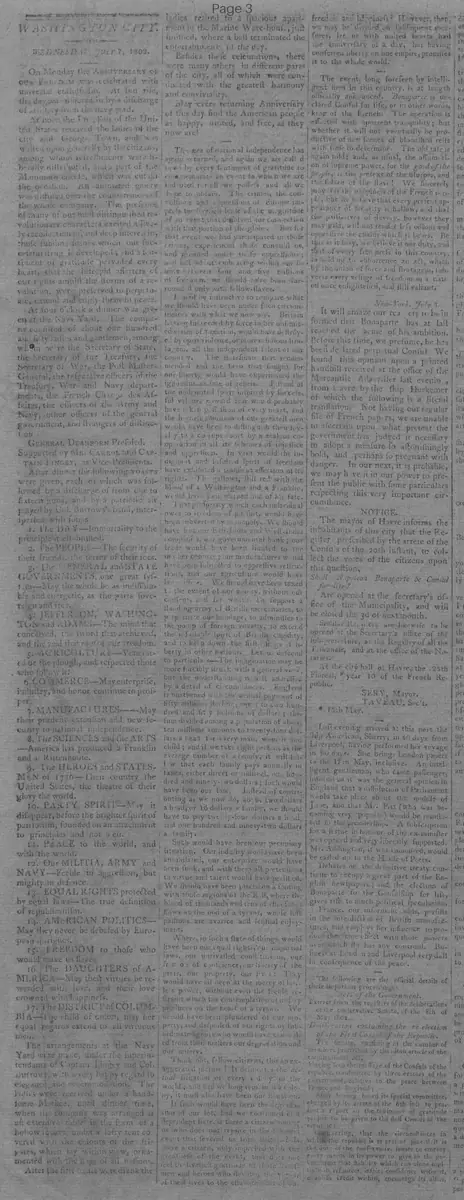
WEDNESDAY JULY 7, 1802.
On Monday the ANNIVERSARY of our INDEPENDENCE was celebrated with universal rejoicings. At sunrise, the day was ushered in by a discharge of artillery from the navy yard.
At noon the President of the United States received the salutes of the city and George Town, and was waited upon generally by the citizens, among whom refreshments were liberally distributed, as a part of the Mammoth cheese, which was cut on the occasion. An animated glee was diffused over the countenances of the whole company. The presence of many of our most distinguished revolutionary characters excited a lively recollection of, and deep interest in, those sublime scenes which our forefathers had developed; and a sentiment of gratitude pervaded every heart, that the intrepid assertors of our rights amidst the storms of a revolution, were preserved to participate, extend and enjoy them in peace.
At four o'clock a dinner was given at the navy yard. The company consisted of about one hundred and fifty ladies and gentlemen, among whom were the Secretary of State, the Secretary of the Treasury, the Secretary of War, the Post Master-General, the respective officers of the Treasury, War and Navy departments, the French Chargé des Affaires, the officers of the Army and Navy, other officers of the general government, and strangers of distinction.
General Dearborn Presided. Supported by MR. CARROLL and CAPTAIN LINGEY, as Vice Presidents.
After dinner the following Toasts were given, each of which was followed by a discharge from one to sixteen guns, and by a patriotic air played by Col. Burrowes's band, interspersed with songs.
1. The DAY—Immortality to the principles it established.
2. The PEOPLE.—The security of their friends, the terror of their foes.
3. The FEDERAL and STATE GOVERNMENTS, one great system—May the whole be as indissoluble and energetic, as the parts are sovereign and free.
4. JEFFERSON, WASHINGTON and ADAMS—The mind that conceived, the sword that achieved, and the zeal that roused our freedom.
5. AGRICULTURE—Venerated be the plough, and respected those who follow it.
6. COMMERCE—May enterprise, industry, and honor continue to prosper.
7. MANUFACTURES—May their prudent extension add security to national independence.
8. The SCIENCES and the ARTS—America has produced a Franklin and a Rittenhouse.
9. The HEROES and STATESMEN of 1776—Their country the United States, the theatre of their glory the world.
10. PARTY SPIRIT—May it disappear, before the brighter spirit of patriotism, founded on an attachment to principles and not to men.
11. PEACE to the world, and with the world,
12. Our MILITIA, ARMY and NAVY—Feeble in aggression, but mighty in defence.
13. EQUAL RIGHTS protected by equal laws—The true definition of republicanism.
14. AMERICAN POLITICS—May they never be debased by European intrigues.
15. FREEDOM to those who would make us slaves.
16. The DAUGHTERS OF AMERICA—May their virtues be rewarded with love, and their love crowned with happiness.
17. The DISTRICT OF COLUMBIA—the child of union, may her equal regards extend to all virtuous men.
The arrangements at the Navy Yard were made, under the superintendence of Captain Lingey and Col. Burrowes, with every laudable regard to elegance and accommodation. The ladies were received under a handsome marquee, until dinner time, when the company was arranged at an extensive table in the form of a hollow square under a lofty tent covered with the colours of the United States, which lay within view, ornamented with the flags of all nations.
After the first toasts were drank the ladies retired to a spacious apartment in the Marine Ware-house, just finished, where a ball terminated the entertainments of the day.
Besides these celebrations, there were many others in different parts of the city, all of which were concluded with the greatest harmony and conviviality.
May every returning Anniversary of this day find the American people as happy, united, and free, as they now are!
The era of national independence has again returned, and again we are called upon by every sentiment of gratitude to commemorate an event to which we are indebted for all we possess, and all we hope to obtain. The crimes, the convulsive and oppressions of Europe impress us with a livelier sense of the magnitude of an event that dissolved our connection with that portion of the globe. But for that event we had participated in those crimes, experienced those convulsions, and groaned under those oppressions; and instead of embracing within our limits between four and five millions of freemen, we should have been surrounded only with fellow-slaves.
It will be instructive to compare what we should have been under foreign circumstances with what we now are. Britain having succeeded by force in her unlimited claim of taxation, would have destroyed, by open violence, or more perfidious stratagem, all the independent talent of our country. The statesman that recommended and the hero that fought for our liberty would have experienced the ignominious fate of rebels. Instead of the bold, animated spirit inspired by successful valor, coward fear would probably have taken possession of every heart, and the highest ambition of our greatest men would have been to distinguish themselves loyally to a corrupt court by a zealous co-operation in all its schemes of injustice and oppression. In vain would the indignant and insulted spirit of freedom have exhibited a transient assertion of its rights. The gallows, still red with the blood of a Washington and a Franklin, would have soon warned him of his fate.
That prosperity which each individual owes to freedom of pursuit, would have been subverted by monopoly. We should have bid our East-India and West-India companies, a governmental bank; our trade would have been limited to the mother country; our manufactures would have been subjected to oppressive restrictions, and our agriculture would have languished. We should have been taxed to the extent of our ability, without our consent, and for what: To support a standing army of British mercenaries, to rivet more securely our bondage, to administer to the pomp of foreign royalty, to extend the waste-table spirits of British cupidity, and to keep down the first sighs of liberty in other nations. Let us descend to particulars—The imagination may be more forcibly struck with a general view, but the understanding is only satisfied by a detail of circumstances. England is burdened with the annual payment of fifty millions sterling, equal to two hundred and fifty millions of dollars; this sum divided among a population of about ten millions amounts to twenty-four dollars a head for every man, woman and child; and if we take eight persons as the average number of a family, it will follow that each family pays annually in taxes, either direct or indirect, one hundred and ninety-two dollars; such would have been our fate. Instead of contributing as we now do, about two dollars a head, or sixteen dollars a family, we should have to pay twenty-four dollars a head, and one hundred and ninety-two dollars a family.
Such would have been our pecuniary situation. Our industry would have been annihilated, our enterprise would have been sunk, and with them all pretensions to virtue and talent would have perished. We should have been placed on a footing with those regions of the East, where the blood of thousands and tens of thousands flows at the nod of a tyrant, whose sole passions are avarice and sensual enjoyment.
Where, in such a state of things, would have been our equal rights, our impartial laws, our unrivalled constitution, our freedom of conscience, our liberty of the press, our property, our lives: They would have all been at the mercy of last's power, without even the safe restraint which the contemplation of a sky produces on the heart of a tyrant. We should have been plundered of our property, and despoiled of our rights by subordinate agents who would have escaped from their masters our degradation and our misery.
Think not, fellow citizens, this an exaggerated picture! It delineates the actual situation of every colony in the world; and had we long remained as one, it must also have been our situation. If such would have been the degradation of our lot, had we continued in a dependent state, is there a citizen among us who does not rejoice in the fortunate event that severed us from Britain? Is there a citizen, duly impressed with the greatest of the event, that does not feel the liveliest gratitude to those wise men and heroes who devoted the years of their lives to the establishment of our freedom and happiness? However, then we may be divided on subsequent measures, let us with united hearts hail the anniversary of a day, that having conferred liberty on one empire, promises it to the whole world.
What sub-type of article is it?
What keywords are associated?
What entities or persons were involved?
Where did it happen?
Domestic News Details
Primary Location
Washington City
Event Date
Monday The Anniversary Of Our Independence
Key Persons
Outcome
the celebrations concluded with the greatest harmony and conviviality.
Event Details
The anniversary was celebrated with artillery salutes at sunrise, presidential receptions with distribution of Mammoth cheese, a dinner at the navy yard for 150 guests including government officials, toasts followed by guns and music, and a ball. Additional celebrations occurred in other parts of the city.