Thank you for visiting SNEWPapers!
Sign up free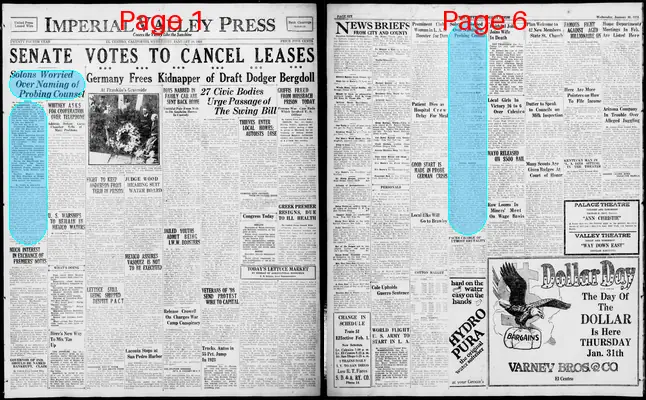
Imperial Valley Press
El Centro, Imperial County, California
What is this article about?
The U.S. Senate voted 46-38 to repudiate naval oil reserve leases in the Teapot Dome scandal, declaring them fraudulent. Dissension emerged between Congress and President Coolidge over appointing special counsel without Senate confirmation, Secretary Denby's stance, and toning down resolutions. Key figures include Senators Lenroot and Walsh, and counsel Gregory and Strawn.
Merged-components note: This is a continuation of the story from page 1 to page 6, as indicated by the '(Continued on page 6)' and 'Continued from page 1' text.
Clippings
1 of 2
OCR Quality
Full Text
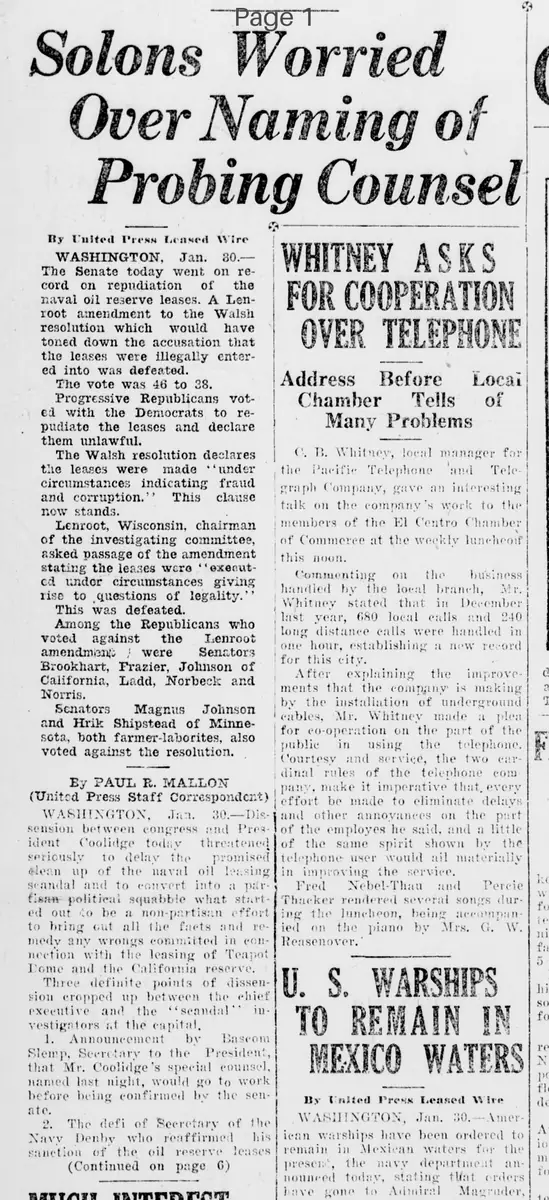
By United Press Leased Wire
WASHINGTON, Jan. 30.-
The Senate today went on record on repudiation of the naval oil reserve leases. A Lenroot amendment to the Walsh resolution which would have toned down the accusation that the leases were illegally entered into was defeated.
The vote was 46 to 38.
Progressive Republicans voted with the Democrats to repudiate the leases and declare them unlawful.
The Walsh resolution declares the leases were made 'under circumstances indicating fraud and corruption.'
This clause now stands.
Lenroot, Wisconsin, chairman of the investigating committee, asked passage of the amendment stating the leases were 'executed under circumstances giving rise to questions of legality.'
This was defeated.
Among the Republicans who voted against the Lenroot amendment were Senators Brookhart, Frazier, Johnson of California, Ladd, Norbeck and Norris.
Senators Magnus Johnson and Henrik Shipstead of Minnesota, both farmer-laborites, also voted against the resolution.
By PAUL R. MALLON
(United Press Staff Correspondent)
WASHINGTON, Jan. 30.-Dissension between congress and President Coolidge today threatened seriously to delay the promised clean up of the naval oil leasing scandal and to convert into a partisan political squabble what started out to be a non-partisan effort to bring out all the facts and remedy any wrongs committed in connection with the leasing of Teapot Dome and the California reserve.
Three definite points of dissension cropped up between the chief executive and the "scandal" investigators at the capital.
1. Announcement by Bascom Slemp, Secretary to the President, that Mr. Coolidge's special counsel, named last night, would go to work before being confirmed by the senate.
2. The defiance of Secretary of the Navy Denby who reaffirmed his sanction of the oil reserve leases
(Continued on page 6)
Solons Worried Over Naming of Probing Counsel
Continued from page 1
and made light of the threat of congress to impeach him.
3. Efforts of administration leaders under personal direction of President Coolidge to "tone down" the Walsh resolution calling upon the president to appoint prosecutors.
Mr. Coolidge's selection of special counsel to prosecute the leasing cases, both civilly and criminally, if evidence warrants, occasioned much surprise.
He chose Thomas Watt Gregory, Democrat, of Texas, attorney general in the Wilson administration, and Silas H. Strawn, Republican, of Chicago.
The senate resolution providing for employment of special counsel calls for their confirmation by the senate.
Strawn Unknown in East
Strawn, unknown here, is a law partner of John Barton Payne, a close friend of the late President Harding. He is described as "one of the best known lawyers of the middle west."
Gregory was a special assistant attorney general in anti-trust cases before Mr. Wilson named him attorney general.
Mr. Coolidge wants Strawn, and Gregory to go to work at once on the leasing cases. They will meet here this week.
The house resolution calling for appropriation of $100,000 was taken up today by the senate appropriations committee.
Physicians who have been attending former Secretary of the Interior Fall told the senate investigation committee today under oath that Fall was suffering from nervous exhaustion. The members of the committee questioned the physicians fully concerning Fall's illness.
The physicians again suggested that a sub-committee go to home of J. W. Zevely, Sinclair attorney, where Fall is staying, and examine him there.
Denby Appears
E. L. Doheny appeared unexpectedly at the senate office building shortly before noon today and asked permission to be heard by the naval oil' lease investigating committee.
While Doheny declined to give the reason for his appearance, it was understood he intends to present Fall's note for the $100,000 loan he made the former secretary.
Secretary Denby approved, a policy of using royalties from the Teapot Dome and Elk Hills oil reserves for a program of building naval oil bases to cost $50,000,000.
This was revealed today before the house naval affairs committee which plunged into an investigation of the legality of the navy converting the oil royalties for a building program instead of turning the money into the treasury.
Rear Admiral J. I. Lattimer, judge advocate of the navy said Denby approved a legal opinion prepared by him, under which the oil company owned by Edward L. Doheny, California oil magnate, has built oil storage tanks at Pearl Harbor, Hawaii. The tanks and harbor improvements are being paid for the navy by exchanging royalty crude oil.
What sub-type of article is it?
What keywords are associated?
What entities or persons were involved?
Where did it happen?
Domestic News Details
Primary Location
Washington
Event Date
Jan. 30
Key Persons
Outcome
lenroot amendment defeated 46-38; walsh resolution declaring leases fraudulent stands; dissension over counsel confirmation and denby's stance; $100,000 appropriation considered; fall reported with nervous exhaustion; doheny seeks to present loan note; denby approved use of royalties for naval bases.
Event Details
The Senate repudiated naval oil reserve leases via Walsh resolution, defeating Lenroot's milder amendment. President Coolidge appointed Gregory and Strawn as special counsel without Senate confirmation, causing dissension. Secretary Denby defended leases and impeachment threats. Investigations continued into Fall's health, Doheny's loan, and royalty uses for naval projects.