Thank you for visiting SNEWPapers!
Sign up free
Delaware Journal
Wilmington, New Castle County, Delaware
What is this article about?
In a House debate, Mr. Stewart of Pennsylvania opposes Mr. P. P. Barbour's motion to sell U.S. Bank Stock to accelerate national debt extinguishment, arguing for reducing the sinking fund to $7 million annually to fund internal improvements while protecting domestic manufactures through duties.
Merged-components note: Continuation of congressional debate on public debt and sinking fund
Clippings
1 of 2
OCR Quality
Full Text
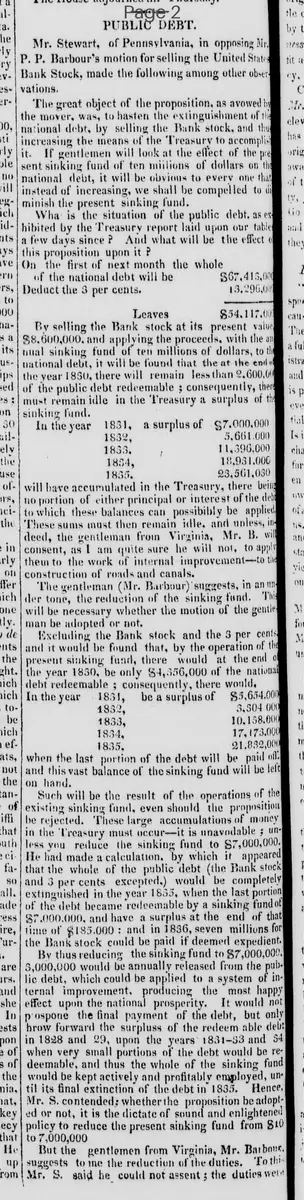
Mr. Stewart, of Pennsylvania, in opposing Mr. P. P. Barbour's motion for selling the United States Bank Stock, made the following among other observations.
The great object of the proposition, as avowed by the mover, was, to hasten the extinguishment of the national debt, by selling the Bank stock, and thus increasing the means of the Treasury to accomplish it. If gentlemen will look at the effect of the present sinking fund of ten millions of dollars on the national debt, it will be obvious to every one that instead of increasing, we shall be compelled to diminish the present sinking fund.
What is the situation of the public debt. as exhibited by the Treasury report laid upon our table a few days since ? And what will be the effect of this proposition upon it ?
On the first of next month the whole of the national debt will be $367,413,000 Deduct the 3 per cents. $13,296,000 Leaves $54,117,000
By selling the Bank stock at its present value $8,600,000, and applying the proceeds, with the annual sinking fund of ten millions of dollars, to the national debt, it will be found that at the end of the year 1830, there will remain less than $2,600,000 of the public debt redeemable ; consequently, there must remain idle in the Treasury a surplus of the sinking fund.
In the year 1831, a surplus of $7,000,000 1832, 5,661,000 1833, 11,396,000 1834, 18,931,000 1835. 23,561,000 will have accumulated in the Treasury, there being no portion of either principal or interest of the debt to which these balances can possibly be applied These sums must then remain idle, and unless, indeed, the gentleman from Virginia, Mr. B. will consent, as I am quite sure he will not, to apply them to the work of internal improvement-to the construction of roads and canals.
The gentleman (Mr. Barbour) suggests, in an under tone, the reduction of the sinking fund. This will be necessary whether the motion of the gentleman be adopted or not.
Excluding the Bank stock and the 3 per cents and it would be found that, by the operation of the present sinking fund, there would at the end of the year 1830, be only $4,356,000 of the national debt redeemable ; consequently, there would,
In the year 1831, be a surplus of $5,654,000 1832, 3,304,000 1833, 10,138,000 1834, 17,173,000 1835, 21,832,000 when the last portion of the debt will be paid off. and this vast balance of the sinking fund will be left on hand.
Such will be the result of the operations of the existing sinking fund, even should the proposition be rejected. These large accumulations of money in the Treasury must occur-it is unavoidable ; unless you reduce the sinking fund to $7,000,000.
He had made a calculation. by which it appeared that the whole of the public debt (the Bank stock and 3 per cents excepted.) would be completely extinguished in the year 1835, when the last portion of the debt became redeemable by a sinking fund of $7,000,000, and have a surplus at the end of that time of $185,000 : and in 1836, seven millions for the Bank stock could be paid if deemed expedient.
By thus reducing the sinking fund to $7,000,000. $3,000,000 would be annually released from the public debt, which could be applied to a system of internal improvement, producing the most happy effect upon the national prosperity. It would not postpone the final payment of the debt, but only throw forward the surplus of the redeemable debt in 1828 and 29, upon the years 1831-33 and 34 when very small portions of the debt would be redeemable, and thus the whole of the sinking fund would be kept actively and profitably employed, until its final extinction of the debt in 1835. Hence, Mr. S. contended: whether the proposition be adopted or not, it is the dictate of sound and enlightened policy to reduce the present sinking fund from $10 to 7,000,000
But the gentleman from Virginia, Mr. Barbour. suggests to me the reduction of the duties. To this Mr. S. said he could not assent ; the duties were
Imposed for protection, and not for revenue; they were imposed to protect our national industry, to protect domestic manufactures from the ruinous effects of foreign competition. He could not, therefore, consent to their repeal. He would collect the revenue for one important object, the protection of our manufactures, and send it back to the people who paid, for another equally important object, the improvement of their country.
By adopting this policy, you will prevent measurably the exhausting and injurious effects of withdrawing annually from the pockets of the people ten millions of dollars, and putting it beyond their reach; by this means three millions of it will be returned to its ordinary channels of circulation, promoting, at the same time, the most important national purposes—the permanent improvement of the internal condition of our common country.
There were many other strong considerations in favor of the adoption of this measure, which it was unnecessary, at this time, to urge upon the attention of the House. Enough had been said, he trusted, to show that there was no propriety in adopting this measure to accelerate the extinguishment of the national debt, the great and principal object of the motion.
What sub-type of article is it?
What keywords are associated?
What entities or persons were involved?
Domestic News Details
Key Persons
Event Details
Mr. Stewart opposes Mr. P. P. Barbour's motion to sell United States Bank Stock to hasten national debt extinguishment, arguing that the current $10 million sinking fund will lead to surpluses by 1830, necessitating reduction to $7 million to fund internal improvements like roads and canals while maintaining protective duties for domestic manufactures.