Thank you for visiting SNEWPapers!
Sign up free
Story
July 12, 1862
The Burlington Weekly Hawk Eye
Burlington, Des Moines County, Iowa
What is this article about?
An anonymous Union army officer, formerly a Democrat opposed to abolition, writes in June 1862 of his conversion to abolitionism after witnessing Southern atrocities and the corrupting influence of slavery during the Civil War.
Clipping
OCR Quality
98%
Excellent
Full Text
Army Officer on Abolition
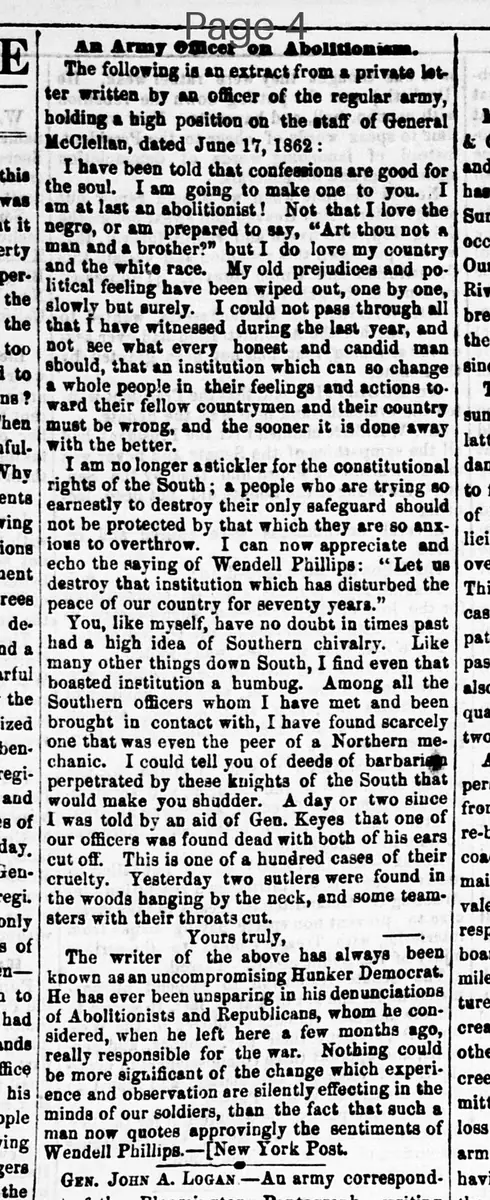
The following is an extract from a private letter written by an officer of the regular army, holding a high position on the staff of General McClellan, dated June 17, 1862:
I have been told that confessions are good for the soul. I am going to make one to you. I am at last an abolitionist! Not that I love the negro, or am prepared to say, "Art thou not a man and a brother?" but I do love my country and the white race. My old prejudices and political feeling have been wiped out, one by one, slowly but surely. I could not pass through all that I have witnessed during the last year, and not see what every honest and candid man should, that an institution which can so change a whole people in their feelings and actions toward their fellow countrymen and their country must be wrong, and the sooner it is done away with the better.
I am no longer a stickler for the constitutional rights of the South; a people who are trying so earnestly to destroy their only safeguard should not be protected by that which they are so anxious to overthrow. I can now appreciate and echo the saying of Wendell Phillips: "Let us destroy that institution which has disturbed the peace of our country for seventy years."
You, like myself, have no doubt in times past had a high idea of Southern chivalry. Like many other things down South, I find even that boasted institution a humbug. Among all the Southern officers whom I have met and been brought in contact with, I have found scarcely one that was even the peer of a Northern mechanic. I could tell you of deeds of barbarity perpetrated by these knights of the South that would make you shudder. A day or two since I was told by an aid of Gen. Keyes that one of our officers was found dead with both of his ears cut off. This is one of a hundred cases of their cruelty. Yesterday two sutlers were found in the woods hanging by the neck, and some teamsters with their throats cut.
Yours truly,
The writer of the above has always been known as an uncompromising Hunker Democrat. He has ever been unsparing in his denunciations of Abolitionists and Republicans, whom he considered, when he left here a few months ago, really responsible for the war. Nothing could be more significant of the change which experience and observation are silently effecting in the minds of our soldiers, than the fact that such a man now quotes approvingly the sentiments of Wendell Phillips.—[New York Post.
The following is an extract from a private letter written by an officer of the regular army, holding a high position on the staff of General McClellan, dated June 17, 1862:
I have been told that confessions are good for the soul. I am going to make one to you. I am at last an abolitionist! Not that I love the negro, or am prepared to say, "Art thou not a man and a brother?" but I do love my country and the white race. My old prejudices and political feeling have been wiped out, one by one, slowly but surely. I could not pass through all that I have witnessed during the last year, and not see what every honest and candid man should, that an institution which can so change a whole people in their feelings and actions toward their fellow countrymen and their country must be wrong, and the sooner it is done away with the better.
I am no longer a stickler for the constitutional rights of the South; a people who are trying so earnestly to destroy their only safeguard should not be protected by that which they are so anxious to overthrow. I can now appreciate and echo the saying of Wendell Phillips: "Let us destroy that institution which has disturbed the peace of our country for seventy years."
You, like myself, have no doubt in times past had a high idea of Southern chivalry. Like many other things down South, I find even that boasted institution a humbug. Among all the Southern officers whom I have met and been brought in contact with, I have found scarcely one that was even the peer of a Northern mechanic. I could tell you of deeds of barbarity perpetrated by these knights of the South that would make you shudder. A day or two since I was told by an aid of Gen. Keyes that one of our officers was found dead with both of his ears cut off. This is one of a hundred cases of their cruelty. Yesterday two sutlers were found in the woods hanging by the neck, and some teamsters with their throats cut.
Yours truly,
The writer of the above has always been known as an uncompromising Hunker Democrat. He has ever been unsparing in his denunciations of Abolitionists and Republicans, whom he considered, when he left here a few months ago, really responsible for the war. Nothing could be more significant of the change which experience and observation are silently effecting in the minds of our soldiers, than the fact that such a man now quotes approvingly the sentiments of Wendell Phillips.—[New York Post.
What sub-type of article is it?
Biography
Personal Triumph
Historical Event
What themes does it cover?
Moral Virtue
Fortune Reversal
Justice
What keywords are associated?
Abolitionist Conversion
Civil War Officer
Southern Atrocities
Slavery Critique
Union Soldier Views
What entities or persons were involved?
General Mcclellan
Wendell Phillips
Gen. Keyes
Story Details
Key Persons
General Mcclellan
Wendell Phillips
Gen. Keyes
Event Date
June 17, 1862
Story Details
A Union army officer confesses his conversion to abolitionism, renouncing past prejudices against it due to observations of slavery's corrupting effects and Southern barbarities during the Civil War, quoting Wendell Phillips approvingly.