Thank you for visiting SNEWPapers!
Sign up free
Concord Register
Concord, Merrimack County, New Hampshire
What is this article about?
Introduction to John Milton's 'Defensio Secunda,' a Latin defense written after his blindness, translated by Wrangham. Milton refutes claims that his blindness is divine judgment for republican views, describes his appearance and strength, cites historical blind figures, affirms his writings were dutiful, and accepts his fate with fortitude, preferring intellectual sight over physical.
Merged-components note: Continuation of John Milton's letter across components on the same page.
Clipping
OCR Quality
Full Text
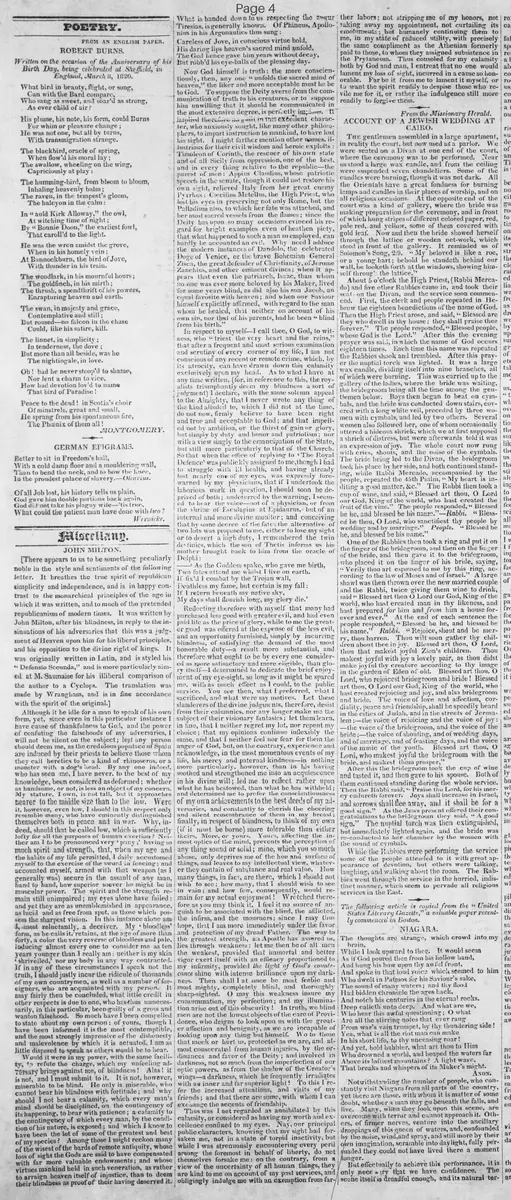
JOHN MILTON.
[There appears to us to be something peculiarly noble in the style and sentiments of the following letter. It breathes the true spirit of republican simplicity and independence, and is in happy contrast to the monarchical principles of the age in which it was written, and to much of the pretended republicanism of modern times. It was written by John Milton, after his blindness, in reply to the insinuations of his adversaries that this was a judgment of Heaven upon him for his liberal principles and his opposition to the divine right of kings. It was originally written in Latin, and is styled his "Defensio Secunda," and is more particularly aimed at M. Saumaise for his illiberal comparison of the author to a Cyclops. The translation was made by Wrangham, and is in fine accordance with the spirit of the original.]
Although it be idle for a man to speak of his own form, yet, since even in this particular instance I have cause of thankfulness to God, and the power of confuting the falsehoods of my adversaries, I will not be silent on the subject; lest any person should deem me, as the credulous populace of Spain are induced by their priests to believe those whom they call heretics to be a kind of rhinoceros, or a monster with a dog's head. By any one indeed who has seen me, I have never, to the best of my knowledge, been considered as deformed: whether as handsome, or not, is less an object of my concern. My stature, I own, is not tall, but it approaches nearer to the middle size than to the low. Were it, however, even low, I should in this respect only resemble many, who have eminently distinguished themselves both in peace and in war. Why, indeed, should that be called low, which is sufficiently lofty for all the purposes of human exertion? Neither am I to be pronounced very 'puny;' having so much spirit and strength, that, when my age and the habits of my life permitted, I daily accustomed myself to the exercise of the sword in fencing; and accounted myself, armed with that weapon (as I generally was) secure in the assault of any man, hand to hand, how superior soever he might be in muscular power. The spirit and the strength remain still unimpaired; my eyes alone have failed: and yet they are as unblemished in appearance, as lucid and as free from spot, as those which possess the sharpest vision. In this instance alone am I, most reluctantly, a deceiver. My bloodless form, as he calls it, retains, at the age of more than forty, a color the very reverse of bloodless and pale, inducing almost every one to consider me as ten years younger than I really am: neither is my skin shrivelled, nor my body in any way contracted. If in any of these circumstances I speak not the truth, I should justly incur the ridicule of thousands of my own countrymen, as well as a number of foreigners, who are acquainted with my person. It may fairly then be concluded, what little credit in other respects is due to one, who has thus unnecessarily, in this particular, been guilty of a gross and wanton falsehood. So much have I been compelled to state about my own person: of yours, though I have been informed it is the most contemptible, and the most strongly impressive of the dishonesty and malevolence by which it is actuated, I am as little disposed to speak as others would be to hear. Would it were in my power, with the same facility, to refute the charge, which my unfeeling adversary brings against me, of blindness! Alas! it is not, and I must submit to it. It is not, however, miserable to be blind. He only is miserable, who cannot bear his blindness with fortitude; and why should I not bear a calamity, which every man's mind should be disciplined, on the contingency of its happening, to bear with patience; a calamity to the contingency of which every man, by the condition of his nature, is exposed; and which I know to have been the lot of some of the greatest and best of my species? Among those I might reckon many of the wisest of the bards of remote antiquity, whose loss of sight the Gods are said to have compensated with far more valuable endowments; and whose virtues mankind held in such veneration, as rather to arraign heaven itself of injustice, than to deem their blindness as proof of their having deserved it.
What is handed down to us respecting the seer Tiresias, is generally known. Of Phineus, Apollonius in his Argonautics thus sung:
Careless of Jove, in conscious virtue bold.
His daring lips heaven's sacred mind unfold,
The God hence gave him years without decay,
But robb'd his eye-balls of the pleasing day.
Now God himself is truth: the more conscientiously, then, any one "unfolds the sacred mind of heaven," the liker and more acceptable must he be to God. To suppose the Deity averse from the communication of truth to his creatures, or to suppose him unwilling that it should be communicated in the most extensive degree, is perfectly impious. It implied therefore no gain in this excellent character, who anxiously sought, like many other philosophers, to impart instruction to mankind, to have lost his sight. I might further mention other names, illustrious for their civil wisdom and heroic exploits: Timoleon of Corinth, the rescuer of his own state and of all Sicily from oppression, one of the best and in every thing relative to the republic—the purest of men: Appius Claudius, whose patriotic speech in the senate, though it could not restore his own sight, relieved Italy from her great enemy Pyrrhus: Caecilius Metellus, the High Priest, who lost his eyes in preserving not only Rome, but the Palladium also, to which her fate was attached, and her most sacred vessels from the flames; since the Deity has upon so many occasions evinced his regard for bright examples even of heathen piety, that what happened to such a man so employed, can hardly be accounted an evil. Why need I adduce the modern instances of Dandolo, the celebrated Doge of Venice, or the brave Bohemian General Zisca, the great defender of Christianity, of Jerome Zanchius, and other eminent divines; when it appears that even the patriarch, Isaac, than whom no one was ever more beloved by his Maker, lived for some years blind, as did also his son Jacob, an equal favorite with heaven; and when our Saviour himself explicitly affirmed, with regard to the man whom he healed, that neither on account of his own sin, nor that of his parents, had he been "blind from his birth."
In respect to myself I call thee, O God, to witness, who "triest the very heart and the reins," that after a frequent and most serious examination and scrutiny of every corner of my life, I am not conscious of any recent or remote crime, which, by its atrocity, can have drawn down this calamity exclusively upon my head. As to what I have at any time written, (for, in reference to this, the royalists triumphantly deem my blindness a sort of judgment) I declare, with the same solemn appeal to the Almighty, that I never wrote any thing of the kind alluded to, which I did not at the time, do not now, firmly believe to have been right and true and acceptable to God; and that impelled not by ambition, or the thirst of gain or glory, but simply by duty and honor and patriotism; nor with a view singly to the emancipation of the State, but still more particularly to that of the Church. So that when the office of replying to The Royal Defence' was publicly assigned to me, though I had to struggle with ill health, and having already lost nearly one of my eyes, was expressly forewarned by my physicians, that if I undertook the laborious work in question, I should soon be deprived of both: undeterred by the warning, I seemed to hear the voice—not of a physician, or from the shrine of Esculapius at Epidaurus,—but of an internal and more divine monitor; and conceiving that by some decree of the fates the alternative of two lots was proposed to me, either to lose my sight or to desert a high duty, I remembered the twin destinies, which the son of Thetis informs us his mother brought back to him from the oracle of Delphi:
As the Goddess spake, who gave me birth
Two fates attend me whilst I live on earth.
If fix'd I combat by the Trojan wall,
Deathless my fame, but certain is my fall:
If I return beneath my native sky.
My days shall flourish long, my glory die.'
Reflecting therefore with myself that many had purchased less good with greater evil, and had even paid life as the price of glory, while to me the greater good was offered at the expense of the less evil, and an opportunity furnished, simply by incurring blindness, of satisfying the demand of the most honorable duty—a result more substantial, and therefore what ought to be by every one considered as more satisfactory and more eligible, than glory itself—I determined to dedicate the brief enjoyment of my eye-sight, so long as it might be spared me, with as much effect as I could, to the public service. You see then, what I preferred, what I sacrificed, and what were my motives. Let these slanderers of the divine judgments, therefore, desist from their calumnies, nor any longer make me the subject of their visionary fantasies; let them learn, in fine, that I neither regret my lot, nor repent my choice; that my opinions continue inflexibly the same, and that I neither feel nor fear for them the anger of God, but, on the contrary, experience and acknowledge, in the most momentous events of my life, his mercy and paternal kindness—in nothing more particularly, however, than in his having soothed and strengthened me into an acquiescence in his divine will; led me to reflect rather upon what he has bestowed, than what he has withheld: and determined me to prefer the conscientiousness of my own achievements to the best deeds of my adversaries, and constantly to cherish the cheering and silent remembrance of them in my breast; finally, in respect of blindness, to think of my own (if it must be borne) more tolerable than either theirs, More, or yours. Yours, affecting the inmost optics of the mind, prevents the perception of any thing sound or solid; mine, which you so much abuse, only deprives me of the hue and surface of things, and leaves to my intellectual view, whatever they contain of substance and real value. How many things, in fact, are there, which I should not wish to see; how many, that I should wish to see in vain; and how few, consequently, would remain for my actual enjoyment! Wretched therefore as you may think it, I feel it no source of anguish to be associated with the blind, the afflicted, the infirm, and the mourners; since I may thus hope, that I am more immediately under the favor and protection of my dread Father. The way to the greatest strength, an Apostle has assured us, lies through weakness: let me then be of all men the weakest, provided that immortal and better vigor exert itself with an efficacy proportioned to my infirmity, provided the light of God's countenance shine with intense brilliance upon my darkness. Then shall I at once be most feeble and most mighty, completely blind, and thoroughly sharp-sighted. O may this weakness insure my consummation, my perfection; and my illumination arise out of this obscurity! In truth, we blind men are not the lowest objects of the care of Providence, who deigns to look upon us with the greater affection and benignity, as we are incapable of looking upon any thing but himself. Wo to those that mock or hurt us, protected as we are, and almost consecrated from human injuries, by the ordinances and favor of the Deity; and involved in darkness, not so much from the imperfection of our optic powers, as from the shadow of the Creator's wings—a darkness, which he frequently irradiates with an inner and far superior light! To this I refer the increased attentions, and visits of my friends; and that there are some, with whom I can exchange the accents of friendship. Thus was I not regarded as annihilated by this calamity, or considered as having my worth and excellence confined to my eyes. Nay, our principal public characters, knowing that my sight had forsaken me, not in a state of torpid inactivity, but while I was strenuously encountering every peril among the foremost in behalf of liberty, do not themselves forsake me: on the contrary, from a view of the uncertainty of all human things, they are kind to me on account of my past services, and obligingly indulge me with an exemption from farther labors; not stripping me of my honors, not taking away my appointment, not curtailing its emoluments; but humanely continuing them to me, in my state of reduced utility, with precisely the same compliment as the Athenian formerly paid to those, to whom they assigned subsistence in the Prytaneum. Thus consoled for my calamity both by God and man, I entreat that no one would lament my loss of sight, incurred in a cause so honorable. Far be it from me to lament it myself, or to want the spirit readily to despise those who revile me for it, or rather the indulgence still more readily to forgive them.
What sub-type of article is it?
What themes does it cover?
What keywords are associated?
What entities or persons were involved?
Literary Details
Title
Defensio Secunda
Author
John Milton, Translated By Wrangham
Subject
Reply To Adversaries Claiming Blindness As Divine Judgment For Opposition To Divine Right Of Kings, Aimed At M. Saumaise
Form / Style
Prose Defense In Letter Form
Key Lines