Thank you for visiting SNEWPapers!
Sign up free
Literary Cadet, And Saturday Evening Bulletin
Providence, Providence County, Rhode Island
What is this article about?
Henry Clay delivers an eloquent address in Lewisburgh defending against political charges, discussing domestic industry protection, Ghent negotiations, Panama mission, and his appointment as Secretary of State.
Clipping
OCR Quality
Full Text
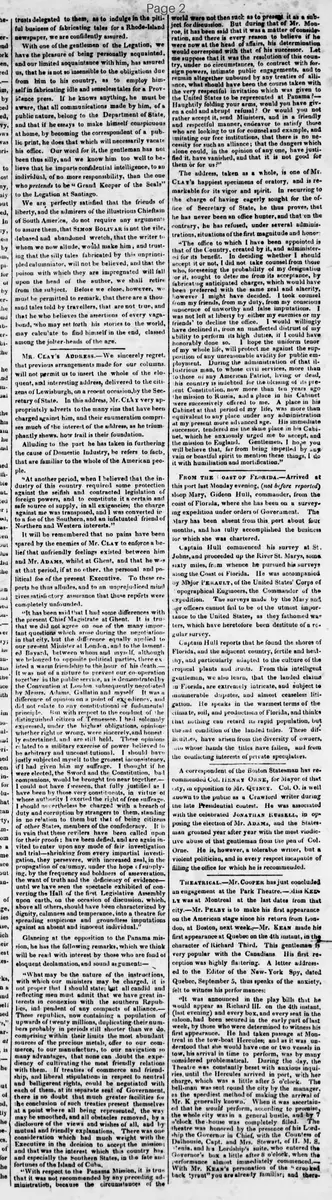
Alluding to the part he has taken in furthering the cause of Domestic Industry, he refers to facts, that are familiar to the whole of the American people.
"At another period, when I believed that the industry of this country required some protection against the selfish and contracted legislation of foreign powers, and to constitute it a certain and safe source of supply, in all exigencies; the charge against me was transposed, and I was converted into a foe of the Southern, and an infatuated friend of Northern and Western interests."
It will be remembered that no pains have been spared by the enemies of Mr. Clay to enforce a belief that unfriendly feelings existed between him and Mr. Adams, whilst at Ghent, and that he was at that period, if at no other, the personal and political foe of the present Executive. To these reports he thus alludes, and to an unprejudiced mind gives satisfactory assurance that these reports were completely unfounded.
"It has been said that I had some differences with the present Chief Magistrate at Ghent. It is true that we did not agree on one of the many important questions which arose during the negotiations in that city, but the difference equally applied to our present Minister at London, and to the lamented Bayard, between whom and myself, although we belonged to opposite political parties, there existed a warm friendship to the hour of his death.— It was not of a nature to prevent our co-operation together in the public service, as is demonstrated by the Convention at London subsequently negotiated by Messrs. Adams, Gallatin and myself. It was a difference of opinion on a point of expediency, and did not relate to any constitutional or fundamental principle. But with respect to the conduct of the distinguished citizen of Tennessee, I had solemnly expressed, under the highest obligations, opinions whether right or wrong, were sincerely, and honestly entertained, and are still held. These opinions related to a military exercise of power believed to be arbitrary and unconstitutional. I should have justly subjected myself to the grossest inconsistency, if I had given him my suffrage. I thought if he were elected, the Sword and the Constitution, bad companions, would be brought too near together.— I could not have foreseen, that fully justified as I have been by those very constituents, in virtue of whose authority I exerted the right of free suffrage I should nevertheless be charged with a breach of duty and corruption by strangers to them, standing in no relation to them but that of being citizens of other States, members of the confederacy. It is in vain that these revilers have been called upon for their proofs; have been defied, and are again invited to enter upon any mode of fair investigation and trial—shrinking from every impartial investigation, they persevere, with increased zeal, in the propagation of calumny, under the hope of supplying, by the frequency and boldness of asseveration, the want of truth and the deficiency of evidence— until we have seen the spectacle exhibited of converting the Hall of the first Legislative Assembly upon earth, on the occasion of discussion, which, above all others, should have been characterized by dignity, calmness and temperance, into a theatre for spreading suspicions and groundless imputations against an absent and innocent individual."
Glancing at the opposition to the Panama mission, he has the following remarks, which we think will be read with interest by those who are fond of eloquent declamation, and sound argument:—
"What may be the nature of the instructions, with which our ministers may be charged, it is not proper that I should state; but all candid and reflecting men must admit that we have great interests in connexion with the southern Republics, independent of any compacts of alliance.— Those republics, now containing a population of upwards of twenty millions, duplicating their numbers probably in periods still shorter than we do, comprising within their limits the most abundant sources of the precious metals, offer to our commerce, to our manufactures, to our navigation so many advantages, that none can doubt the expediency of cultivating the most friendly relations with them. If treaties of commerce and friendship, and liberal stipulations in respect to neutral and belligerent rights, could be negotiated with each of them, at its separate seat of Government, there is no doubt that much greater facilities for the conclusion of such treaties present themselves at a point where all being represented, the way may be smoothed, and all obstacles removed, by a disclosure of the views and wishes of all, and by mutual and friendly explanations. There was one consideration which had much weight with the Executive in the decision to accept the mission and that was the interest which this country has and especially the Southern States, in the fate and fortunes of the Island of Cuba,
"With respect to the Panama Mission, it is true that it was not recommended by any preceding administration, because the circumstances of the world were not then such as to present it as a subject of discussion. But during that of Mr. Monroe, it has been said that it was a matter of consideration, and there is every reason to believe if he were now at the head of affairs, his determination would correspond with that of his successor. Let me suppose that it was the resolution of this country, under no circumstances, to contract with foreign powers, intimate public engagements, and to remain altogether unbound by any treaties of alliance, what should have been the course taken with the very respectful invitation which was given to the United States to be represented at Panama?— Haughtily folding your arms, would you have given a cold and abrupt refusal? Or would you not rather accept it, send Ministers, and in a friendly and respectful manner, endeavor to satisfy those who are looking to us for counsel and example, and imitating our free institutions, that there is no necessity for such an alliance; that the dangers which alone could, in the opinion of any one, have justified it, have vanished, and that it is not good for them or for us?"
The address, taken as a whole, is one of Mr. Clay's happiest specimens of oratory, and is remarkable for its vigor and spirit. In recurring to the charge of having eagerly sought for the office of Secretary of State, he thus proves, that he has never been an office hunter, and that on the contrary, he has refused, under several administrations, situations of the first magnitude and honor:
"The office to which I have been appointed is that of the Country, created by it, and administered for its benefit. In deciding whether I should accept it or not, I did not take counsel from those who, foreseeing the probability of my designation for it, sought to deter me from its acceptance, by fabricating anticipated charges, which would have been preferred with the same zeal and alacrity, however I might have decided. I took counsel from my friends, from my duty, from my conscious innocence of unworthy and false imputations. I was not left at liberty by either my enemies or my friends' to decline the office. I would willingly have declined it, from an unaffected distrust of my ability to perform its high duties, if I could have honorably done so. I hope the uniform tenor of my whole life, will protect me against the supposition of any unreasonable avidity for public employment. During the administration of that illustrious man, to whose civil services, more than to those of any American Patriot, living or dead, this country is indebted for the blessing of its present Constitution, now more than ten years ago the mission to Russia, and a place in his Cabinet were successively offered to me. A place in his Cabinet at that period of my life, was more than equivalent to any place under any administration at my present more advanced age. His immediate successor, tendered me the same place in his Cabinet, which he anxiously urged me to accept, and the mission to England." Gentlemen, I hope you will believe that, far from being impelled by any vain or boastful spirit to mention these things, I do it with humiliation and mortification.
What sub-type of article is it?
What keywords are associated?
What entities or persons were involved?
Where did it happen?
Domestic News Details
Primary Location
Lewisburgh
Event Date
On A Recent Occasion
Key Persons
Outcome
mr. clay defends his reputation against political charges and affirms his integrity regarding appointments and past decisions.
Event Details
Mr. Clay delivers an address to citizens of Lewisburgh, addressing charges against him related to domestic industry protection, Ghent negotiations, opposition to the Panama mission, and his acceptance of the Secretary of State position, refuting calumnies and highlighting his past refusals of high offices.