Thank you for visiting SNEWPapers!
Sign up free
Story
February 24, 1876
The Cairo Bulletin
Cairo, Alexander County, Illinois
What is this article about?
Report on the thirteenth day of the Babcock trial in St. Louis, where Judge Porter delivered a closing defense argument, criticizing newspapers, defending President Grant, and eulogizing Babcock. Notes differences in evidence from prior Whiskey Ring cases and upcoming arguments.
Clipping
OCR Quality
98%
Excellent
Full Text
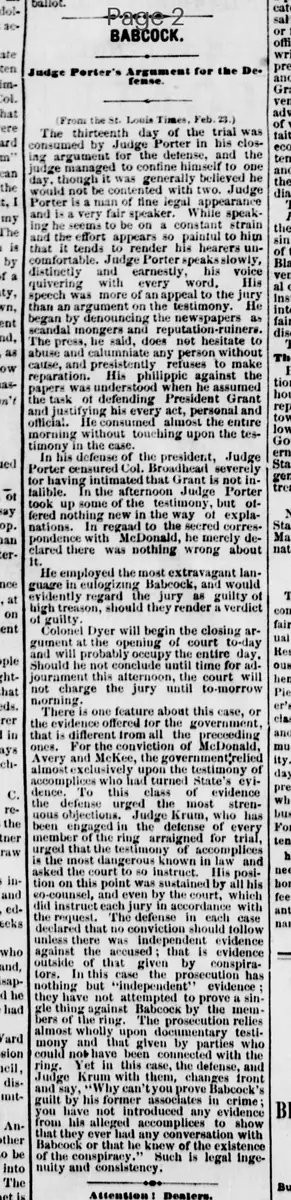
BABCOCK.
Judge Porter's Argument for the Defense.
(From the St. Louis Times, Feb. 23.)
The thirteenth day of the trial was consumed by Judge Porter in his closing argument for the defense, and the judge managed to confine himself to one day, though it was generally believed he would not be contented with two. Judge Porter is a man of fine legal appearance and is a very fair speaker. While speaking he seems to be on a constant strain and the effort appears so painful to him that it tends to render his hearers uncomfortable. Judge Porter speaks slowly, distinctly and earnestly, his voice quivering with every word.
His speech was more of an appeal to the jury than an argument on the testimony. He began by denouncing the newspapers as scandal mongers and reputation-ruiners. The press, he said, does not hesitate to abuse and calumniate any person without cause, and persistently refuses to make reparation. His philippic against the papers was understood when he assumed the task of defending President Grant and justifying his every act, personal and official. He consumed almost the entire morning without touching upon the testimony in the case.
In his defense of the president, Judge Porter censured Col. Broadhead severely for having intimated that Grant is not infallible. In the afternoon Judge Porter took up some of the testimony, but offered nothing new in the way of explanations. In regard to the secret correspondence with McDonald, he merely declared there was nothing wrong about it.
He employed the most extravagant language in eulogizing Babcock, and would evidently regard the jury as guilty of high treason, should they render a verdict of guilty.
Colonel Dyer will begin the closing argument at the opening of court to-day and will probably occupy the entire day. Should he not conclude until time for adjournment this afternoon, the court will not charge the jury until to-morrow morning.
There is one feature about this case, or the evidence offered for the government, that is different from all the preceding ones. For the conviction of McDonald, Avery and McKee, the government relied almost exclusively upon the testimony of accomplices who had turned State's evidence. To this class of evidence the defense urged the most strenuous objections. Judge Krum, who has been engaged in the defense of every member of the ring arraigned for trial, urged that the testimony of accomplices is the most dangerous known in law and asked the court to so instruct. His position on this point was sustained by all his co-counsel, and even by the court, which did instruct each jury in accordance with the request. The defense in each case declared that no conviction should follow unless there was independent evidence against the accused; that is evidence outside of that given by conspirators. In this case the prosecution has nothing but "independent" evidence; they have not attempted to prove a single thing against Babcock by the members of the ring. The prosecution relies almost wholly upon documentary testimony and that given by parties who could not have been connected with the ring. Yet in this case, the defense, and Judge Krum with them, changes front and say, "Why can't you prove Babcock's guilt by his former associates in crime; you have not introduced any evidence from his alleged accomplices to show that they ever had any conversation with Babcock or that he knew of the existence of the conspiracy." Such is legal ingenuity and consistency.
Judge Porter's Argument for the Defense.
(From the St. Louis Times, Feb. 23.)
The thirteenth day of the trial was consumed by Judge Porter in his closing argument for the defense, and the judge managed to confine himself to one day, though it was generally believed he would not be contented with two. Judge Porter is a man of fine legal appearance and is a very fair speaker. While speaking he seems to be on a constant strain and the effort appears so painful to him that it tends to render his hearers uncomfortable. Judge Porter speaks slowly, distinctly and earnestly, his voice quivering with every word.
His speech was more of an appeal to the jury than an argument on the testimony. He began by denouncing the newspapers as scandal mongers and reputation-ruiners. The press, he said, does not hesitate to abuse and calumniate any person without cause, and persistently refuses to make reparation. His philippic against the papers was understood when he assumed the task of defending President Grant and justifying his every act, personal and official. He consumed almost the entire morning without touching upon the testimony in the case.
In his defense of the president, Judge Porter censured Col. Broadhead severely for having intimated that Grant is not infallible. In the afternoon Judge Porter took up some of the testimony, but offered nothing new in the way of explanations. In regard to the secret correspondence with McDonald, he merely declared there was nothing wrong about it.
He employed the most extravagant language in eulogizing Babcock, and would evidently regard the jury as guilty of high treason, should they render a verdict of guilty.
Colonel Dyer will begin the closing argument at the opening of court to-day and will probably occupy the entire day. Should he not conclude until time for adjournment this afternoon, the court will not charge the jury until to-morrow morning.
There is one feature about this case, or the evidence offered for the government, that is different from all the preceding ones. For the conviction of McDonald, Avery and McKee, the government relied almost exclusively upon the testimony of accomplices who had turned State's evidence. To this class of evidence the defense urged the most strenuous objections. Judge Krum, who has been engaged in the defense of every member of the ring arraigned for trial, urged that the testimony of accomplices is the most dangerous known in law and asked the court to so instruct. His position on this point was sustained by all his co-counsel, and even by the court, which did instruct each jury in accordance with the request. The defense in each case declared that no conviction should follow unless there was independent evidence against the accused; that is evidence outside of that given by conspirators. In this case the prosecution has nothing but "independent" evidence; they have not attempted to prove a single thing against Babcock by the members of the ring. The prosecution relies almost wholly upon documentary testimony and that given by parties who could not have been connected with the ring. Yet in this case, the defense, and Judge Krum with them, changes front and say, "Why can't you prove Babcock's guilt by his former associates in crime; you have not introduced any evidence from his alleged accomplices to show that they ever had any conversation with Babcock or that he knew of the existence of the conspiracy." Such is legal ingenuity and consistency.
What sub-type of article is it?
Crime Story
Historical Event
What themes does it cover?
Crime Punishment
Justice
What keywords are associated?
Babcock Trial
Defense Argument
Judge Porter
Whiskey Ring
President Grant
Accomplice Testimony
St Louis Times
What entities or persons were involved?
Judge Porter
Babcock
President Grant
Col. Broadhead
Colonel Dyer
Judge Krum
Mcdonald
Avery
Mckee
Where did it happen?
St. Louis
Story Details
Key Persons
Judge Porter
Babcock
President Grant
Col. Broadhead
Colonel Dyer
Judge Krum
Mcdonald
Avery
Mckee
Location
St. Louis
Event Date
Feb. 23
Story Details
Judge Porter's closing defense argument in Babcock's trial denounces newspapers, defends Grant, dismisses secret correspondence issues, and praises Babcock. Highlights shift in defense strategy on accomplice testimony compared to prior Whiskey Ring cases. Colonel Dyer to follow.