Thank you for visiting SNEWPapers!
Sign up free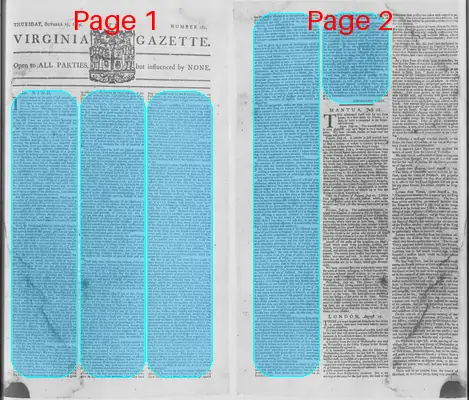
The Virginia Gazette
Williamsburg, Virginia
What is this article about?
A letter to Mr. Rind refuting 'Americanus'' arguments that defend the British Ministry's unconstitutional taxation of America and demean public petitions as unruly. The writer upholds the virtue of the people's suffrage and resistance, citing historical precedents and the Bill of Rights.
Merged-components note: This is a single continuous letter to the editor split across pages 1 and 2, with sequential reading order and matching content flow.
Clippings
1 of 2
OCR Quality
Full Text
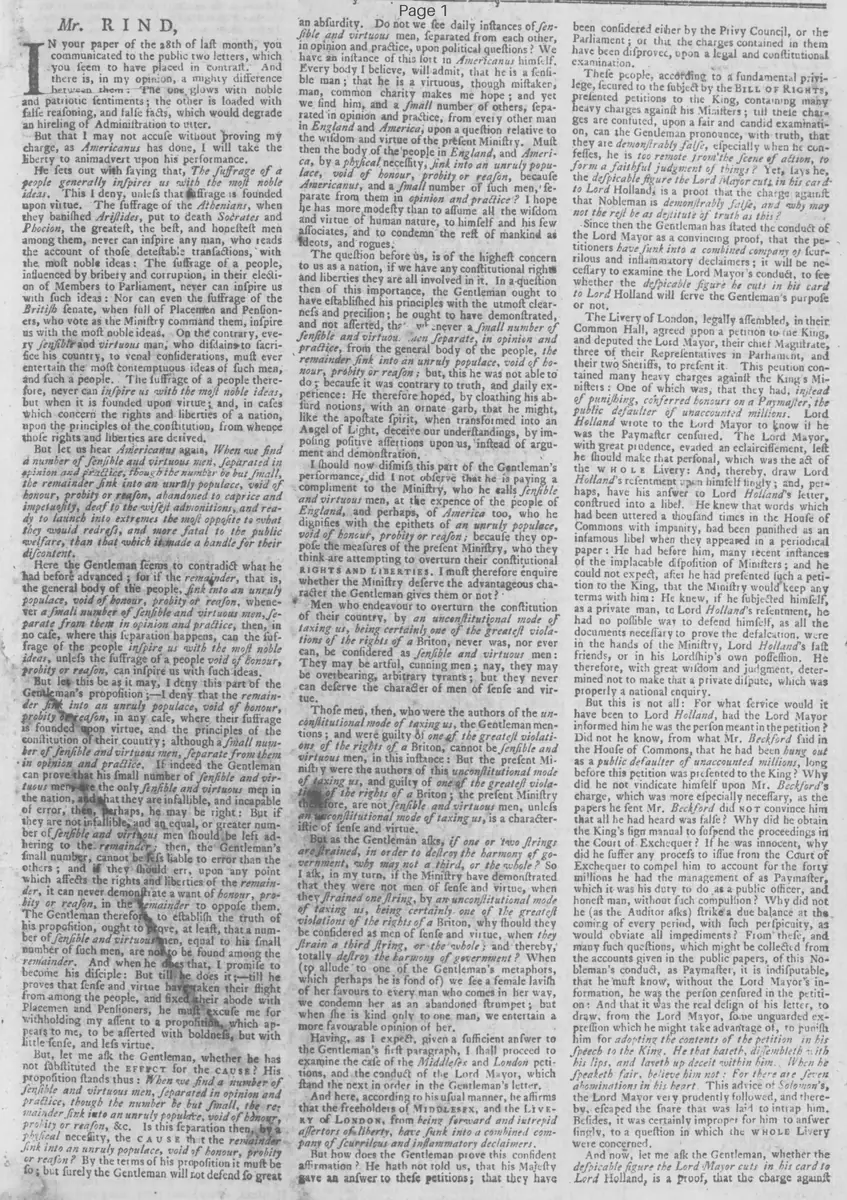
In your paper of the 28th of last month, you communicated to the public two letters, which you seem to have placed in contrast. And there is, in my opinion, a mighty difference between them: The one glows with noble and patriotic sentiments; the other is loaded with false reasoning, and false facts, which would degrade an hireling of Administration to utter.
But that I may not accuse without proving my charge, as Americanus has done, I will take the liberty to animadvert upon his performance.
He sets out with saying that, The Suffrage of a people generally inspires us with the most noble ideas. This I deny, unless that suffrage is founded upon virtue. The suffrage of the Athenians, when they banished Aristides, put to death Socrates and Phocion, the greatest, the best, and honestest men among them, never can inspire any man, who reads the account of those detestable transactions, with the most noble ideas: The suffrage of a people, influenced by bribery and corruption, in their election of Members to Parliament, never can inspire us with such ideas: Nor can even the suffrage of the British senate, when full of Placemen and Pensioners, who vote as the Ministry command them, inspire us with the most noble ideas. On the contrary, every sensible and virtuous man, who disdains to sacrifice his country to venal considerations, must ever entertain the most contemptuous ideas of such men, and such a people. The suffrage of a people therefore, never can inspire us with the most noble ideas, but when it is founded upon virtue; and, in cases which concern the rights and liberties of a nation, upon the principles of the constitution, from whence those rights and liberties are derived.
But let us hear Americanus again, When we find a number of sensible and virtuous men, Separated in opinion and practice, though the number be but small, the remainder sink into an unruly populace, void of honour, probity or reason, abandoned to caprice and impetuosity, deaf to the wisest admonitions, and ready to launch into extremes the most opposite to what they would redress, and more fatal to the public welfare, than that which it made a handle for their discontent.
Here the Gentleman seems to contradict what he had before advanced; for if the remainder, that is, the general body of the people, sink into an unruly populace, void of honour, probity or reason, whenever a small number of sensible and virtuous men, Separate from them in opinion and practice, then, in no case, where this separation happens, can the suffrage of the people inspire us with the most noble ideas, unless the suffrage of a people void of honour, probity or reason, can inspire us with such ideas.
But let this be as it may, I deny this part of the Gentleman's proposition;—I deny that the remainder sink into an unruly populace, void of honour, probity or reason, in any case, where their suffrage is founded upon virtue, and the principles of the constitution of their country: although a small number of sensible and virtuous men, separate from them in opinion and practice. If indeed the Gentleman can prove that his small number of sensible and virtuous men are the only sensible and virtuous men in the nation, and that they are infallible, and incapable of error, then, perhaps, he may be right: But if they are not infallible, and an equal, or greater number of sensible and virtuous men should be left adhering to the remainder; then, the Gentleman's small number, cannot be less liable to error than the others; and if they should err, upon any point which affects the rights and liberties of the remainder, it can never demonstrate a want of honour, probity or reason, in the remainder to oppose them.
The Gentleman therefore to establish the truth of his proposition, ought to prove, at least, that a number of sensible and virtuous men, equal to his small number of such men, are not to be found among the remainder. And when he does that, I promise to become his disciple: But till he does it: till he proves that sense and virtue have taken their flight from among the people, and fixed their abode with Placemen and Pensioners, he must excuse me for withholding my assent to a proposition, which appears to me, to be asserted with boldness, but with little sense, and less virtue.
But, let me ask the Gentleman, whether he has not substituted the EFFECT for the CAUSE? His proposition stands thus: When we find a number of sensible and virtuous men, Separated in opinion and practice, though the number be but small, the remainder sink into an unruly populace, void of honour, probity or reason, &c. Is this separation then, by a physical necessity, the CAUSE that the remainder sink into an unruly populace, void of honour, probity or reason? By the terms of his proposition it must be so; but surely the Gentleman will not defend so great an absurdity. Do not we see daily instances of sensible and virtuous men, separated from each other, in opinion and practice, upon political questions? We have an instance of this sort in Americanus himself. Every body I believe, will admit, that he is a sensible man: that he is a virtuous, though mistaken, man, common charity makes me hope; and yet we find him, and a small number of others, separated in opinion and practice, from every other man in England and America, upon a question relative to the wisdom and virtue of the present Ministry. Must then the body of the people in England, and America, by a physical necessity, sink into an unruly populace, void of honour, probity or reason, because Americanus, and a small number of such men, separate from them in opinion and practice? I hope he has more modesty than to assume all the wisdom and virtue of human nature, to himself and his few associates, and to condemn the rest of mankind as idiots, and rogues.
The question before us, is of the highest concern to us as a nation, if we have any constitutional rights and liberties they are all involved in it. In a question then of this importance, the Gentleman ought to have established his principles with the utmost clearness and precision; he ought to have demonstrated, and not asserted, that it never a small number of sensible and virtuous men separate, in opinion and practice, from the general body of the people, the remainder sink into an unruly populace, void of honour, probity or reason; but, this he was not able to do; because it was contrary to truth, and daily experience: He therefore hoped, by cloathing his absurd notions, with an ornate garb, that he might, like the apostate spirit, when transformed into an Angel of Light, deceive our understandings, by imposing positive assertions upon us, instead of argument and demonstration.
I should now dismiss this part of the Gentleman's performance, did I not observe that he is paying a compliment to the Ministry, who he calls sensible and virtuous men, at the expence of the people of England, and perhaps, of America too, who he dignifies with the epithets of an unruly populace, void of honour, probity or reason; because they oppose the measures of the present Ministry, who they think are attempting to overturn their constitutional RIGHTS AND LIBERTIES. I must therefore enquire whether the Ministry deserve the advantageous character the Gentleman gives them or not?
Men who endeavour to overturn the constitution of their country, by an unconstitutional mode of taxing us, being certainly one of the greatest violations of the rights of a Briton, never was, nor ever can, be considered as sensible and virtuous men: They may be artful, cunning men; nay, they may be overbearing, arbitrary tyrants; but they never can deserve the character of men of sense and virtue.
Those men, then, who were the authors of the unconstitutional mode of taxing us, the Gentleman mentions: and were guilty of one of the greatest violations of the rights of a Briton, cannot be sensible and virtuous men, in this instance: But the present Ministry were the authors of this unconstitutional mode of taxing us, and guilty of one of the greatest violations of the rights of a Briton; the present Ministry therefore, are not sensible and virtuous men, unless an unconstitutional mode of taxing us, is a characteristic of sense and virtue.
But as the Gentleman asks, if one or two strings are strained, in order to destroy the harmony of government, why may not a third, or the whole? So I ask, in my turn, if the Ministry have demonstrated that they were not men of sense and virtue, when they strained one string, by an unconstitutional mode of taxing us, being certainly one of the greatest violations of the rights of a Briton, why should they be considered as men of sense and virtue, when they strain a third string, or the whole; and thereby, totally destroy the harmony of government? When (to allude to one of the Gentleman's metaphors, which perhaps he is fond of) we see a female lavish of her favours to every man who comes in her way, we condemn her as an abandoned strumpet; but when she is kind only to one man, we entertain a more favourable opinion of her.
Having, as I expect, given a sufficient answer to the Gentleman's first paragraph, I shall proceed to examine the case of the Middlesex and London petitions, and the conduct of the Lord Mayor, which stand the next in order in the Gentleman's letter.
And here, according to his usual manner, he affirms that the freeholders of Middlesex, and the Livery of London, from being forward and intrepid assertors of liberty, have sunk into a combined company of scurrilous and inflammatory declaimers.
But how does the Gentleman prove this confident affirmation? He hath not told us, that his Majesty gave an answer to these petitions; that they have been considered either by the Privy Council, or the Parliament: or that the charges contained in them have been disproved, upon a legal and constitutional examination.
These people, according to a fundamental privilege, secured to the subject by the BILL OF RIGHTS, presented petitions to the King, containing many heavy charges against his Ministers: till these charges are confuted, upon a fair and candid examination, can the Gentleman pronounce, with truth, that they are demonstrably false, especially when he confesses, he is too remote from the scene of action, to form a faithful judgment of things? Yet, says he, the despicable figure the Lord Mayor cuts in his card to Lord Holland is a proof that the charge against that Nobleman is demonstrably false, and why may not the rest be as destitute of truth as this?
Since then the Gentleman has stated the conduct of the Lord Mayor as a convincing proof, that the petitioners have sunk into a combined company of scurrilous and inflammatory declaimers; it will be necessary to examine the Lord Mayor's conduct, to see whether the despicable figure he cuts in his card to Lord Holland will serve the Gentleman's purpose or not.
The Livery of London, legally assembled, in their Common Hall, agreed upon a petition to the King, and deputed the Lord Mayor, their chief Magistrate, three of their Representatives in Parliament, and their two Sheriffs, to present it. This petition contained many heavy charges against the King's Ministers: One of which was, that they had, instead of punishing, conferred honours on a Paymaster, the public defaulter of unaccounted millions. Lord Holland wrote to the Lord Mayor to know if he was the Paymaster censured. The Lord Mayor, with great prudence, evaded an eclaircissement, lest he should make that personal, which was the act of the WHOLE Livery: And, thereby, draw Lord Holland's resentment upon himself singly; and, perhaps, have his answer to Lord Holland's letter, construed into a libel. He knew that words which had been uttered a thousand times in the House of Commons with impunity, had been punished as an infamous libel when they appeared in a periodical paper: He had before him, many recent instances of the implacable disposition of Ministers: and he could not expect, after he had presented such a petition to the King, that the Ministry would keep any terms with him: He knew, if he subjected himself, as a private man, to Lord Holland's resentment, he had no possible way to defend himself, as all the documents necessary to prove the defalcation, were in the hands of the Ministry, Lord Holland's fast friends, or in his Lordship's own possession. He therefore, with great wisdom and judgment, determined not to make that a private dispute, which was properly a national enquiry.
But this is not all: For what service would it have been to Lord Holland, had the Lord Mayor informed him he was the person meant in the petition? Did not he know, from what Mr. Beckford said in the House of Commons, that he had been hung out as a public defaulter of unaccounted millions, long before this petition was presented to the King? Why did he not vindicate himself upon Mr. Beckford's charge, which was more especially necessary, as the papers he sent Mr. Beckford did not convince him that all he had heard was false? Why did he obtain the King's sign manual to suspend the proceedings in the Court of Exchequer? If he was innocent, why did he suffer any process to issue from the Court of Exchequer to compel him to account for the forty millions he had the management of as Paymaster, which it was his duty to do as a public officer, and honest man, without such compulsion? Why did not he (as the Auditor asks) strike a due balance at the coming of every period, with such perspicuity, as would obviate all impediments? From these, and many such questions, which might be collected from the accounts given in the public papers, of this Nobleman's conduct, as Paymaster, it is indubitable, that he must know, without the Lord Mayor's information, he was the person censured in the petition: And that it was the real design of his letter, to draw, from the Lord Mayor, some unguarded expression which he might take advantage of, to punish him for adopting the contents of the petition in his Speech to the King. He that hateth, dissembleth with his lips, and layeth up deceit within him. When he speaketh fair, believe him not: For there are seven abominations in his heart. This advice of Solomon's, the Lord Mayor very prudently followed, and thereby, escaped the snare that was laid to entrap him.
Besides, it was certainly improper for him to answer singly, to a question in which the WHOLE Livery were concerned.
And now, let me ask the Gentleman, whether the despicable figure the Lord Mayor cuts in his card to Lord Holland, is a proof, that the charge against that Nobleman is demonstrably false? And if it is not, then whatever the Paymaster alluded to in the petition, is demonstrably true; and whatever the Gentleman has said relative to the Lord Mayor's conduct, cannot possibly be true.
Having fully exposed the Gentleman's sophistry and fallacious reasoning upon the case of one Lord Mayor, and shewn that, instead of a despicable, he acted a wise and prudent part with Lord Holland; I will now examine the remainder of the Gentleman's letter.
And he gives us a piece of intelligence which is quite new to me: He says, every article of grievance enumerated in the petition, has been canvassed over and over by the cool and dispassionate pens of Senators, Lawyers, and Divines, and whatever appears atrocious in the representation, is either false in general, or has been justified by law, or innumerable precedents. If this is true, it will give me inexpressible concern: Because one article of the petition relates to our grievances. The apparent sticklers for liberty at home, says this intelligencer, take care, in all their complaints, to blend our grievances with their own; not that they look upon themselves as galled by our burdens, but because the unconstitutional mode of taxing us, being certainly one of the greatest violations of the rights of a Briton, it is hooked in to give imaginary grievances the air of reality; and when this could not be done without the aid of falsehood and disloyalty, to render the taxation, if possible, more odious and disgusting.
This last paragraph, makes me hope the Gentleman has only flung out a piece of false intelligence, for a purpose he does not chuse to declare openly, for he seems to have forgot what he had said in the page of his letter just before quoted. In that page he tells us that EVERY article of grievance, enumerated in the petition, is either false in general, or had been justified by law, or innumerable precedents: But now he admits that ONE article, which immediately concerns America, is true; that the grievance is real; and the mode of taxing us, unconstitutional, and one of the greatest violations of the rights of a Briton. As then, by the Gentleman's own admission, one article in the petition is demonstrably true, why may not his intelligence as to every other article be as demonstrably false? Why may not the rest be as true as this? I argue according to the Gentleman's own method, which surely, as it is his, must carry conviction with it.
However, to connive at this, what sentiments must we entertain of the Gentleman, when we hear him affirm with the utmost confidence, that the article in the petition, which charges the Ministry with "causing a revenue to be raised, by prerogative, in America," is an assertion so notoriously false, that a bare negation will confute it?
Has the Gentleman never heard of a Royal proclamation, which, by virtue of the prerogative alone imposed a duty of four and a half per cent upon all sugars which are the produce of the new acquired islands in the West Indies? Has he not heard that they are obliged to pay that duty at this time, according to the proclamation? If he has not heard this, he may be in some sort excusable, as his assertion proceeds from ignorance; though even in that case, it would be no great instance of his good breeding, to charge such respectable bodies of men, as the freeholders of the first county, and first city in England, with asserting a notorious falsehood to their Sovereign. But if he has heard of the proclamation, what shall I say then?--I will say, in his own words, his confident assertion is so notoriously false, that a bare negation will confute it.
But here I must take notice of his illiberal treatment of our friends in England; they take care, says he, in all their complaints, to blend our grievances with their own; not that they look upon themselves as galled by our burthens, but they hook them in to give imaginary grievances the air of reality; and even this could not be done without the aid of falsehood and disloyalty. From whence did the Gentleman get this intelligence? He tells us that we, Americans, are too remote from the scene of action, to form a faithful judgment of things; and that we pick up our politics by piece-meal, as they are retailed to us by the public prints. Has he then, by any quotation from the public prints, proved a single iota of this ungenerous charge? No, he has not been able to do it, even with the aid of falsehood. But suppose the people of England do not look upon themselves as galled by our burthens; has not the Gentleman assigned a very strong reason why they should interest themselves in our behalf? Has not he told us that the unconstitutional mode of taxing us, is one of the greatest violations of the rights of a Briton? and is not every Briton concerned, in interest, to oppose a measure, which is one of the greatest violations of his rights, whether he lives upon this, or the other Side of the atlantic? How then does the Gentleman know but this, and not the reason he has assigned, is their motive for blending our grievances with their own? He has given us no evidence to the contrary, but his own bare assertion; and, by this time, that may not be thought sufficient.
If the Gentleman cannot establish his principles, without advancing absurdities, and abusing the friends to America, he had better be silent. Indeed I am surprised to find a Virginian with such principles; I thought no Virginian would censure the people of England for appearing as friends to America; I knew great numbers of my countrymen had entered into an association immediately after the dissolution of the last Assembly, and solicited the friendship of their fellow subjects in Britain to second us in our representations against the grievances we complain of; and I expected their espousing our cause would have been acknowledged with gratitude by every American.
But I am mistaken! We have ONE ungrateful American among us! Who, instead of thanks, renders abuse to our kind benefactors.
This man I have endeavoured to detect in all his meanders and turnings, and to warn my countrymen not only against his false conclusions, but the vain premises also, from which he thinks they are so forcibly drawn.
And now, in imitation of Americanus in this, tho I hope in no other instance, I will conclude with an exhortation.
Leave, my countrymen, to bear instruction that will cause you to err from the words of knowledge. Let no virtuous American be won by the deceitful arguments and false assertions of a placeman: We are promised a removal of our grievances; let us not rely upon that promise till we see it warranted by authority: The hypocrite rusheth with his mouth destroyeth his neighbour; but through knowledge shall the just be delivered. When our grievances are removed. let the mutual confidence of Britons be restored; but even then, let us not relinquish our oeconomy, which cannot be too long, nor too strictly persevered in: Let us totally root out from among us, every kind of luxury and extravagance, which destroy our happiness, and are the bane of every virtue: Let us be loyal to our King, and dutiful to our Governors; but let us steadfastly adhere in our resolutions, to defend our inestimable rights and liberties.
I will now, Mr. Printer, as an apology for this long letter, tell you a short story. A certain Henry FitzSymonds, an Irish Jesuit, sent a challenge to the excellent and learned Archbishop Ussher, which was contained in half a sheet of paper; and yet, it was so loaded with sophistry and fallacies, that it cost the Archbishop a large quarto before he could give a satisfactory answer to all the points contained in it.
AMERICANUS VERUS.
What sub-type of article is it?
What themes does it cover?
What keywords are associated?
What entities or persons were involved?
Letter to Editor Details
Author
Americanus Verus
Recipient
Mr. Rind
Main Argument
the writer refutes 'americanus'' claims that public opposition to the ministry's unconstitutional taxation reflects an unruly populace, instead arguing that the people's virtuous suffrage and petitions defend constitutional rights against tyrannical measures.
Notable Details