Thank you for visiting SNEWPapers!
Sign up free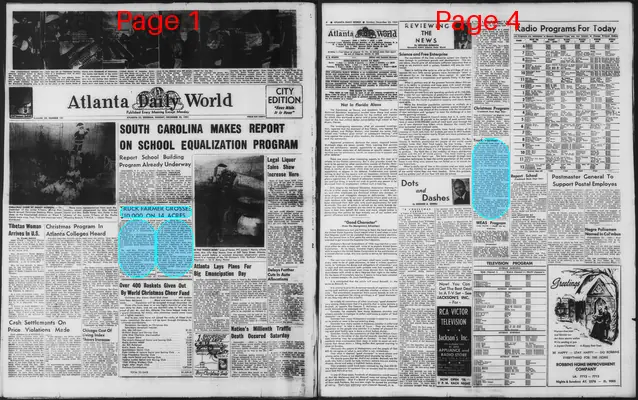
Atlanta Daily World
Atlanta, Fulton County, Georgia
What is this article about?
Samuel Freeman, 35, and wife gross over $10,000 yearly from 14-acre diversified truck farm in St. Helena Parish, La., after starting as sharecroppers in 1935; sell produce in New Orleans, built home, prioritize kids' education.
Merged-components note: Continuation of story on truck farmer from page 1 to page 4.
Clippings
1 of 2
OCR Quality
Full Text
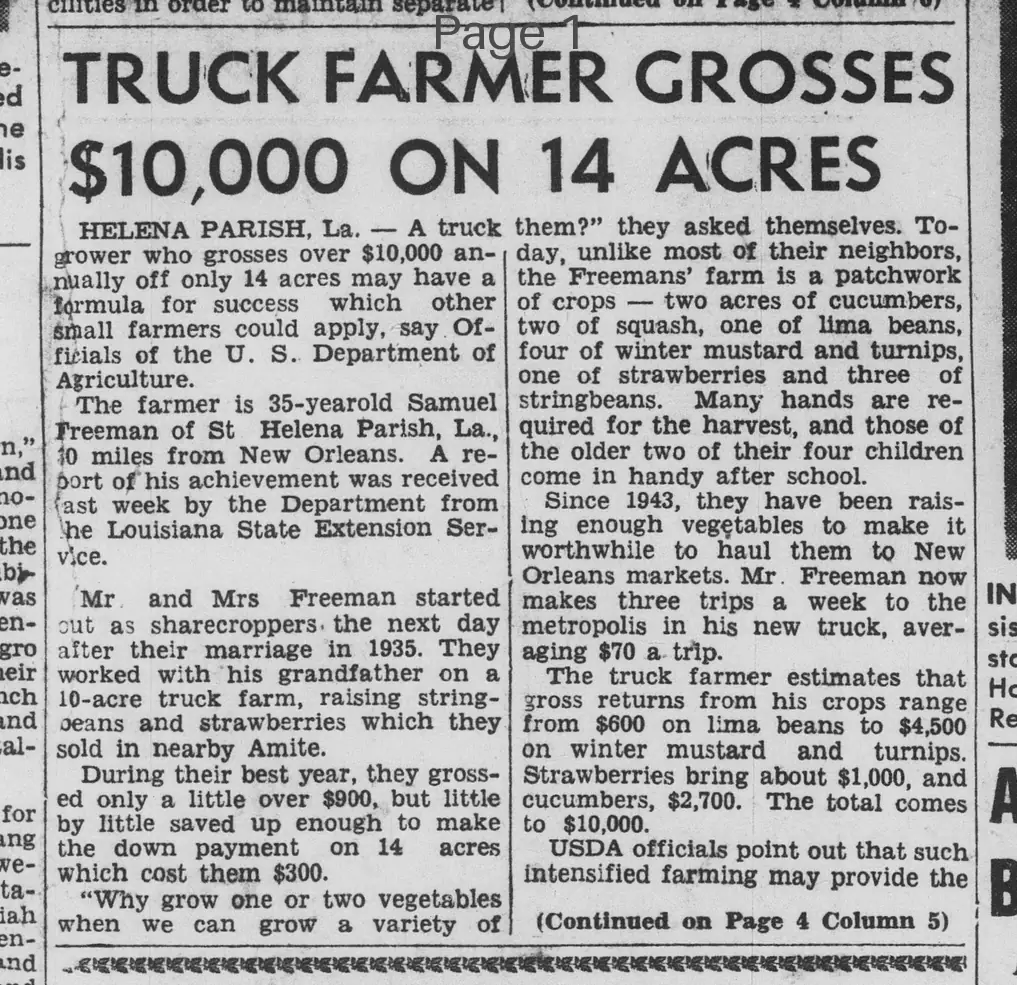
HELENA PARISH, La.—A truck grower who grosses over $10,000 annually off only 14 acres may have a formula for success which other small farmers could apply, say Officials of the U. S. Department of Agriculture. The farmer is 35-year-old Samuel Freeman of St. Helena Parish, La., 50 miles from New Orleans. A report of his achievement was received last week by the Department from the Louisiana State Extension Service.
Mr. and Mrs. Freeman started out as sharecroppers, the next day after their marriage in 1935. They worked with his grandfather on a 10-acre truck farm, raising string beans and strawberries which they sold in nearby Amite. During their best year, they grossed only a little over $900, but little by little saved up enough to make the down payment on 14 acres which cost them $300.
"Why grow one or two vegetables when we can grow a variety of them?" they asked themselves. Today, unlike most of their neighbors, the Freemans' farm is a patchwork of crops—two acres of cucumbers, two of squash, one of lima beans, four of winter mustard and turnips, one of strawberries and three of string beans. Many hands are required for the harvest, and those of the older two of their four children come in handy after school.
Since 1943, they have been raising enough vegetables to make it worthwhile to haul them to New Orleans markets. Mr. Freeman now makes three trips a week to the metropolis in his new truck, averaging $70 a trip. The truck farmer estimates that gross returns from his crops range from $600 on lima beans to $4,500 on winter mustard and turnips. Strawberries bring about $1,000, and cucumbers, $2,700. The total comes to $10,000.
USDA officials point out that such intensified farming may provide the... (Continued on Page 4 Column 5)
Truck Farmer
(Continued from Page One)
solution to the problem of many small cotton farmers in the South who in the future may not be able to compete effectively with large scale mechanized units.
Another advantage of truck farming is the ease with which operators may feed their families at home. A couple of milk cows and a few pigs and chickens round out the source of the Freeman's food supply.
But the couple believe in feeding their land too. They rotate their crops, turn under Austrian winter peas and other legumes, and maintain a cover of oats or ryegrass on any unused acres in order to keep their soil highly productive.
However, feeding themselves and feeding their land aren't the whole story. Four years ago they built a new home and began equipping it. Mrs Mary B. Wicker, their home demonstration agent, helped them with the selection of wall paper and furnishings.
Mrs. Freeman is particularly proud of her $400 gas range with its automatic features. The next step is to get an electric pump and install bathroom facilities.
They are going slow, buying for the home without sacrificing the money they are saving up to ensure their childrens' education. One of them will enter college next year.
What sub-type of article is it?
What themes does it cover?
What keywords are associated?
What entities or persons were involved?
Where did it happen?
Story Details
Key Persons
Location
St. Helena Parish, La., 50 Miles From New Orleans
Event Date
Since 1935, Hauling To Markets Since 1943
Story Details
Samuel and Mrs. Freeman started as sharecroppers in 1935, saved to buy 14 acres for $300, diversified crops including cucumbers, squash, lima beans, winter mustard, turnips, strawberries, and string beans, gross $10,000 annually by selling in New Orleans markets since 1943, built new home four years ago, saving for children's education.