Thank you for visiting SNEWPapers!
Sign up free
Editorial
December 12, 1838
Macon Intelligencer
Macon, Noxubee County, Mississippi
What is this article about?
Editorial from New York Quarterly Review praises George Washington's administration for its purity, merit-based appointments, and avoidance of partisan corruption in government patronage, urging young men to study it via Marshall's history.
Clipping
OCR Quality
98%
Excellent
Full Text
From the New York Quarterly Review.
ADMINISTRATION OF WASHINGTON.
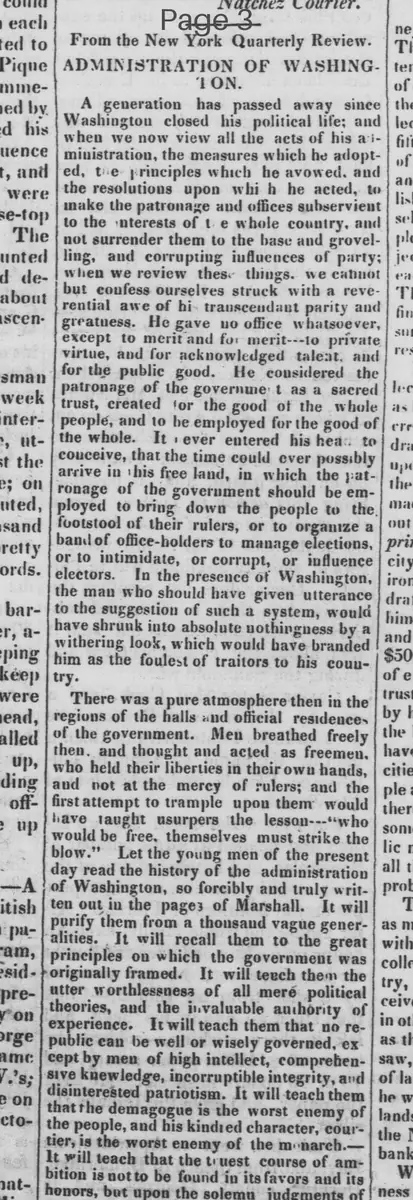
A generation has passed away since Washington closed his political life; and when we now view all the acts of his administration, the measures which he adopted, the principles which he avowed, and the resolutions upon which he acted, to make the patronage and offices subservient to the interests of the whole country, and not surrender them to the base and grovelling, and corrupting influences of party; when we review these things, we cannot but confess ourselves struck with a reverential awe of his transcendent purity and greatness. He gave no office whatsoever, except to merit and for merit--to private virtue, and for acknowledged talent, and for the public good. He considered the patronage of the government as a sacred trust, created for the good of the whole people, and to be employed for the good of the whole. It never entered his head to conceive, that the time could ever possibly arrive in his free land, in which the patronage of the government should be employed to bring down the people to the footstool of their rulers, or to organize a band of office-holders to manage elections, or to intimidate, or corrupt, or influence electors. In the presence of Washington, the man who should have given utterance to the suggestion of such a system, would have shrunk into absolute nothingness by a withering look, which would have branded him as the foulest of traitors to his country.
There was a pure atmosphere then in the regions of the halls and official residences of the government. Men breathed freely then, and thought and acted as freemen, who held their liberties in their own hands, and not at the mercy of rulers; and the first attempt to trample upon them would have taught usurpers the lesson--"who would be free, themselves must strike the blow." Let the young men of the present day read the history of the administration of Washington, so forcibly and truly written out in the pages of Marshall. It will purify them from a thousand vague generalities. It will recall them to the great principles on which the government was originally framed. It will teach them the utter worthlessness of all mere political theories, and the invaluable authority of experience. It will teach them that no republic can be well or wisely governed, except by men of high intellect, comprehensive knowledge, incorruptible integrity, and disinterested patriotism. It will teach them that the demagogue is the worst enemy of the people, and his kindred character, courtier, is the worst enemy of the monarch. It will teach that the truest course of ambition is not to be found in its favors and its honors, but upon the solemn judgments of the wise and good, upon the distant praises whose voice speaks from the hearts of millions, and give back from the tomb the deep echoes of its own thankfulness.
ADMINISTRATION OF WASHINGTON.
A generation has passed away since Washington closed his political life; and when we now view all the acts of his administration, the measures which he adopted, the principles which he avowed, and the resolutions upon which he acted, to make the patronage and offices subservient to the interests of the whole country, and not surrender them to the base and grovelling, and corrupting influences of party; when we review these things, we cannot but confess ourselves struck with a reverential awe of his transcendent purity and greatness. He gave no office whatsoever, except to merit and for merit--to private virtue, and for acknowledged talent, and for the public good. He considered the patronage of the government as a sacred trust, created for the good of the whole people, and to be employed for the good of the whole. It never entered his head to conceive, that the time could ever possibly arrive in his free land, in which the patronage of the government should be employed to bring down the people to the footstool of their rulers, or to organize a band of office-holders to manage elections, or to intimidate, or corrupt, or influence electors. In the presence of Washington, the man who should have given utterance to the suggestion of such a system, would have shrunk into absolute nothingness by a withering look, which would have branded him as the foulest of traitors to his country.
There was a pure atmosphere then in the regions of the halls and official residences of the government. Men breathed freely then, and thought and acted as freemen, who held their liberties in their own hands, and not at the mercy of rulers; and the first attempt to trample upon them would have taught usurpers the lesson--"who would be free, themselves must strike the blow." Let the young men of the present day read the history of the administration of Washington, so forcibly and truly written out in the pages of Marshall. It will purify them from a thousand vague generalities. It will recall them to the great principles on which the government was originally framed. It will teach them the utter worthlessness of all mere political theories, and the invaluable authority of experience. It will teach them that no republic can be well or wisely governed, except by men of high intellect, comprehensive knowledge, incorruptible integrity, and disinterested patriotism. It will teach them that the demagogue is the worst enemy of the people, and his kindred character, courtier, is the worst enemy of the monarch. It will teach that the truest course of ambition is not to be found in its favors and its honors, but upon the solemn judgments of the wise and good, upon the distant praises whose voice speaks from the hearts of millions, and give back from the tomb the deep echoes of its own thankfulness.
What sub-type of article is it?
Constitutional
Partisan Politics
What keywords are associated?
Washington Administration
Government Patronage
Political Integrity
Republican Principles
Merit Appointments
Anti Demagogue
Partisan Corruption
What entities or persons were involved?
Washington
Marshall
Editorial Details
Primary Topic
Praise Of Washington's Administration Principles
Stance / Tone
Reverential Praise For Purity And Anti Partisan Integrity
Key Figures
Washington
Marshall
Key Arguments
Washington Made Patronage Subservient To National Interests, Not Party Corruption
Appointments Based Solely On Merit, Virtue, Talent, And Public Good
Government Patronage As Sacred Trust For The Whole People
Opposition To Using Offices To Control Elections Or Intimidate Electors
Pure Atmosphere Of Freedom In Government Under Washington
Study Of Washington's History Teaches Republican Principles And Value Of Experience
Republics Require Governance By Men Of Intellect, Integrity, And Patriotism
Demagogues And Courtiers As Enemies Of People And Monarchs