Thank you for visiting SNEWPapers!
Sign up free
Rhode Island Republican
Newport, Newport County, Rhode Island
What is this article about?
Proceedings of the Rhode-Island General Assembly's October 1801 session in South-Kingstown, covering debates on amending administration laws, presidential electors, militia compensation, deposition rules, a thanksgiving day resolution (rejected), and resolutions defending the governor against slander.
Merged-components note: Continuation of the legislative proceedings story across multiple components on page 3 based on sequential reading order and text flow.
Clipping
OCR Quality
Full Text
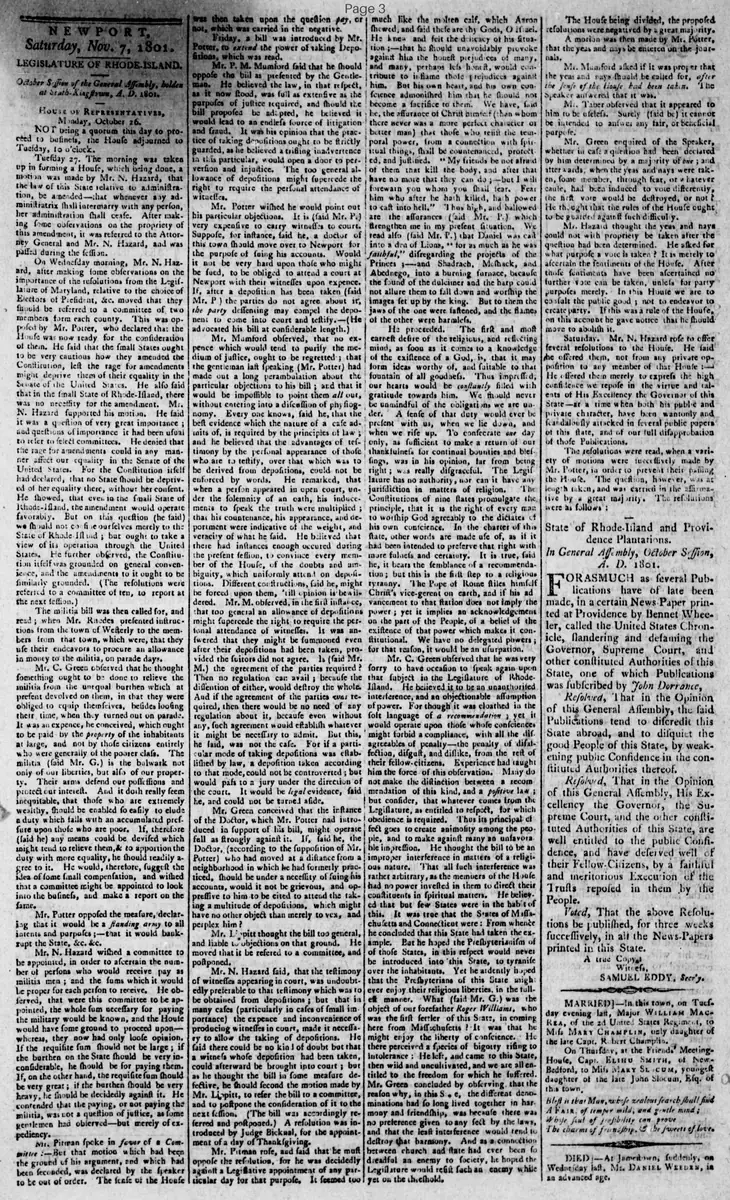
Saturday, Nov. 7, 1801.
LEGISLATURE OF RHODE-ISLAND.
October Session of the General Assembly, holden at South-Kingstown, A. D. 1801.
House of Representatives,
Monday, October 26.
Not being a quorum this day to proceed to business, the House adjourned to Tuesday, 10 o'clock.
Tuesday 27. The morning was taken up in forming a House, which being done, a motion was made by Mr. N. Hazard, that the law of this State relative to administration, be amended—that whenever any administratrix shall intermarry with any person, her administration shall cease. After making some observations on the propriety of this amendment, it was referred to the Attorney General and Mr. N. Hazard, and was passed during the session.
On Wednesday morning, Mr. N. Hazard, after making some observations on the importance of the resolutions from the Legislature of Maryland, relative to the choice of Electors of President, &c. moved that they should be referred to a committee of two members from each county. This was opposed by Mr. Potter, who declared that the House was now ready for the consideration of them. He said that the small States ought to be very cautious how they amended the Constitution, lest the rage for amendments might deprive them of their equality in the Senate of the United States. He also said that in the small State of Rhode-Island, there was no necessity for the amendment. Mr. N. Hazard supported his motion. He said it was a question of very great importance; and questions of importance it had been usual to refer to select committees. He denied that the rage for amendments could in any manner affect our equality in the Senate of the United States. For the Constitution itself had declared, that no State should be deprived of her equality there, without her consent. He showed, that even in the small State of Rhode-Island, the amendment would operate favorably. But on this question (he said) we should not confine ourselves merely to the State of Rhode-Island: but ought to take a view of its operation through the United States. He further observed, the Constitution itself was grounded on general convenience, and the amendments to it ought to be similarly grounded. (The resolutions were referred to a committee of ten, to report at the next session.)
The militia bill was then called for, and read: when Mr. Rades presented instructions from the town of Westerly to the members from that town, which were, that they use their endeavors to procure an allowance in money to the militia, on parade days.
Mr. C. Green observed that he thought something ought to be done to relieve the militia from the unequal burden which at present devolved on them, in that they were obliged to equip themselves, besides losing their time, when they turned out on parade. It was an expense, he conceived, which ought to be paid by the property of the inhabitants at large, and not by those citizens entirely who were generally of the poorer class. The militia (said Mr. G.) is the bulwark not only of our liberties, but also of our property. Their arms defend our possessions and protect our interest. And it doth really seem inequitable, that those who are extremely wealthy, should be enabled so easily to elude a duty which falls with an accumulated pressure upon those who are poor. If, therefore (said he) any means could be devised which might tend to relieve them, & to apportion the duty with more equality, he should readily agree to it. He would, therefore, suggest the idea of some small compensation, and wished that a committee might be appointed to look into the business, and make a report on the same.
Mr. Potter opposed the measure, declaring that it would be a standing army to all intents and purposes—that it would bankrupt the State, &c. &c.
Mr. N. Hazard wished a committee to be appointed, in order to ascertain the number of persons who would receive pay as militia men; and the sums which it would be proper for each person to receive. He observed, that were this committee to be appointed, the whole sum necessary for paying the military would be known, and the House would have some ground to proceed upon—whereas, they now had only loose opinion. If the requisite sum should not be large; if the burden on the State should be very inconsiderable, he should be for paying them. If, on the other hand, the requisite sum should be very great; if the burden should be very heavy, he should be decidedly against it. He contended that the paying, or not paying the militia, was not a question of justice, as some gentlemen had observed—but merely of expediency.
Mr. Pitman spoke in favor of a Committee:—But that motion which had been the ground of his argument, and which had been seconded, was declared by the Speaker to be out of order. The sense of the House
was then taken upon the question pass, or not which was carried in the negative.
Friday, a bill was introduced by Mr. Potter, to extend the power of taking Depositions, which was read.
Mr. P. M. Mumford said that he should oppose the bill as presented by the Gentleman. He believed the law, in that respect, as it now stood, was full as extensive as the purposes of justice required, and should the bill proposed be adopted, he believed it would lead to an endless source of litigation and fraud. It was his opinion that the practice of taking depositions ought to be strictly guarded, as he believed a trifling inadvertence in this particular, would open a door to perversion and injustice. The too general allowance of depositions might supersede the right to require the personal attendance of witnesses.
Mr. Potter wished he would point out his particular objections. It is (said Mr. P.) very expensive to carry witnesses to court. Suppose, for instance, said he, a doctor of this town should move over to Newport for the purpose of going his accounts. Would it not be very hard upon those who might be sued, to be obliged to attend a court at Newport with their witnesses upon expense. If, after a deposition has been taken (said Mr. P.) the parties do not agree about it, the party dissenting may compel the deponent to come into court and testify.—(He advocated his bill at considerable length.)
Mr. Mumford observed that no expense which would tend to purify the medium of justice, ought to be regretted; that the gentleman last speaking (Mr. Potter) had made out a long perambulation about the particular objections to his bill: and that it would be impossible to point them all out, without entering into a discussion of physiology. Every one knows, said he, that the best evidence which the nature of a case admits of, is required by the principles of law; and he believed that the advantages of testimony by the personal appearance of those who are to testify, over that which was to be derived from depositions, could not be enforced by words. He remarked, that when a person appeared in open court, under the solemnity of an oath, his inducements to speak the truth were multiplied; that his countenance, his appearance, and deportment were indicative of the weight, and veracity of what he said. He believed that there had instances enough occurred during the present session, to convince every member of the House, of the doubts and ambiguity, which uniformly attend depositions. Different constructions, said he, might be forced upon them, till opinion is bewildered. Mr. M. observed, in the first instance, that too general an allowance of depositions might supersede the right to require the personal attendance of witnesses. It was answered that they might be summoned even after their depositions had been taken, provided the suitors did not agree. Is (said Mr. M.) the agreement of the parties required? Then no regulation can avail; because the dissension of either, would destroy the whole. And if the agreement of the parties was required, then there would be no need of any regulation about it, because even without any, such agreement would establish whatever it might be necessary to admit. But this, he said, was not the case. For if a particular mode of taking depositions was established by law, a deposition taken according to that mode, could not be controverted; but would pass to a jury under the direction of the court. It would be legal evidence, said he, and could not be turned aside.
Mr. Green conceived that the instance of the Doctor, which Mr. Potter had introduced in support of his bill, might operate full as strongly against it. If, said he, the Doctor, (according to the supposition of Mr. Potter) who had moved at a distance from a neighborhood in which he had formerly practiced, should be under a necessity of suing his accounts, would it not be grievous, and oppressive to him to be cited to attend the taking a multitude of depositions, which might have no other object than merely to vex, and perplex him?
Mr. Lippitt thought the bill too general, and liable to objections on that ground. He moved that it be referred to a committee, and postponed.
Mr. N. Hazard said, that the testimony of witnesses appearing in court, was undoubtedly preferable to that testimony which was to be obtained from depositions: but that in many cases (particularly in cases of small importance) the expense and inconvenience of producing witnesses in court, made it necessary to allow the taking of depositions. He said there could be no kind of doubt but that a witness whose deposition had been taken, could afterward be brought into court: but as he thought the bill in some measure defective, he should second the motion made by Mr. Lippitt, to refer the bill to a committee, and to postpone the consideration of it to the next session. (The bill was accordingly referred and postponed.) A resolution was introduced by Judge Bicksall, for the appointment of a day of Thanksgiving.
Mr. Pitman rose, and said that he must oppose the resolution, for he was decidedly against a Legislative appointment of any particular day for that purpose. It seemed too much like the molten calf, which Aaron showed, and said these are thy Gods, O Israel.
He knew and felt the delicacy of his situation;—that he should unavoidably provoke against him the honest prejudices of many, and many, perhaps less honest, would contribute to inflame those prejudices against him. Both his own heart, and his own conscience admonished him that he should not become a sacrifice to them. We have, said he, the assurance of Christ himself (than whom there never was a more perfect character or better man) that those who resist the temporal power, from a connection with spiritual things, shall be countenanced, protected, and justified. "My friends be not afraid of them that kill the body, and after that have no more that they can do unto you—but I will forewarn you whom you shall fear. Fear him who after he hath killed, hath power to cast into hell." Thus high, and hallowed are the assurances (said Mr. P.), which strengthen me in my present situation. We read also (said Mr. P.) that Daniel was cast into a den of Lions, "for as much as he was faithful," disregarding the projects of the Princes;—and Shadrach, Meshach, and Abednego, into a burning furnace, because the sound of the dulcimer and the harp could not allure them to fall down and worship the images set up by the king. But to them the jaws of the one were fastened, and the flames of the other were harmless.
He proceeded. The first and most ardent desire of the religious, and reflecting mind, as soon as it comes to a knowledge of the existence of a God, is, that it may form ideas worthy of, and suitable to that fountain of all goodness. Thus impressed, our hearts would be constantly filled with gratitude towards him. We should never be unmindful of the obligations we are under. A sense of that duty would ever be present with us, when we lie down, and when we rise up. To consecrate one day only, as sufficient to make a return of our thankfulness, for continual bounties and blessings, was in his opinion, far from being right; was really disgraceful. The Legislature has no authority, nor can it have any jurisdiction in matters of religion. The Constitutions of nine states promulgate the principle, that it is the right of every man to worship God agreeably to the dictates of his own conscience. In the charter of this state, other words are made use of, as if it had been intended to preserve that right with more fullness and certainty. It is true, said he, it bears the semblance of a recommendation; but this is the first step to a religious tyranny. The Pope of Rome styles himself Christ's vice-gerent on earth, and if his advancement to that station does not imply the power; yet it implies an acknowledgement on the part of the People, of a belief of the existence of that power which makes it constitutional. We have no delegated powers; for that reason, it would be an usurpation.
Mr. C. Green observed that he was very sorry to have occasion to speak again upon that subject in the Legislature of Rhode-Island. He believed it to be an unauthorized interference, and an objectionable assumption of power. For though it was clothed in the soft language of a recommendation; yet it would operate upon those whose consciences might forbid a compliance, with all the disagreeables of penalty—the penalty of disaffection, disgust, and dislike, from the rest of their fellow-citizens. Experience had taught him the force of this observation. Many do not make the distinction between a recommendation of this kind, and a positive law; but consider, that whatever comes from the Legislature, as entitled to respect, for which obedience is required. Thus in principle it goes to create animosity among the people, and to make against many an unfavorable impression. He thought the bill to be an improper interference in matters of a religious nature. That all such interference was rather arbitrary, as the members of the House had no power invested in them to direct their constituents in spiritual matters. He believed that but few States were in the habit of this. It was true that the States of Massachusetts and Connecticut were: From whence he concluded that this State had taken the example. But he hoped the Presbyterianism of those States, in this respect would never be introduced into this State, to tyrannize over the inhabitants. Yet he ardently hoped that the Presbyterians of this State might ever enjoy their religious liberties, in the fullest manner. What (said Mr. G.) was the object of our forefather Roger Williams, who was the first settler of this State, in coming here from Massachusetts?—It was that he might enjoy the liberty of conscience. He there perceived a species of bigotry rising to intolerance: He left, and came to this State, then wild and uncultivated, and we are all entitled to the freedom for which he suffered.
Mr. Green concluded by observing, that the reason why, in this State, the different denominations had so long lived together in harmony and friendship, was because there was no preference given to any sect by the laws, and that the least interference would tend to destroy that harmony. And as a connection between church and state had ever been so dreadful an enemy to society, he hoped the Legislature would resist such an enemy while yet on the threshold.
The House being divided, the proposed resolutions were negatived by a great majority.
A motion was then made by Mr. Potter, that the yeas and nays be entered on the journal.
Mr. Mumford asked if it was proper that the yeas and nays should be called for, after the sense of the house had been taken. The Speaker answered that it was.
Mr. Taber observed that it appeared to him to be useless. Surely (said he) it cannot be intended to answer any fair, or beneficial purpose.
Mr. Green enquired of the Speaker, whether in case a question had been declared by him determined by a majority of one; and afterwards, when the yeas and nays were taken, some member, through fear, or whatever cause, had been induced to vote differently, the first vote would be destroyed, or not?
He thought that the rules of the House ought to be guarded against such difficulty.
Mr. Hazard thought the yeas and nays could not with propriety be taken after the question had been determined. He asked for what purpose a vote is taken? It is merely to ascertain the sentiments of the House. After those sentiments have been ascertained no further vote can be taken, unless for party purposes merely. In this House we are to consult the public good: not to endeavor to create party. If this was a rule of the House, on this account he gave notice that he should move to abolish it.
Saturday. Mr. N. Hazard rose to offer several resolutions to the House. He said he offered them, not from any private opposition to any member of that House: He offered them merely to express the high confidence we repose in the virtue and talents of His Excellency the Governor of this State—at a time when both his public and private character, have been wantonly and scandalously attacked in several public papers of this state, and of our full disapprobation of those Publications.
The resolutions were read, when a variety of motions were successively made by Mr. Potter, in order to prevent their passing the House. The question, however, was at length taken, and was carried in the affirmative by a great majority. The resolutions were as follows:
State of Rhode-Island and Providence Plantations.
In General Assembly, October Session,
A. D. 1801.
WHEREAS AS MUCH as several Publications have of late been made, in a certain News-Paper printed at Providence by Bennet Wheeler, called the United States Chronicle, slandering and defaming the Governor, Supreme Court, and other constituted Authorities of this State, one of which Publications was Subscribed by John Dorrance,
Resolved, That in the Opinion of this General Assembly, the said Publications tend to discredit this State abroad, and to disquiet the good People of this State, by weakening public Confidence in the constituted Authorities thereof.
Resolved, That in the Opinion of this General Assembly, His Excellency the Governor, the Supreme Court, and the other constituted Authorities of this State, are well entitled to the public Confidence, and have deserved well of their Fellow-Citizens, by a faithful and meritorious Execution of the Trusts reposed in them by the People.
Voted, That the above Resolutions be published, for three weeks successively, in all the News-Papers printed in this State.
A true Copy:
Attest,
SAMUEL EDDY, Sec'y.
What sub-type of article is it?
What themes does it cover?
What keywords are associated?
What entities or persons were involved?
Where did it happen?
Story Details
Key Persons
Location
South Kingstown, Rhode Island
Event Date
October Session, A. D. 1801
Story Details
The House debates and acts on amendments to administration laws upon marriage, refers Maryland resolutions on presidential electors to committee, discusses but rejects militia pay, refers and postpones bill on extending depositions, rejects thanksgiving day resolution citing separation of church and state, and passes resolutions defending the governor and authorities against slanderous publications.