Thank you for visiting SNEWPapers!
Sign up free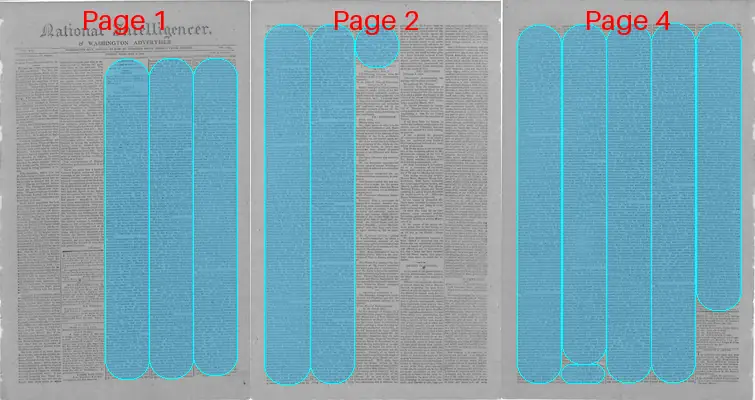
The National Intelligencer And Washington Advertiser
Washington, District Of Columbia
What is this article about?
Debate in the U.S. House of Representatives on January 12, 1807, over Mr. Rowan's resolution to inquire into General Wilkinson's conduct, amid allegations of treason and Spanish pension. Speakers like Sloan, Williams, Urham, and Randolph argue constitutional powers, separation of branches, and national security implications tied to Burr conspiracy.
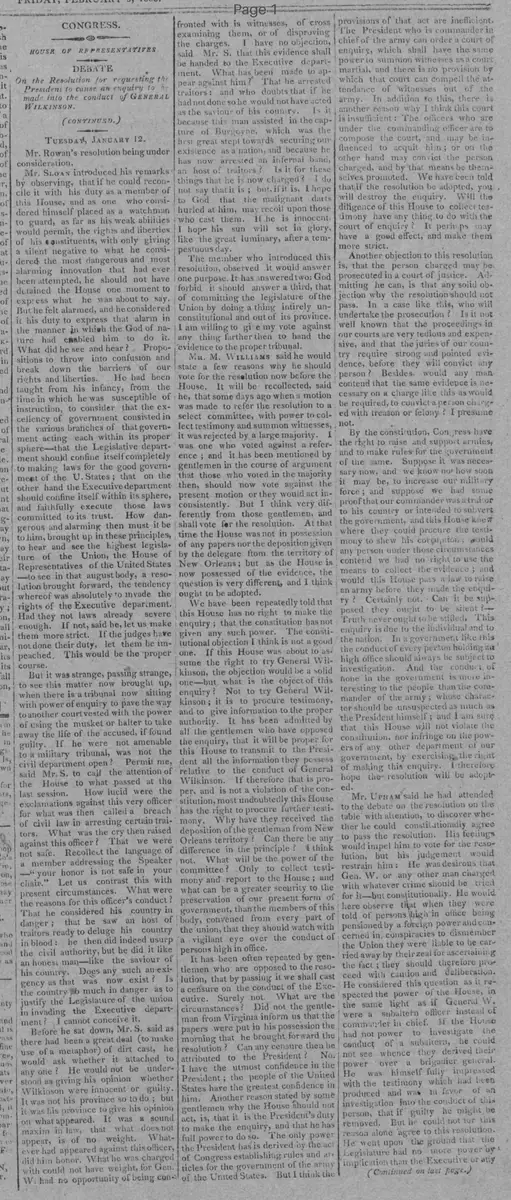
Merged-components note: These components form a single continued narrative story reporting on the congressional debate regarding General Wilkinson, spanning pages 1, 2, and 4 with explicit continuation indicators.
Clippings
1 of 3
OCR Quality
Full Text
HOUSE
OF REPRESENTATIVES
DEBATE
On the Resolution for requesting the President to cause an enquiry to be made into the conduct of GENERAL WILKINSON.
(CONTINUED.)
TUESDAY, JANUARY 12.
Mr. Rowan's resolution being under consideration.
Mr. Sloan introduced his remarks by observing, that if he could reconcile it with his duty as a member of this House, and as one who considered himself placed as a watchman to guard, as far as his weak abilities would permit, the rights and liberties of his constituents, with only giving a silent negative to what he considered the most dangerous and most alarming innovation that had ever been attempted, he should not have detained the House one moment to express what he was about to say. But he felt alarmed, and he considered it his duty to express that alarm in the manner in which the God of nature had enabled him to do it. What did he see and hear? Propositions to throw into confusion and break down the barriers of our rights and liberties. He had been taught from his infancy, from the time in which he was susceptible of instruction, to consider that the excellency of government consisted in the various branches of that government acting each within its proper sphere—that the Legislative department should confine itself completely to making laws for the good government of the U. States; that on the other hand the Executive department should confine itself within its sphere, and faithfully execute those laws committed to its trust. How dangerous and alarming then must it be to him, brought up in these principles, to hear and see the highest legislature of the Union, the House of Representatives of the United States—to see in that august body, a resolution brought forward, the tendency whereof was absolutely to invade the rights of the Executive department. Had they not laws already severe enough. If not, said he, let us make them more strict. If the judges have not done their duty, let them be impeached. This would be the proper course. But it was strange, passing strange, to see this matter now brought up, when there is a tribunal now sitting with power of enquiry to pave the way to another court vested with the power of using the musket or halter to take away the life of the accused, if found guilty. If he were not amenable to a military tribunal, was not the civil department open? Permit me, said Mr. S. to call the attention of the House to what passed at the last session. How lucid were the exclamations against this very officer for what was then called a breach of civil law in arresting certain traitors. What was the cry then raised against this officer? That we were not safe. Recollect the language of a member addressing the Speaker—'your honor is not safe in your chair.' Let us contrast this with present circumstances. What were the reasons for this officer's conduct? That he considered his country in danger; that he saw an host of traitors ready to deluge his country in blood: he then did indeed usurp the civil authority, but he did it like an honest man—like the saviour of his country. Does any such an exigency as that was now exist? Is the country so much in danger as to justify the Legislature of the union in invading the Executive department? I cannot conceive it. Before he sat down, Mr. S. said as there had been a great deal (to make use of a metaphor) of dirt cast, he would ask whether it attached to any one? He would not be understood as giving his opinion whether Wilkinson were innocent or guilty. It was not his province so to do; but it was his province to give his opinion on what appeared. It was a sound maxim in law, that what does not appear, is of no weight. Whatever had appeared against this officer, did him honor. What he was charged with could not have weight, for Gen. W. had no opportunity of being confronted with his witnesses, of cross examining them, or of disproving the charges. I have no objection, said Mr. S. that this evidence shall be handed to the Executive department. What has been made to appear against him? That he arrested traitors: and who doubts that if he had not done so he would not have acted as the saviour of his country. Is it because this man assisted in the capture of Burgoyne, which was the first great step towards securing our existence as a nation, and because he has now arrested an infernal band, an host of traitors? Is it for these things that he is now charged? I do not say that it is; but, if it is, I hope to God that the malignant darts hurled at him, may recoil upon those who cast them. If he is innocent. I hope his sun will set in glory, like the great luminary, after a tempestuous day. The member who introduced this resolution, observed it would answer one purpose. It has answered two: God forbid it should answer a third, that of committing the legislature of the Union by doing a thing entirely unconstitutional and out of its province. I am willing to give my vote against any thing farther than to hand the evidence to the proper tribunal.
Mr. M. Williams said he would state a few reasons why he should vote for the resolution now before the House. It will be recollected, said he, that some days ago when a motion was made to refer the resolution to a select committee, with power to collect testimony and summon witnesses, it was rejected by a large majority. I was one who voted against a reference; and it has been mentioned by gentlemen in the course of argument that those who voted in the majority then, should now vote against the present motion or they would act inconsistently. But I think very differently from those gentlemen, and shall vote for the resolution. At that time the House was not in possession of any papers nor the deposition given by the delegate from the territory of New Orleans; but as the House is now possessed of the evidence, the question is very different, and I think ought to be adopted. We have been repeatedly told that this House has no right to make the enquiry; that the constitution has not given any such power. The constitutional objection I think is not a good one. If this House was about to assume the right to try General Wilkinson, the objection would be a solid one—but what is the object of this enquiry? Not to try General Wilkinson; it is to procure testimony, and to give information to the proper authority. It has been admitted by all the gentlemen who have opposed the enquiry, that it will be proper for this House to transmit to the President all the information they possess relative to the conduct of General Wilkinson. If therefore that is proper, and is not a violation of the constitution, most undoubtedly this House has the right to procure further testimony. Why have they received the deposition of the gentleman from New Orleans territory? Can there be any difference in the principle? I think not. What will be the power of the committee? Only to collect testimony and report to the House; and what can be a greater security to the preservation of our present form of government, than the members of this body, convened from every part of the union, that they should watch with a vigilant eye over the conduct of persons high in office. It has been often repeated by gentlemen who are opposed to the resolution, that by passing it we shall cast a censure on the conduct of the Executive. Surely not What are the circumstances? Did not the gentleman from Virginia inform us that the papers were put in his possession the morning that he brought forward the resolution? Can any censure then be attributed to the President? No. I have the utmost confidence in the President; the people of the United States have the greatest confidence in him. Another reason stated by some gentlemen why the House should not act, is, that it is the President's duty to make the enquiry, and that he has full power to do so. The only power the President has is derived by the act of Congress establishing rules and articles for the government of the army of the United States. But I think the provisions of that act are inefficient. The President who is commander in chief of the army can order a court of enquiry, which shall have the same power to summon witnesses as a court martial, and there is no provision by which that court can compel the attendance of witnesses out of the army. In addition to this, there is another reason why I think this court is insufficient: The officers who are under the commanding officer are to compose the court, and may be influenced to acquit him; or on the other hand may convict the person charged, and by that means be themselves promoted. We have been told that if the resolution be adopted, you will destroy the enquiry. Will the diligence of this House to collect testimony have any thing to do with the court of enquiry? It perhaps may have a good effect, and make them more strict. Another objection to this resolution is, that the person charged may be prosecuted in a court of justice. Admitting he can, is that any solid objection why the resolution should not pass. In a case like this, who will undertake the prosecution? Is it not well known that the proceedings in our courts are very tedious and expensive, and that the juries of our country require strong and pointed evidence, before they will convict any person? Besides, would any man contend that the same evidence is necessary on a charge like this as would be required, to convict a person charged with treason or felony? I presume not. By the constitution, Congress have the right to raise and support armies, and to make rules for the government of the same. Suppose it was necessary now, and we know not how soon it may be, to increase our military force; and suppose we had some proof that our commander was a traitor to his country or intended to subvert the government, and this House knew where they could procure the testimony to shew his corruption; would any person under those circumstances contend we had no right to use the means to collect the evidence; and would this House pass a law to raise an army before they made the enquiry? Certainly not. Can it be supposed they ought to be silent?—Truth never ought to be stifled, This enquiry is due to the individual and to the nation. In a government like this the conduct of every person holding an high office should always be subject to investigation. And the conduct of none in the government is more interesting to the people than the commander of the army; whose character should be unsuspected as much as the President himself; and I am sure that this House will not violate the constitution, nor infringe on the powers of any other department of our government, by exercising the right of making this enquiry. I therefore hope the resolution will be adopted.
Mr. Urham said he had attended to the debate on the resolution on the table with attention, to discover whether he could constitutionally agree to pass the resolution. His feelings would impel him to vote for the resolution, but his judgement would restrain him: He was desirous that Gen. W. or any other man charged with whatever crime should be tried for it—but constitutionally. He would here observe that when they were told of persons high in office being pensioned by a foreign power and concerned in, conspiracies to dismember the Union they were liable to be carried away by their zeal for ascertaining the fact; they should therefore proceed with caution and deliberation. He considered this question as it respected the power of the House, in the same light as if General W. were a subaltern officer instead of commander in chief. If the House had not power to investigate the conduct of a subaltern, he could not see whence they derived their power over a brigadier general. He was himself fully impressed with the testimony which had been produced and was in favor of an investigation into the conduct of this person, that if guilty he might be removed. But he could not for this reason alone agree to this resolution. He went upon the ground that the Legislature had no more power by implication than the Executive or any
(Continued on last page.)
(Mr. Randolph's speech concluded from last page.)
The gentleman from North Carolina was followed by the gentleman from Pennsylvania (Mr. Smilie) whose arguments were almost similar to these, except that he had not charged the advocates of the enquiry with an intention to slander, but equally inculcated the necessity of extreme delicacy towards General Wilkinson.
Mr. R. execrated the delicacy which preferred the feelings of individuals to the national concern; he did not understand such delicacy and hoped he never should.
The gentleman from S. C. (Mr. Taylor) had expressed his fears that they were about to take away the trial by jury. Mr. R. was surprised at the confusion of ideas by which the gentleman's understanding (generally clear & luminous) was bewildered; at one time speaking of the refusal of trial by his peers and again that the life and liberty of this officer were in jeopardy. In the first place this was not a trial; it was an enquiry for the national good, of which Gen. W. happened to be an object, but of no more importance than any other thing. No man should stand in the way of an enquiry by the people when it was legitimate and Gen. W. was but a subordinate thing when compared with the great object of enquiry. If ever after this enquiry shall have been voted by the House, or if before, a court shall choose to take cognizance of Gen. Wilkinson, then his trial by his peers would be attended to, and he would not be deprived, as had been depicted in such glowing colours, of the constitutional right of every citizen.
He was not less surprised at another reason which had been opposed to this enquiry; that the Executive was going on with an enquiry. If Gen. W. was going on with a process which would terminate in the prostration of our civil liberty, said Mr. R. we should be told we should not interfere because the Executive was to see to it, he was managing it. If the Executive has instituted an enquiry, let him conduct it; we do not wish to interfere with him; we are carrying on an enquiry for a certain object, he for the same, or some other; it might be for some particular act as it related to subalterns, or for unmilitary conduct. To subject him to such an enquiry as that ordered by the President, he must have done a thing which the rules and regulations of the army did not admit: Gen. W. had requested an enquiry, and he might direct it to what object he pleased. Mr. R. was for making a sweeping enquiry as to the whole of this person's conduct since he had been an officer of the United States. He felt the more inclined to this, because in drawing the net, they might catch smaller fish. He had good grounds to believe that in this disclosure matters would come out of importance to the nation. If another argument used by the gentleman from S.C. was to have influence, they might stop at the threshold, and all argument might cease; that they should not do good, because the extreme of good was evil! France went into an enquiry. She went too far, and brought her guillotine into play; ergo, said the gentleman, it is improper to inquire! Well then, said Mr. R. let us stop. Let power and Burr carry on their dismembering plan, because if we go into an enquiry, we might think of the guillotine; we might possibly think of taking off the head of the man who would be daring enough to plot the dismemberment of the union! I am for conducting the enquiry really and temperately. I have no idea of throwing the weight of the House of Representatives against Gen. Wilkinson; and I lament that there is cause, or that there seems to be cause for suspicion on the part of so high an officer.
As to the guillotine and the horrors of the French revolution, the way to avoid them was to rally round the constitution, and not to break or bruise it, or render caprice the sole rule of action. Instead of boasting of confidence, said Mr. R. let this House, the judiciary, the Executive and every other department rest within its own sphere, do its duty, and look to the legitimate source of approbation, and let us not poison the minds of the people by exhausting the whole stores of eulogium on any man or men when there was no occasion for it. If they were to speak less of confidence & endeavor more to deserve it, by pursuing a correct and independent course each, according not to executive, but his own views, and leave the people (the only legitimate tribunal upon such subjects) to withhold or express their approbation as well of the Executive as the legislative functionaries, then there would be nothing to fear from a guillotine. If the Executive had done his duty he would have in his favor the verdict of the people in his re-election. A sanction worth more than a thousand fulsome and factious addresses: he would neither need, or be gratified with that ascription of confidence of which so many are now so profuse.
But Mr. R. said his astonishment continued through the whole investigation on this subject. The gentleman from New Jersey (Mr. Sloan) while he contended that the prostration of the constitution at Orleans was grateful and meritorious, was extremely curious in thus taking so much care of the constitution now. The gentleman had told them that the constitution had not said that this House should enquire into the conduct of the commander in chief, and because it had not, that they should take care of it; thus particularly expressing an approbation of conduct in Gen. W. which the nation could not have empowered him to pursue; carefully guarding the constitution now, and yet profuse in his approbation of this man for violating the constitution unnecessarily, and sending persons from place to place without the process expressly required by the constitution.
This was the way that prejudice worked in favor of or against the matter in discussion.
Mr. R. begged that gentlemen would consider; that they would pause, and think before they went too great a length in denying their own power.
A great many minor objections had been made to the operations of this committee when instituted—all valid, If the House had not the power to appoint a committee.. If they could not appoint a committee, they could not compel attendance on that committee. But if the appointing a committee of enquiry was within their constitutional power, (and he hoped it would be so decided) they would find ways and means to compel attendance. Who would dare to prevent it? When the nation moved upon deliberation, and within the circle of constitutional powers, he should like to see the man who would dare to counteract its motions! Let the nation thus move, said he, and shew me the man who would dare to counteract it! The nation would not be wanting to do itself justice in such a case. Mr. R. had no doubt that there were witnesses, whom he had in his eye, who would refuse to give testimony; he hoped that the committee would imprison them and coerce their evidence; & that the judge who would oppose it should also be made to feel their power. He had no notion of the action of the nation being impeded by these little obstacles
One gentleman was afraid that if they adopted this resolution they would support the slander that the government wanted energy. If the government was deficient in energy, Mr. R. said it was time that it should be asserted; if it had energy, they should redeem the nation from the disgrace by displaying, by their conduct on this occasion, that the slander was unfounded. So that, take it either way, this was no argument against the resolution. He had no idea of acting in this way: he hoped there was not a member of the House who was not satisfied of the propriety of the vote he would give on better grounds than these; he hoped no member would be induced to vote against, or restrained from voting for the resolution by such observations as these.
Mr. R. did not know whether, according to the doctrine laid down by the same gentleman (Mr. Holland) corruption would rally round this committee if appointed; or whether perjury was to resort to it for an asylum. He hoped for the honor of the House and of the nation, for the honor of the Speaker (for the committee were appointed by him on his responsibility, and as he was an old member he hoped he could distinguish between those who were slanderers, and those who were not) for the honor of the nation he hoped the gentleman's assertions were groundless; he hoped the body could be exculpated from such charges; but if not, Mr. R. had no doubt that the Speaker by a judicious choice would secure the nation against those evils.
He therefore hoped that the Congress of the United States would not declare that they had not a power to execute a purpose of this kind in such a case as this; he hoped they would consider it as belonging to them by the constitution, as a body possessed of the power to declare war and resist foreign corruption. The evidence before them related to an attempt of this kind. What, said Mr. R. would be the language of a foreign court on hearing a refusal by this House to enquire—" you dare not to enquire," would be their expression : " Spain is in your neighborhood, and you dare not to enquire." The result of the enquiry might be cause for war, if not of the rupture of treaties now pending. It would belong to this House to say whether it would make appropriations for fulfilling those treaties or not, This enquiry had already produced important evidence; he would not accept a treaty now which he might have done before this evidence came out. In this point of view then this House had the power to make the enquiry. Upon principles of general reasoning, said Mr. R. every effort of a corporate body to preserve itself is legitimate; and upon every view of the subject with my feeble understanding, there is no doubt on my mind but we possess the power of passing the resolution now upon our table.
(DEBATE TO BE CONTINUED.)
Continued from first page.
Other department of the government; and when gentlemen talked about the House of Representatives being the guardians of the public weal, he could not understand distinctly what was meant. If the authority for doing this act were not shewn in the constitution, and it could not be, he did not know whence they derived their authority. Whatever authority was not expressly granted by the constitution remained with the people; and no more authority was granted by implication to the legislature than to the Executive or judiciary. He believed it was not contended that the power to pass this resolution was given expressly by the constitution. Was it then given by implication? The power of removal for misconduct or without alleged guilt was given to the Executive alone. Had the House the power to try an officer for treason or other crimes? An authority to do this was expressly given to the judiciary department. What was the object of the resolution? It must go either to removal from office or trial for treason or misdemeanor. The power to accomplish both these objects is expressly vested in two other departments of the government, and certainly not in the House of Representatives. It would not be contended, he presumed, that the House by implication possessed the power to do that which was expressly reposed in another department of the government.
While up he would state what he did believe—that if it were stated to the House that Gen. W. had received a pension from Spain, and that the President under a knowledge of this act had refused to remove Gen. W. from office, for the purpose of examining whether it would be proper to impeach the Executive, a committee might be appointed to call for persons and papers, because there the end proposed was within the power of the House; and they were clothed with authority to do all that was necessary to accomplish the duties imposed upon or delegated to them by the constitution. So if a gentleman proposed the impeachment of a judge, and moved the appointment of a committee to send for persons and papers, it could be done, because it also was within their constitutional power.
So also, the House had power to disband the army. If the question proposed by the resolution was the collection of proof of corruption in the army, with a view to disbanding it, it would be in the power of the House by implication to erect a committee of enquiry. The object of this resolution, however, must be to collect facts, by which to enquire into the individual guilt or innocence of Gen. W. and with this the House of Representatives had nothing to do. Suppose they collected evidence, what was to be done with it? They might send it to the proper department—but could it be received as evidence before a judicial court? Upon the same principle as this now contended for, the House might on being informed of a murder committed in the neighborhood, appoint a committee with compulsory power to enquire into the transaction. Suppose a committee appointed agreeably to the resolution; and a witness summoned by that committee were to refuse to attend and testify, were to treat their process with contempt, and the committee were to commit this person. If application were made for a writ of habeas corpus, would not a court dismiss him by such writ, because the legislature had assumed the power to act on a subject not within their province?
He had always considered that the very existence of our government depended on keeping the several departments separate, and taking care that one should not encroach upon another. Gentlemen had said that this was an extreme case, and that as guardians of the public weal they ought to pursue this course. Mr. U. thought this principle was a dangerous one. It was as important that this House should not encroach on the judiciary as that the judiciary should not encroach upon other departments. One thing he observed that when gentlemen of the first abilities in the House had been called upon to shew authority for this resolution, they had failed to shew any. He had stated thus much, because the yeas and nays had been called, and because he could not reconcile the giving his affirmative to this resolution with his oath to support the constitution.
Mr. Rowan said, to avoid a delay of time, he would accept the amendment as part of his resolution, though he should move for a division of the question, that they might be decided on separately. Gentlemen who opposed his resolution, had gone upon the principle that by passing it, this House would transcend its power, and upon that had predicated all their objections. It was upon this ground that he advocated this resolution. He contended that this House had the power: the very first clause of the powers delegated, seemed to vest this in Congress. It must be allowed that to have a commander in chief friendly to our enemies, was against the common weal: "Congress shall have power (says the constitution) to lay and collect taxes, &c. and provide for the common welfare and defence of the U. S. &c." Would it not be providing for the general welfare to remove an officer thus situated? Suppose a commander in chief, said Mr. R. leagued secretly with our enemies, could we under these circumstances think of carrying on war? We certainly should not. What could we do in such a case? Disband the army we could not, when menaced by our adversary; for that would be throwing ourselves directly into the enemy's hands. Would you withdraw the supplies? The same consequence would result. What then could be done? Request the President to remove him? It will then be said, as it is now, that the House is encroaching on Executive prerogative. The House certainly possessed power to request the removal of the commander in chief under the general provision of the constitution; and consequently possessed the power to collect evidence for ascertaining the guilt or innocence of that officer.
Gentlemen wondered what could be the object of an enquiry. Mr. R. said he would tell them. He was unwilling to make a request without strong grounds on which to make it. The power to make the request seemed to be conceded: the power of collecting evidence on which to found it followed of course. He would then receive such information as would justify the House in impeaching not Wilkinson, but the President, if he should refuse to remove that officer.
He contended for the power of the House because he could not see how the common defence could be maintained and the general welfare promoted without it. In vain had the convention given to Congress the power of raising and supporting armies and providing for the common weal, except it had also given the power to enquire into the conduct of the commander in chief—not, as had been said by the gentleman just sat down, to enquire into the conduct of a subaltern officer, because his misconduct would not so imminently endanger the public weal. It was under this provision of the constitution that the commander in chief became subject to enquiry as to his conduct and disposition. The President was commander in chief in time of war—Would it be said that any conduct of his in that character which would justly expose him to the animadversion of the nation, could not be enquired into—And although his misconduct in character of military chief, could not be the subject of impeachment, yet this House, the two characters of President and commander in chief being combined, would, and ought in promotion of the common weal to impeach and remove the President, to get clear of the commander—a destitution of this power might be fatal to the nation. Its exercise was not only deducible from the genius and texture of our government; but resulted from necessity.
My mind, said Mr. R. revolts at the idea of our not having power to enquire into the conduct of the commander in chief who conducts our armies. It seems to me that on the principle of self preservation we possess this power; the government is in fact annihilated if we do not possess it. Suppose it was declared to you that a person, the commander in chief or col. Burr for instance, was to turn Congress out of doors; suppose that the President had a secret understanding and was leagued with him, and that for the better covering their designs col. B. had threatened to tie him neck and heels and throw him into the Potomac; suppose at this time it should be necessary to raise an army of 50,000 men, and we made a request to the President in consequence of this information to remove this commander; he may not chuse to obey the request—may refuse to remove him. What power have we to compel him? Should we prosecute him for the refusal? No. You ought to lay before him such evidence as would compel him to remove this officer; and if he then refuses, you ought to remove him. The very opposition to this power on constitutional grounds furnishes arguments in its favor. It was lodged in this House by reasoning, by implication, and by expression.
Mr. R. did not wish to try Gen. Wilkinson; he had no desire to try him—far other were his purposes; he viewed the critical situation of the country at present—a man at the head of our army, against whom to say the least of it there was a very strong suspicion. What was to be done? Look at the proceedings of the session before this, when the President had pronounced Gen. Wilkinson a patriot, and a man of honor. Look at the papers now on your table; by these he is pronounced an enemy, as being concerned in a project for dismembering the government, and as a foreign pensioner. It was not to be expected that the President would remove Gen. W. except good grounds were shewn for that removal. How could they come at them? It was contended by the opponents of this measure that they could not come at them. It followed, that if they had no power to collect them, and the President retained his good opinion of this officer, that the armies of the U. States must continue to be commanded by Gen. Wilkinson. The President no doubt, would remove him whenever they laid before him testimony, to authorize this removal. It was to obtain this testimony, and not to punish General Wilkinson that Mr. R. wished this enquiry. When this was had, if military or civil courts chose to prosecute this person, it was very well; but his views went beyond this—he would not otherwise trouble the House with so unimportant a subject. He wished the nation either to be satisfied of the innocence of this man, or the nation and the President to be convinced of his guilt, and that the nation might have a commander in whom they could confide. How then would an enquiry infringe on any constitutional provision? It was not a trial that was now asked. It had been said by some gentlemen that this was a trial, that this person would be tried again by a court, and the House had been told that the constitution declared no person should be twice jeopardized for the same offence. If this were actually a trial that was proposed the argument would hold. But unfortunately the argument admitted that a prosecution might be instituted for a crime of this kind against a civil officer, who after impeachment and removal, falls into the hands of a court of justice, and any man would be laughed at who would say in a court of justice that a prosecution should not be instituted because Congress had enquired into the subject. These arguments only went to prove that what a man wishes he can easily find a reason for: those who were opposed to an enquiry into the conduct of this man, could find reasons against it.
As to the charge against those who advocated the resolution, that they slandered or calumniated, it was unjust and unfair. Mr. R. said he knew not Gen. Wilkinson; he should rejoice that he should come out clear of even suspicion; but he had no idea that delicacy should stand as a barrier betwixt the nation and its true interests, or that delicacy should screen this man from a timely enquiry in a time of danger. If they were to consult delicacy, or if the object of this committee was to shut out light as had been said, then indeed a majority of the House would reject the proposition he could not, however, but admire the sapience of the position that the appointment of a committee to enquire was the exclusion of an enquiry. A tribunal of three officers was said to be competent, and delicacy was called upon to prevent the expression of a doubt of their power or competence; while the same gentleman told them that an enquiry by a committee of the House appointed by the Speaker was to be in the dark! He was not surprized that gentlemen who were so greatly in the habit of confidence, should wish that a military enquiry should have preference to an enquiry of this kind; the delicacy of courts, thank God, had not so much influence over him as to induce him to resign the rusticity of the republican to motives of "delicacy towards a military tribunal. If gentlemen could reconcile with that doctrine their cry against incroachment, let them do it -he should be pleased to hear them. But, he contended, that the Executive department was not possessed of all power, and that this power rested with this House. If it were not in this House, where did it rest? Point out the clause of the constitution which gave the President this power. If not there to be found, whence did he derive it? From this House. From a constitutional delegation of it to the Executive? Had the House so far divested itself of power as to leave itself incompetent to this enquiry? Their portion of power was indeed scant, if they had not left themselves a remnant for national purposes, and that remnant he hoped they would not from false delicacy transfer to the Executive or to a military tribunal, if indeed an enquiry was intended to be made.
As he had been asked for authority he would in turn ask gentlemen to shew or point out the power vested in this triune court; the law of Congress or the clause of the constitution which gave to this tribunal exclusively the power, and took it from Congress. It was not arguing fairly, when they called upon him to shew an express power vested by the constitution in this House, without shewing on their part the authority of the Executive to exercise it exclusively. They were told that General Wilkinson was a military man, and ought to be tried according to the etiquette of military courts, and not upon the plain ground that members of Congress could pursue. If this was the authority which gentlemen would produce, and they were willing thus to surrender their own rights, let them do so; but he was not prepared to go with them.
Mr. R. thought it essential to the common weal that they should request the President to remove General Wilkinson; and if after this request he should still continue in command. that they should try; not Gen. W. but the President of the U. States. He did not nor would he say that it would be necessary to do it in this case: No President could withstand the voice of the nation so supported. He did not mean to say by this that the President would require any great exertion of their authority to induce him to do his duty, though he was not so fond of expressing confidence in the Executive as some gentlemen were. He had confidence in the Executive, but his confidence was seasoned with vigilance—a vigilance predicated upon the frailty, the fallibility and the corruption of human nature. It was in perfect consonance with his confidence not to rely implicitly upon a single individual; and therefore, when the common weal required an enquiry, he should not be deterred from it by the professions of confidence in the Executive, or by that delicacy and abhorrence of slander displayed by a gentleman who talked of clamor, against those who were honestly endeavoring to discharge their duty to the best of their ability. He as one did not mean in this or any other case, to effect any purpose by "clamor," he hoped always to be able to shew cause for any proposition which he should make, with a due regard to the feelings of those who might entertain a different opinion.
If Congress could not make this enquiry, and no power could be shewn in the Executive to make it exclusively, what resulted? That no enquiry could be had? Suppose the Executive did not chuse to make an enquiry (though in this case it seemed he had ordered one, after this House had taken it up) what was to be done? Was there to be no enquiry? After testimony had been produced, and that supported by circumstances almost as strong as proofs from holy writ, that the commander in chief was a pensioner of Spain and had plotted the dismemberment of the union, nothing could be done. This would be a dissolution of national power. All the arguments opposed to this power in the House, went to the very vitals of the union; they went to vest an individual with a power extremely dangerous and against which the people were more jealous than upon any other subject. And he confessed he was surprised that gentlemen who wished to be thought exclusively the advocates of the people's rights, should argue that the Executive in preference to Congress should possess a power so important to the public weal, and this doctrine supported by no better arguments than charges of slander, want of confidence and indelicacy against their opponents in opinion.
But it was urged by one gentleman that if it were stated in this resolution that the object was to impeach the Executive, he would vote for it, because it would then be within the power of the House. By fair implication this object was expressed as strongly as if specifically stated. If the resolution would have the support of the gentleman on that ground, why not give his support when it was intended to effect that object which must be resorted to if the Executive refused to remove this officer? For if a refusal was made it followed that all this was preparatory to an impeachment. Instead of making a request to enquire the House had wisely prepared to collect information, in order to call the Executive to account on a refusal to remove this officer, if the information when collected made his removal necessary. As he conceived that gentlemen would impeach the President if it should become necessary, they should vote for this resolution, as it was the first step to impeach him if the national weal were not consulted short of such a resort.
Mr. R. beseeched gentlemen of the House to consider the danger which might result from a decision contrary to that which he supported. He might be mistaken in his ideas; and if he was so he hoped he should be voted down. For himself, he voted with no man or set of men; he felt gratified when his opinion met the sanction of the majority; but should never abandon a subject because there was a prospect of his being in the minority.
It had been opposed as a great argument to this measure that they were assailing a character without giving him an opportunity to defend himself. Into the conduct of what officer had they ever enquired without doing it in this manner? If they involved the character of a man it was done with a view to the public good and must be submitted to—they could not enquire into the conduct of a man without implicating his character. Would any gentleman say that the door should be barred to enquiry for the public good, because it might implicate or even sacrifice an individual character? It was better to sacrifice an individual than that the nation should fall. If gen. Wilkinson was innocent, and he sincerely hoped he might be so found, though acquainted as he was with the character of the deponent, he could not but have his fears—if gen. Wilkinson should be innocent, his character would shine with additional lustre; no sacrifice of character would have taken place, and the nation would go on to perform its usual functions. If on the contrary, the statement of the gentleman from Orleans should be correct, what would be their situation? They would go on in this way, out of delicacy, with a traitor at the head of our army. He was shocked at the arguments which had been used which led to this conclusion.
As to a person being put twice in jeopardy, contrary to the constitution, it was in vain to tell the nation that a court of justice could make this enquiry. A trial might be carried on in court; a jury might be "packed or wrought upon by means of the press. Every one had seen books written and the presses teeming in vindication of this man, and the public papers made the vehicle of his defence. When energies of this kind were employed, who could say what might be the result? If a jury should find him guilty, fine and imprisonment. And even in this case it remained a question whether the Executive would chuse to remove him or not: the crime might not carry with it such a conviction as to compel him to remove him, and what would be the consequence? The nation would remain in this situation, said Mr. R. because we have not the power to collect evidence on which to make a request, which the President could not disobey, to remove that officer.
The arguments which had been used, much as Mr. R. might be charged with having particular views, tended to shew that there were other gentlemen in the House yet more acquainted with the business than he was. The gentleman from N. Carolina had alluded to papers which gen. Wilkinson had, and which he could not shew. Mr. R. did not know what papers the gentleman alluded to; but he did not distrust the nation or the House; if the House instituted an enquiry, this officer would have justice. The gentleman seemed to know that he had papers which would avail him much; they would not be lost; the nation would read them, and the committee of the House would read them so as to do him complete justice. He could only say before he quitted that gentleman, that he was infinitely beyond him, when he gave the House to understand that he was prepared to prefer military to civil institutions—when he thought it safer that this power should rest with three military officers than with the grand inquest of the nation, or he must yet use this word, which had been so much carped at. Mr. R. said there was more safety, as much justice, & more propriety in an enquiry by this inquest, than by three subaltern officers of the commander in chief.
(Speech continued on second page.)
What sub-type of article is it?
What themes does it cover?
What keywords are associated?
What entities or persons were involved?
Where did it happen?
Story Details
Key Persons
Location
House Of Representatives
Event Date
Tuesday, January 12
Story Details
Debate on resolution to inquire into General Wilkinson's conduct amid suspicions of treason, Spanish pension, and involvement in Burr's conspiracy to dismember the Union. Speakers argue over Congress's constitutional power to investigate versus Executive authority, separation of powers, and national security needs.