Thank you for visiting SNEWPapers!
Sign up free
Editorial
December 10, 1848
The Daily Union
Washington, District Of Columbia
What is this article about?
Editorial defends President Polk's annual message against Whig criticism of its length, praises its comprehensive coverage of national prosperity, the American system, and veto power. Includes excerpt from the Pennsylvanian lauding Democratic achievements in expansion, war, finances, and policy vindication amid incoming Whig administration.
Clipping
OCR Quality
98%
Excellent
Full Text
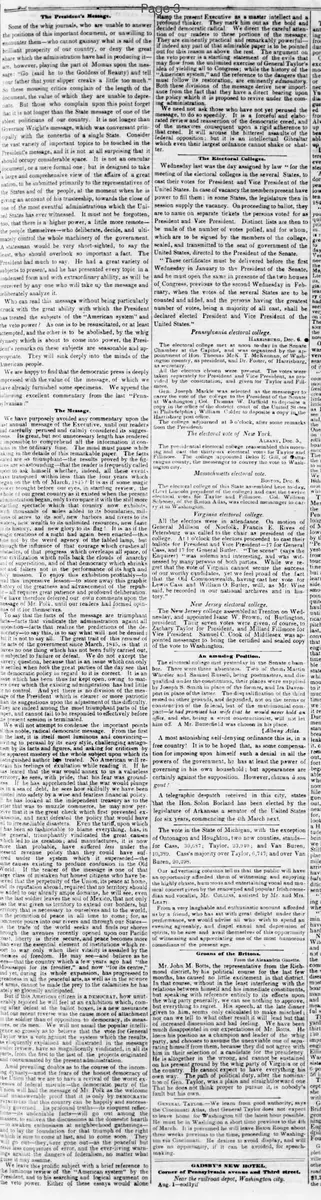
Some of the whig journals, who are unable to answer the positions of this important document, or unwilling to encounter them—who cannot gainsay what is said of the brilliant prosperity of our country, or deny the great share which the administration have had in producing it—are, however, playing the part of Momus upon the message: "Go (said he to the Goddess of Beauty) and tell your father that your slipper creaks a little too much."
So these mousing critics complain of the length of the document, the value of which they are unable to depreciate. But those who complain upon this point forget that it is not longer than the State message of one of the ablest politicians of our country. It is not longer than Governor Wright's message, which was conversant principally with the concerns of a single State. Consider the vast variety of important topics to be touched in the President's message, and it is not at all surprising that it should occupy considerable space. It is not an oracular document, or a mere formal one; but is designed to take a large and comprehensive view of the affairs of a great nation, to be submitted primarily to the representatives of the States and of the people, at the moment when he is giving an account of his trusteeship, towards the close of one of the most eventful administrations which the United States has ever witnessed. It must not be forgotten, too, that there is a higher power, a little more remote—the people themselves—who deliberate, decide, and ultimately control the whole machinery of the government. A statesman would be very short-sighted, to say the least, who should overlook so important a fact. The President had much to say. He had a great variety of subjects to present, and he has presented every topic in a condensed form and with extraordinary ability, as will be perceived by any one who will take up the message and deliberately analyze it.
Who can read this message without being particularly struck with the great ability with which the President has treated the subjects of the "American system" and the veto power? As one is to be resuscitated, or at least attempted, and the other is to be abolished, by the whig dynasty which is about to come into power, the President's remarks on these subjects are seasonable and appropriate. They will sink deeply into the minds of the American people.
We are happy to find that the democratic press is deeply impressed with the value of the message, of which we have already furnished some specimens. We append the following excellent commentary from the last "Pennsylvanian:"
The Message,
We have purposely avoided any commentary upon the last annual message of the Executive, until our readers had carefully perused and calmly considered its suggestions. Its great, but not unnecessary length has rendered impossible to comprehend all the information it contains in the ordinary time. The mind must pause while taking in the details of this remarkable paper. The facts detailed are so triumphant—the results proved by the figures are so astounding—that the reader is frequently called upon to ask himself whether, indeed, all these events have transpired within less than the four years which began on the 4th of March, 1845? It is as if some magic power brought before our eyes, in startling review, the whole of our great country as it existed when the present administration began, only to compare it with the still more startling spectacle which that country now exhibits—with thousands of miles added to its boundaries, millions of acres to its soil, new harbors and rivers to its waters, new wealth to its unlimited resources, new fame to its history, and new glory to its flag! It is as if the magic creations of a night had again been enacted—this time not by the weird agency of the fabled lamp, but through the influence of that courage which crushes all obstacles, of that progress which overleaps all space, of that civilization which rolls back the clouds of anarchy and of superstition, and of that democracy which shrinks not and falters not in the performance of its high and holy mission. To enjoy this exhibition profitably—to read this impressive lesson—to store away this graphic story of the greatness and advancement of the republic—all requires great patience and profound deliberation. We have therefore deferred our own comments upon the message of Mr. Polk, until our readers had formed opinions of it for themselves.
To say that the facts of the message are triumphant facts—facts that vindicate the administration against all opposition—facts that realize the predictions of the democracy—to say this, is to say what will not be denied: but it is not to say all. The great trait of this résumé of the acts of the government since March, 1845, is that it leaves no one thing which has not been fully carried out, or subjected to failure or defeat. We do not except the slavery question, because that is an issue which can only be settled when both the great parties of the day see that the democratic policy in regard to it is correct. It is an issue which has been thus far kept open, owing to matters over which the existing administration has had little or no control. And yet there is no division of the message of the President which is clearer or more patriotic than its suggestions upon the adjustment of this difficulty. They are indeed among the most triumphant parts of the paper, and cannot fail to be responded to effectively before the present session is terminated.
We will not attempt to condense the important points of this noble, radical democratic message. From the first to the last, it is itself most luminous and convincing—inviting to perusal by its easy style, challenging antagonism by its facts and figures, and asking for criticism by the apparent mastery of the whole subject upon which its distinguished author has treated. No American will restrain his feelings of exultation while reading it. If he has feared that the war would annex to us a valueless territory, he sees, with pride, that his fear was groundless. If he has apprehended that the war would plunge us in a sea of debt, he sees how skilfully we have been floated into safety by a wise and fearless financial policy. If he has looked at the independent treasury as the fetter that was to muzzle commerce, he may now perceive that it is the great check which first prevented expansions, and next defeated the policy that would have led to irretrievable disasters. Even the tariff, upon which it has been so fashionable to blame everything, has, in the general, triumphantly vindicated the great causes which led to its creation; and manufactures, it is now more than probable, have suffered less under the present revenue policy than they could have suffered under the system which it superseded—the same causes existing to produce confusion in the Old World. If the reader of the message is one of that large class of mistaken but honest citizens who have believed that the perpetuity of the Union, its peace at home, and its reputation abroad, required that no territory should be added to our already ample domains, he will see, even as the last soldier leaves the soil of Mexico, that not only has the war given us territory to extend our borders, but territory that is necessary to ourselves and to the world, in the promotion of peace in all time to come; for, as commerce pours into our rivers and through our States—as the trade of the world seeks and finds our shores through the avenues recently opened upon our Pacific coast, liberty is thrice secure, and peace becomes more than ever the essential element of institutions which resort to war only when their vitality is assailed by the enemies of freedom. He may see—and believe as he sees—that the country which a few years ago had "the Mississippi for its frontier," and now "for its centre," and yet, during its whole expansion, has progressed to greatness in all the peaceful arts, as well as in the science of arms, cannot be made the prey to the calamities he has lately so gloomily anticipated.
But if this American citizen is a democrat, how unutterably rejoiced he will feel at an exhibition which, coming after defeat at the ballot boxes, is a new assurance that our recent reverse was the cause more of attachment to the soldier than of opposition to democracy, its measures, or its men. We will not assail the popular intelligence so grossly as to believe that the vote for General Taylor was a vote against the system which the results, as eloquently explained and illustrated in the message under review, have so magnificently vindicated, in all its parts, from the first to the last of the projects originated and consummated by the present administration.
Amid prevailing doubts as to the course of the incoming dynasty—amid the fears of the honest democracy of The Union that we are to have a revival of the worst excesses of federal misrule—the democratic party of the Union will hail the message of Mr. Polk as the welcome and unanswerable proof that it is only by Democratic principles that this country can be happily and successfully governed. Its profound truths—its eloquent reflections—its undeniable facts—will go out among the masses, to enliven the discussions at the domestic hearth—to awaken enthusiasm at neighborhood gatherings—and to lay the foundation for that triumph of the right which is sure to come at last, and to come soon. They will go out—they have gone out—as the peaceful but resistless conquerors of error, and the ever-living warnings against the dangers of federalism, no matter what guise it may assume.
We leave this prolific subject with a brief reference to the luminous review of the "American system" by the President, and to his searching and logical argument on the veto power. Either of these essays would alone stamp the present Executive as a master intellect and a profound thinker. They mark him out as the bold and decided democratic radical. We direct the careful attention of our readers to these portions of the message. They are eminently practical and remarkably powerful—if indeed any part of that admirable paper is to be pointed out for this reason as above the rest. The argument on the veto power is a startling statement of the evils that may flow from the unlimited exercise of General Taylor's idea of yielding all to Congress; while the history of the "American system," and the reference to the dangers that must follow its restoration, are eminently admonitory. Both these divisions of the message derive new importance from the fact that they have a direct bearing upon the policy which it is proposed to revive under the coming administration.
We need not ask those who have not yet perused the message, to do so speedily. It is a forceful and elaborated review and reassertion of the democratic creed, and of the measures consequent upon a rigid adherence to that creed. It will arouse the bitterest assaults of the federal opposition; but it is an intellectual Gibraltar which even their largest ordnance cannot shake or shatter.
So these mousing critics complain of the length of the document, the value of which they are unable to depreciate. But those who complain upon this point forget that it is not longer than the State message of one of the ablest politicians of our country. It is not longer than Governor Wright's message, which was conversant principally with the concerns of a single State. Consider the vast variety of important topics to be touched in the President's message, and it is not at all surprising that it should occupy considerable space. It is not an oracular document, or a mere formal one; but is designed to take a large and comprehensive view of the affairs of a great nation, to be submitted primarily to the representatives of the States and of the people, at the moment when he is giving an account of his trusteeship, towards the close of one of the most eventful administrations which the United States has ever witnessed. It must not be forgotten, too, that there is a higher power, a little more remote—the people themselves—who deliberate, decide, and ultimately control the whole machinery of the government. A statesman would be very short-sighted, to say the least, who should overlook so important a fact. The President had much to say. He had a great variety of subjects to present, and he has presented every topic in a condensed form and with extraordinary ability, as will be perceived by any one who will take up the message and deliberately analyze it.
Who can read this message without being particularly struck with the great ability with which the President has treated the subjects of the "American system" and the veto power? As one is to be resuscitated, or at least attempted, and the other is to be abolished, by the whig dynasty which is about to come into power, the President's remarks on these subjects are seasonable and appropriate. They will sink deeply into the minds of the American people.
We are happy to find that the democratic press is deeply impressed with the value of the message, of which we have already furnished some specimens. We append the following excellent commentary from the last "Pennsylvanian:"
The Message,
We have purposely avoided any commentary upon the last annual message of the Executive, until our readers had carefully perused and calmly considered its suggestions. Its great, but not unnecessary length has rendered impossible to comprehend all the information it contains in the ordinary time. The mind must pause while taking in the details of this remarkable paper. The facts detailed are so triumphant—the results proved by the figures are so astounding—that the reader is frequently called upon to ask himself whether, indeed, all these events have transpired within less than the four years which began on the 4th of March, 1845? It is as if some magic power brought before our eyes, in startling review, the whole of our great country as it existed when the present administration began, only to compare it with the still more startling spectacle which that country now exhibits—with thousands of miles added to its boundaries, millions of acres to its soil, new harbors and rivers to its waters, new wealth to its unlimited resources, new fame to its history, and new glory to its flag! It is as if the magic creations of a night had again been enacted—this time not by the weird agency of the fabled lamp, but through the influence of that courage which crushes all obstacles, of that progress which overleaps all space, of that civilization which rolls back the clouds of anarchy and of superstition, and of that democracy which shrinks not and falters not in the performance of its high and holy mission. To enjoy this exhibition profitably—to read this impressive lesson—to store away this graphic story of the greatness and advancement of the republic—all requires great patience and profound deliberation. We have therefore deferred our own comments upon the message of Mr. Polk, until our readers had formed opinions of it for themselves.
To say that the facts of the message are triumphant facts—facts that vindicate the administration against all opposition—facts that realize the predictions of the democracy—to say this, is to say what will not be denied: but it is not to say all. The great trait of this résumé of the acts of the government since March, 1845, is that it leaves no one thing which has not been fully carried out, or subjected to failure or defeat. We do not except the slavery question, because that is an issue which can only be settled when both the great parties of the day see that the democratic policy in regard to it is correct. It is an issue which has been thus far kept open, owing to matters over which the existing administration has had little or no control. And yet there is no division of the message of the President which is clearer or more patriotic than its suggestions upon the adjustment of this difficulty. They are indeed among the most triumphant parts of the paper, and cannot fail to be responded to effectively before the present session is terminated.
We will not attempt to condense the important points of this noble, radical democratic message. From the first to the last, it is itself most luminous and convincing—inviting to perusal by its easy style, challenging antagonism by its facts and figures, and asking for criticism by the apparent mastery of the whole subject upon which its distinguished author has treated. No American will restrain his feelings of exultation while reading it. If he has feared that the war would annex to us a valueless territory, he sees, with pride, that his fear was groundless. If he has apprehended that the war would plunge us in a sea of debt, he sees how skilfully we have been floated into safety by a wise and fearless financial policy. If he has looked at the independent treasury as the fetter that was to muzzle commerce, he may now perceive that it is the great check which first prevented expansions, and next defeated the policy that would have led to irretrievable disasters. Even the tariff, upon which it has been so fashionable to blame everything, has, in the general, triumphantly vindicated the great causes which led to its creation; and manufactures, it is now more than probable, have suffered less under the present revenue policy than they could have suffered under the system which it superseded—the same causes existing to produce confusion in the Old World. If the reader of the message is one of that large class of mistaken but honest citizens who have believed that the perpetuity of the Union, its peace at home, and its reputation abroad, required that no territory should be added to our already ample domains, he will see, even as the last soldier leaves the soil of Mexico, that not only has the war given us territory to extend our borders, but territory that is necessary to ourselves and to the world, in the promotion of peace in all time to come; for, as commerce pours into our rivers and through our States—as the trade of the world seeks and finds our shores through the avenues recently opened upon our Pacific coast, liberty is thrice secure, and peace becomes more than ever the essential element of institutions which resort to war only when their vitality is assailed by the enemies of freedom. He may see—and believe as he sees—that the country which a few years ago had "the Mississippi for its frontier," and now "for its centre," and yet, during its whole expansion, has progressed to greatness in all the peaceful arts, as well as in the science of arms, cannot be made the prey to the calamities he has lately so gloomily anticipated.
But if this American citizen is a democrat, how unutterably rejoiced he will feel at an exhibition which, coming after defeat at the ballot boxes, is a new assurance that our recent reverse was the cause more of attachment to the soldier than of opposition to democracy, its measures, or its men. We will not assail the popular intelligence so grossly as to believe that the vote for General Taylor was a vote against the system which the results, as eloquently explained and illustrated in the message under review, have so magnificently vindicated, in all its parts, from the first to the last of the projects originated and consummated by the present administration.
Amid prevailing doubts as to the course of the incoming dynasty—amid the fears of the honest democracy of The Union that we are to have a revival of the worst excesses of federal misrule—the democratic party of the Union will hail the message of Mr. Polk as the welcome and unanswerable proof that it is only by Democratic principles that this country can be happily and successfully governed. Its profound truths—its eloquent reflections—its undeniable facts—will go out among the masses, to enliven the discussions at the domestic hearth—to awaken enthusiasm at neighborhood gatherings—and to lay the foundation for that triumph of the right which is sure to come at last, and to come soon. They will go out—they have gone out—as the peaceful but resistless conquerors of error, and the ever-living warnings against the dangers of federalism, no matter what guise it may assume.
We leave this prolific subject with a brief reference to the luminous review of the "American system" by the President, and to his searching and logical argument on the veto power. Either of these essays would alone stamp the present Executive as a master intellect and a profound thinker. They mark him out as the bold and decided democratic radical. We direct the careful attention of our readers to these portions of the message. They are eminently practical and remarkably powerful—if indeed any part of that admirable paper is to be pointed out for this reason as above the rest. The argument on the veto power is a startling statement of the evils that may flow from the unlimited exercise of General Taylor's idea of yielding all to Congress; while the history of the "American system," and the reference to the dangers that must follow its restoration, are eminently admonitory. Both these divisions of the message derive new importance from the fact that they have a direct bearing upon the policy which it is proposed to revive under the coming administration.
We need not ask those who have not yet perused the message, to do so speedily. It is a forceful and elaborated review and reassertion of the democratic creed, and of the measures consequent upon a rigid adherence to that creed. It will arouse the bitterest assaults of the federal opposition; but it is an intellectual Gibraltar which even their largest ordnance cannot shake or shatter.
What sub-type of article is it?
Partisan Politics
Economic Policy
War Or Peace
What keywords are associated?
Polk Message
Democratic Administration
Whig Criticism
American System
Veto Power
Mexican War
Territorial Expansion
Financial Policy
What entities or persons were involved?
President Polk
Whig Journals
Governor Wright
General Taylor
Democratic Press
Pennsylvanian
Editorial Details
Primary Topic
Defense Of President Polk's Annual Message
Stance / Tone
Strongly Supportive Of Democratic Administration And Polk's Policies, Critical Of Whigs
Key Figures
President Polk
Whig Journals
Governor Wright
General Taylor
Democratic Press
Pennsylvanian
Key Arguments
Message Length Justified By Comprehensive Coverage Of National Affairs
Polk's Administration Achieved Brilliant Prosperity And Expansion
Triumphant Facts Vindicate Democratic Policies Against Opposition
War With Mexico Added Valuable Territory Without Debt Or Disaster
American System And Veto Power Critiques Warn Against Whig Revival
Message Reasserts Democratic Creed For Future Success