Thank you for visiting SNEWPapers!
Sign up free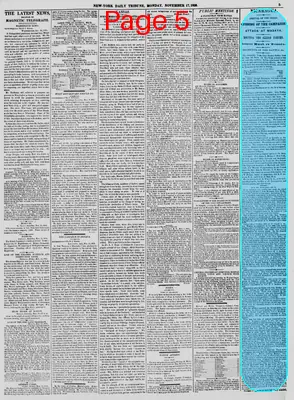
New York Daily Tribune
New York, New York County, New York
What is this article about?
The steamship Texas arrived with news from Nicaragua to November 1, 1856, reporting Gen. Walker's forces of 2,000 men preparing for battle at Masaya and Leon after previous victories. Details include the October 11 march from Granada, army composition, high spirits, and economic notes on mines and a state survey. Passengers include Nicaraguan and US officials.
Clipping

OCR Quality
Full Text
ARRIVAL OF THE TEXAS.
OPENING OF THE CAMPAIGN.
ATTACK AT MASAYA.
ROUTING THE ALLIED FORCES.
Counter March on Granada.
INCIDENTS OF THE BATTLE. &c.
The steamship Texas, Capt. Thomas Forbes, from San Juan del Norte, via Key West, arrived at this port yesterday morning, having experienced heavy northerly gales since leaving Cape Florida. She connected with the steamship Sierra Nevada, which left San Francisco on the 20th of October.
SPECIE LIST OF THE TEXAS
Charles Morgan... $101,104
O. H. Wines & Co. 25,947
G. Durand. Total, $127,051
The transit through Nicaragua was made without any detention, the boats being in excellent condition, and the River San Juan much higher than at any time during the last season.
Our dates from Nicaragua are to the 1st of November.
Everything is quiet since the battle. Gen. Walker was awaiting the arrival of the recruits from the United States before marching upon Masaya and Leon. In the mean time, Gen. Heningsen, who superseded Gen. Guardia, has been very active in drilling his brigade with the mountain howitzers and mortars, which arrived after the battles of October 12 and 18, and in instructing the men in the use of the Minie rifle, many of whom have already attained great proficiency. Walker's army now consists of about 2,000 fighting men, including the recent reinforcements under Col. Jacques.
They are in high spirits, and extremely anxious for another engagement with the enemy. The brutal and unprovoked murder of unarmed American citizens at Granada, on the 17th ult., created the strongest feeling of indignation throughout the Nicaraguan army, and they are all eager for revenge.
It was expected that Walker would fight a decisive battle about the 5th or 10th inst., unless the enemy retreated too rapidly before him.
The steamer La Virgin arrived at Granada on the 30th ult., from Ubaldi, in Chontales, with a full freight of cattle, corn, and rice. Everything was quiet in that department. The accounts from the mines were very favorable. Another rich silver vein has been opened and extensive copper mines have been discovered in the neighborhood of Boaco.
A topographical and geological survey of the State is to be made. Prof. James T. Hodge, of New-York, has been appointed State Surveyor and Geologist.
Among the passengers by the Texas are Don Fermin Ferrer, formerly Provisional President of the Republic of Nicaragua and Secretary of Hacienda and Public Credit, now Minister Plenipotentiary to the United States; the Hon. John H. Wheeler, U. S. Minister to Nicaragua, who returns on account of his health; Col. J. W. Fabens, bearer of dispatches; Col. B. F. Anderson, N. A., and Col. G. B. Hall, N. A.
We are indebted to C. H. Wines & Co., of the California Express Co., for files of El Nicaraguense and California papers, and other favors.
From The Nicaraguense, Oct. 18.
As we informed our readers last week, the Allied forces having advanced from Managua, Gen. Walker ordered the garrison at that place, amounting to 350 men, to fall back immediately on Granada, in order to allow the enemy to occupy that place. This they did; and it was the unanimous wish of every American in Granada that their apparent success would inspire them with sufficient courage to attack this city. Such an attack could be followed only by one result—a most disastrous defeat. The citizens—that is, the persons not belonging to the army, but engaged in trade and attending to the civil business of the State—formed themselves into a company to assist in the defense of this city, and participate in the glory of a victory.
But, as the enemy would not come, Gen. Walker, having received a reinforcement from the United States, as well as two mountain howitzers, and shells—grape-shot, &c., advanced on to Masaya to give them battle.
On the 11th of October, 1856, at 11 o'clock a. m., Gen. Walker, accompanied by his staff, rode across the large plaza of Granada to put himself at the head of the advancing columns. The troops were formed into battalions at various places. As the General passed them he was greeted with loud cheers.
On the level ground in the vicinity of the Jalteba Church near to the quarters of the First Rifles, he halted until the troops ordered to march had all arrived. About twenty minutes only were consumed by this delay. The First Rifle battalion was in the front. As soon as the General halted they took up their line of march, and passed, headed by a fife and drum. The colors of the battalion were those that had but a few days previously been presented to them by the mother and sisters of the Colonel commanding them—E. J. Sanders.
The Second Rifles and Infantry came on headed by the military band. On the colors of the Second Rifles were the words, "Victory or Death," a sentiment that might be read in the countenances of every soldier of the entire force as plainly as if it was written there.
The First and Second Infantry followed those, and with the Minies, with which they were lately armed, appeared like men who were fully equal to any emergency.
Each soldier of the entire command was served with rations for three days. They were in excellent spirits; they looked active and strong; and the manner in which they conducted themselves proved that they were under strict discipline.
The order to move forward was given—two companies of Rangers, under the command of Major Waters, forming the advance guard. The First Rifle Battalion, commanded by Col. E. J. Sanders, were next.
Immediately after the Rifles rode Gen. Walker and his staff. Among his staff officers were Gen. Carrasco and Gen. Pineda. These were followed by the body-guard of the General, who are distinguishable by their sky-blue uniforms with red facings. In this party were also several gentlemen volunteers.
Following the General's guard were the pack mules, bearing ammunition, &c., and the two mountain howitzers, which were in charge of Capt. Swartz and Lieut. Farren, with the necessary number of men for their proper working.
After the artillery marched the Second Rifles, Col. Jack Allen; the First Light Infantry, Col. John Markham; the Second Light Infantry, Col. J. McIntosh.
All the latter were under the command of Brig. Gen. Hornsby.
On the extreme rear were mounted Rangers.
There was but little of interest transpired on the march out. It rained a shower or two, and the men halted about midway to take something to eat. They were all in excellent spirits, and compared themselves to a large pic-nic party. The road in the vicinity of Granada was very difficult for pedestrians. While closing over a very bad spot, some one requested Gen. Carrascosa to allow him to ride behind him on his mule; the General consented, but instead of getting a deck passage, as he hoped, the person who applied succeeded in pulling the General off his mule, falling into the mud. The incident excited a laugh that ran along the entire line; and indeed men in good humor often laugh at a less ludicrous circumstance.
The General's mule was not called upon to carry double during the remainder of the distance.
The utmost good order was observed. There were no stragglers, nor were there any that appeared anxious to remain behind. Before entering Masaya, Gen. Walker ordered a halt, in order to allow every man to rest half an hour, and have all things put into the most complete working order. At about 10 o'clock the entire force was encamped in the outskirts of Masaya.
The clouds which had hung loweringly during the afternoon all cleared away in the early part of the evening. The moon—near its full—arose in splendid majesty and by its light we could see at a distance of about seven hundred yards the roof of the upper church, which was, we supposed, in the morning to be the scene of a severe conflict. Everything in the city was as still as if a pall of death was hanging over it. Across the lake Masaya was distinctly visible, rising silently smoke from the volcano of Mount Masaya. Those of our soldiers who were not on picket or other service, spread their blankets on the ground for a sleep, with as much apparent unconcern as if an enemy was not in the country.
The hum of voices in our camp had nearly subsided.
What sub-type of article is it?
What keywords are associated?
What entities or persons were involved?
Where did it happen?
Foreign News Details
Primary Location
Nicaragua
Event Date
November 1, 1856
Key Persons
Outcome
everything quiet since battles of october 12 and 18; walker's army of 2,000 men awaiting recruits; expected decisive battle around 5th or 10th november; favorable mine reports and state survey planned.
Event Details
Steamship Texas arrived with Nicaraguan news to November 1. Gen. Walker's forces, 2,000 strong, drill with new artillery and rifles, eager after Granada murders. Detailed account of October 11, 1856 march from Granada to Masaya: troops formed, advanced with Rangers, Rifles, Infantry, artillery; halted midway, encamped outskirts; high spirits and discipline noted. Transit smooth, specie $127,051; passengers include officials; quiet in Chontales with new mines discovered.