Thank you for visiting SNEWPapers!
Sign up free
The Nome Nugget
Nome, Nome County, Alaska
What is this article about?
Scientists at the Smithsonian Astrophysical Observatory predict that Russia's Sputnik II satellite, with its dead dog passenger, will burst apart upon re-entering Earth's atmosphere, possibly on Saturday, due to internal air tanks. It may appear as a flaming meteor at night or a smoke plume by day. Visible tonight over northern US and Canada.
Clipping
OCR Quality
Full Text
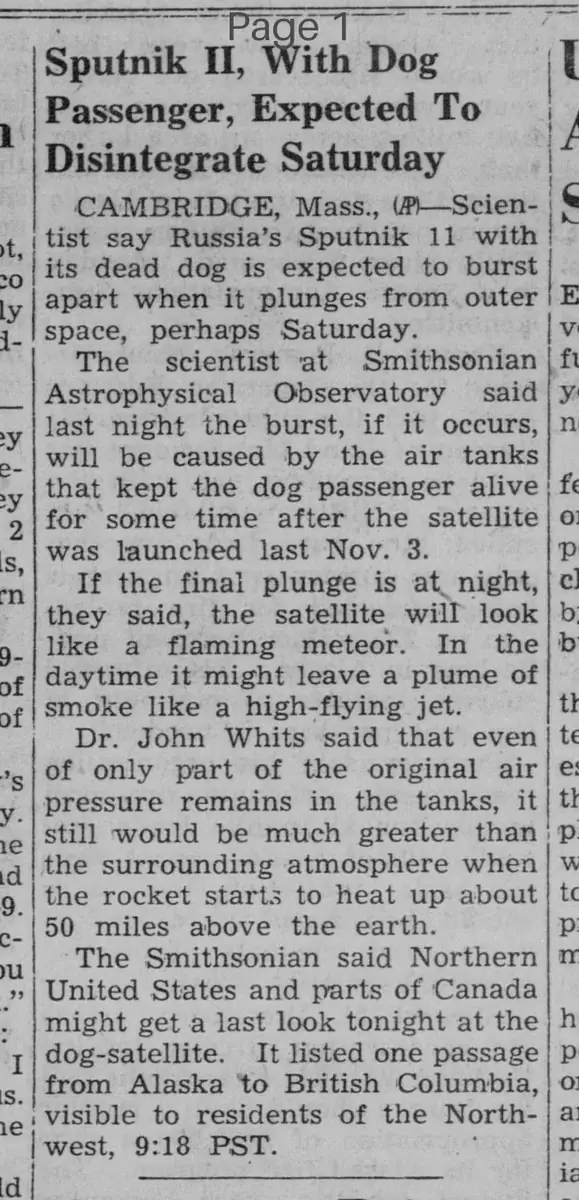
CAMBRIDGE, Mass., (AP) Scientists say Russia's Sputnik II with its dead dog is expected to burst apart when it plunges from outer space, perhaps Saturday.
The scientists at Smithsonian Astrophysical Observatory said last night the burst, if it occurs, will be caused by the air tanks that kept the dog passenger alive for some time after the satellite was launched last Nov. 3.
If the final plunge is at night, they said, the satellite will look like a flaming meteor. In the daytime it might leave a plume of smoke like a high-flying jet.
Dr. John Hynek said that even if only part of the original air pressure remains in the tanks, it still would be much greater than the surrounding atmosphere when the rocket starts to heat up about 50 miles above the earth.
The Smithsonian said Northern United States and parts of Canada might get a last look tonight at the dog-satellite. It listed one passage from Alaska to British Columbia visible to residents of the Northwest, 9:18 PST.
What sub-type of article is it?
What keywords are associated?
What entities or persons were involved?
Where did it happen?
Foreign News Details
Primary Location
Russia
Event Date
Launched Last Nov. 3; Expected Saturday
Key Persons
Outcome
satellite expected to burst apart; dog passenger dead
Event Details
Russia's Sputnik II satellite, with its dead dog passenger kept alive initially by air tanks after launch on Nov. 3, is expected to disintegrate upon re-entry, possibly Saturday, due to pressurized tanks. It may resemble a flaming meteor at night or a daytime smoke plume. Visible tonight over northern US and Canada.