Thank you for visiting SNEWPapers!
Sign up free
Litchfield Enquirer
Litchfield, Litchfield County, Connecticut
What is this article about?
In 1712, astronomer Mr. Whiston's prediction of a comet on October 14 foretelling the world's fiery end sparked panic in London. People seized boats on the Thames, stocks plummeted, clergymen sought prayers, and thousands of mistresses married hastily, with the Bank on high alert.
Clipping
OCR Quality
Full Text
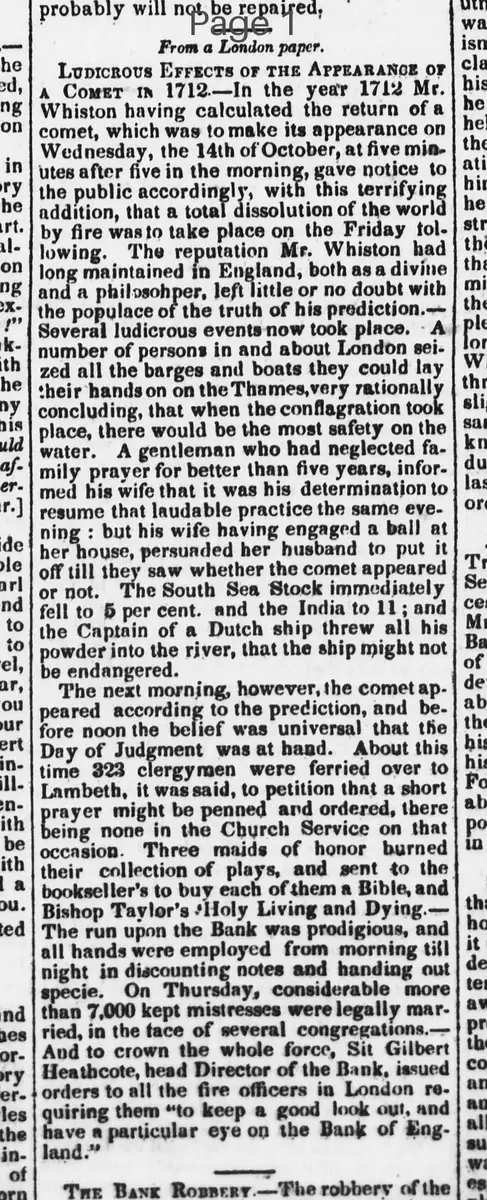
Ludicrous Effects of the Appearance of
A Comet in 1712.—In the year 1712 Mr.
Whiston having calculated the return of a
comet, which was to make its appearance on
Wednesday, the 14th of October, at five minutes
after five in the morning, gave notice to
the public accordingly, with this terrifying
addition, that a total dissolution of the world
by fire was to take place on the Friday following.
The reputation Mr. Whiston had
long maintained in England, both as a divine
and a philosopher, left little or no doubt with
the populace of the truth of his prediction.—
Several ludicrous events now took place,— A
number of persons in and about London seized
all the barges and boats they could lay
their hands on on the Thames, very rationally
concluding, that when the conflagration took
place, there would be the most safety on the
water. A gentleman who had neglected family
prayer for better than five years, informed
his wife that it was his determination to
resume that laudable practice the same evening:
but his wife having engaged a ball at
her house, persuaded her husband to put it
off till they saw whether the comet appeared
or not. The South Sea Stock immediately
fell to 5 per cent. and the India to 1 1/2; and
the Captain of a Dutch ship threw all his
powder into the river, that the ship might not
be endangered.
The next morning, however, the comet appeared
according to the prediction, and before
noon the belief was universal that the
Day of Judgment was at hand. About this
time 323 clergymen were ferried over to
Lambeth, it was said, to petition that a short
prayer might be penned and ordered, there
being none in the Church Service on that
occasion. Three maids of honor burned
their collection of plays, and sent to the
bookseller's to buy each of them a Bible, and
Bishop Taylor's Holy Living and Dying.—
The run upon the Bank was prodigious, and
all hands were employed from morning till
night in discounting notes and handing out
specie. On Thursday, considerable more
than 7,000 kept mistresses were legally married,
in the face of several congregations.—
And to crown the whole farce. Sir Gilbert
Heathcote, head Director of the Bank, issued
orders to all the fire officers in London to
requiring them "to keep a good look out, and
have a particular eye on the Bank of England."
What sub-type of article is it?
What themes does it cover?
What keywords are associated?
What entities or persons were involved?
Where did it happen?
Story Details
Key Persons
Location
London, Thames, Lambeth
Event Date
1712 10 14
Story Details
Mr. Whiston's prediction of a comet on October 14, 1712, signaling the world's end by fire on the following Friday caused panic: people seized boats for safety, stocks fell, a gentleman delayed prayers for a ball, a Dutch captain dumped powder, clergymen sought new prayers, maids burned plays for Bibles, bank runs occurred, thousands married, and the Bank ordered fire watch.