Thank you for visiting SNEWPapers!
Sign up free
Story
July 6, 1906
The Hawaiian Star
Honolulu, Honolulu County, Hawaii
What is this article about?
Detailed account of Harry K. Thaw's murder of architect Stanford White in New York, including legal proceedings, Thaw's insanity defense efforts, Evelyn Nesbit Thaw's backstory of White's alleged persecution, prior assault on White, and witness testimonies.
Clipping
OCR Quality
95%
Excellent
Full Text
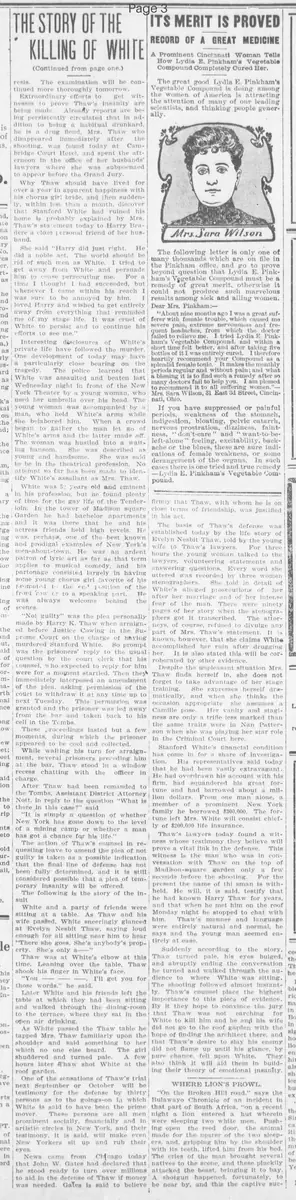
THE STORY OF THE KILLING OF WHITE
(Continued from page one.)
...resis. The examination will be continued more thoroughly tomorrow.
Extraordinary efforts to get witnesses to prove Thaw's insanity are being made. Already reports are being persistently circulated that in addition to being a habitual drunkard, he is a drug fiend. Mrs. Thaw who disappeared immediately after the shooting, was found today at Cambridge Court Hotel, and spent the afternoon in the office of her husband's lawyers where she was subpoenaed to appear before the Grand Jury.
Why Thaw should have lived for over a year in apparent happiness with his chorus girl bride, and then suddenly, within less than a month, discover that Stanford White had ruined his home is probably explained by Mrs. Thaw's statement today to Harry Brader, a close personal friend of her husband.
She said "Harry did just right. He did a noble act. The world should be rid of such men as White. I tried to get away from White and persuade him to cease persecuting me. For a time I thought I had succeeded, but whenever I came within his reach I was sure to be annoyed by him. I loved Harry and wished to get entirely away from everything that reminded me of my stage life. It was cruel of White to persist and to continue his efforts to see me."
Interesting disclosures of White's private life have followed the murder. One development of today may have a particularly close bearing on the tragedy.
The police learned that White was assaulted and beaten last Wednesday night in front of the New York Theater by a young woman, who used her umbrella over his head. The young woman was accompanied by a man, who held White's arms while she belabored him.
When a crowd began to gather the man let go of White's arms and the latter made off. The woman was hustled into a waiting hansom. She was described as young and handsome. She was said to be in the theatrical profession. No attempt so far has been made to identify White's assailant as Mrs. Thaw.
White was 57 years old and eminent in his profession, but he found plenty of time for the gay life of the Tenderloin. In the tower of Madison Square Garden he had bachelor apartments and it was there that he and his actress friends held high revels. He was, perhaps, one of the best known and prodigal examples of New York's men-about-town. He was an ardent patron of lyric art as far as that term applies to musical comedy, and his patronage consisted largely in having some young chorus girl favorite of his promote from the front row to a speaking part. He was always welcome behind the scenes.
"Not guilty" was the plea personally made by Harry K. Thaw when arraigned before Justice Cowing in the Supreme Court on the charge of having murdered Stanford White. So prompt was the prisoner's reply to the usual question by the court clerk that his counsel, who expected to reply for him were for a moment startled. Then they immediately interposed an amendment of the plea, asking permission of the court to withdraw it at any time up to next Tuesday. This permission was granted and the prisoner was led away from the bar and taken back to his cell in the Tombs.
These proceedings lasted but a few moments, during which the prisoner appeared to be cool and collected.
While waiting his turn for arraignment, several prisoners preceding him at the bar, Thaw stood in a window recess chatting with the officer in charge.
After Thaw had been remanded to the Tombs, Assistant District Attorney Nott, in reply to the question "What is there in this case?" said "It is simply a question of whether New York has gone down to the level of a mining camp or whether a man has got a chance for his life."
The action of Thaw's counsel in requesting leave to amend the plea of not guilty is taken as a possible indication that the final line of defense has not been fully determined, and it is still considered possible that a plea of temporary insanity will be offered.
The following is the story of the insult
White and a party of friends were sitting at a table. As Thaw and his wife passed, White sneeringly glanced at Evelyn Nesbit Thaw, saying loud enough for all sitting near him to hear "There she goes. She's anybody's property. She's only a"
Thaw was at White's elbow at this time. Leaning over the table, Thaw shook his finger in White's face.
"You — —. I'll get you for those words," he said.
Later White and his friends left the table at which they had been sitting and walked through the dining-room to the terrace, where they sat in the open air drinking.
As White passed the Thaw table he tapped Mrs. Thaw familiarly upon the shoulder and said something to her which no one else heard.
The girl shuddered and turned pale.
A few hours later Thaw shot White at the roof garden.
One of the sensations of Thaw's trial next September or October will be testimony for the defense by thirty persons as to the goings-on in which White is said to have been the prime mover.
These persons are all men prominent socially, financially and in artistic circles in New York, and their testimony, it is said, will make even New Yorkers sit up and rub their eyes.
News came from Chicago today that John W. Gates had declared that he stood ready to turn over millions to aid in the defense of Thaw if money was needed. Gates is said to believe firmly that Thaw, with whom he is on close terms of friendship, was justified in his act.
The basis of Thaw's defense was established today by the life story of Evelyn Nesbit Thaw, told by the young wife to Thaw's lawyers. For three hours the young woman talked to the lawyers, volunteering statements and answering questions. Every word she uttered was recorded by three women stenographers. She told in detail of White's alleged prosecutions of her after her marriage and of her intense fear of the man. There were ninety pages of her story when the stenographers got it transcribed. The attorneys, of course, refused to divulge any part of Mrs. Thaw's statement. It is known, however, that she claims White accomplished her ruin after drugging her. It is also stated this will be corroborated by other evidence.
Despite the unpleasant situation Mrs. Thaw finds herself in, she does not forget to take advantage of her stage training. She expresses herself dramatically, and when she thinks the occasion appropriate she assumes a Camille pose. Her vanity and staginess are only a trifle less marked than the same traits were in Nan Patterson when she was playing her star role in the Criminal Court here.
Stanford White's financial condition has come in for a share of investigation. His representatives said today that he had been vastly extravagant. He had overdrawn his account with his firm, had squandered his great fortune and had borrowed about a million dollars. From one man alone, a member of a prominent New York family he borrowed $300,000. The fortune left Mrs. White will consist chiefly of $200,000 life insurance.
Thaw's lawyers today found a witness whose testimony they believe will prove a vital link in the defense. This witness is the man who was in conversation with Thaw on the top of Madison Square Garden only a few seconds before the shooting. For the present the name of this man is withheld. He will, it is said, testify that he had known Harry Thaw for years, and that when he met him on the roof Monday night he stopped to chat with him. Thaw's manner and language were entirely natural and normal, he says and the young man seemed entirely at ease.
Suddenly according to the story, Thaw turned pale, his eyes bulged, and abruptly ending the conversation he turned and walked through the audience to where White was sitting.
The shooting followed almost instantly. Thaw's counsel place the highest importance to this piece of evidence.
By it they hope to convince the jury that Thaw was not searching for White to kill him and he and his wife did not go to the roof garden with the hope of finding the architect there, and that Thaw's desire to slay his enemy did not flame up until his glance, by pure chance, fell upon White. They also think it will aid them in building their theory of emotional insanity.
(Continued from page one.)
...resis. The examination will be continued more thoroughly tomorrow.
Extraordinary efforts to get witnesses to prove Thaw's insanity are being made. Already reports are being persistently circulated that in addition to being a habitual drunkard, he is a drug fiend. Mrs. Thaw who disappeared immediately after the shooting, was found today at Cambridge Court Hotel, and spent the afternoon in the office of her husband's lawyers where she was subpoenaed to appear before the Grand Jury.
Why Thaw should have lived for over a year in apparent happiness with his chorus girl bride, and then suddenly, within less than a month, discover that Stanford White had ruined his home is probably explained by Mrs. Thaw's statement today to Harry Brader, a close personal friend of her husband.
She said "Harry did just right. He did a noble act. The world should be rid of such men as White. I tried to get away from White and persuade him to cease persecuting me. For a time I thought I had succeeded, but whenever I came within his reach I was sure to be annoyed by him. I loved Harry and wished to get entirely away from everything that reminded me of my stage life. It was cruel of White to persist and to continue his efforts to see me."
Interesting disclosures of White's private life have followed the murder. One development of today may have a particularly close bearing on the tragedy.
The police learned that White was assaulted and beaten last Wednesday night in front of the New York Theater by a young woman, who used her umbrella over his head. The young woman was accompanied by a man, who held White's arms while she belabored him.
When a crowd began to gather the man let go of White's arms and the latter made off. The woman was hustled into a waiting hansom. She was described as young and handsome. She was said to be in the theatrical profession. No attempt so far has been made to identify White's assailant as Mrs. Thaw.
White was 57 years old and eminent in his profession, but he found plenty of time for the gay life of the Tenderloin. In the tower of Madison Square Garden he had bachelor apartments and it was there that he and his actress friends held high revels. He was, perhaps, one of the best known and prodigal examples of New York's men-about-town. He was an ardent patron of lyric art as far as that term applies to musical comedy, and his patronage consisted largely in having some young chorus girl favorite of his promote from the front row to a speaking part. He was always welcome behind the scenes.
"Not guilty" was the plea personally made by Harry K. Thaw when arraigned before Justice Cowing in the Supreme Court on the charge of having murdered Stanford White. So prompt was the prisoner's reply to the usual question by the court clerk that his counsel, who expected to reply for him were for a moment startled. Then they immediately interposed an amendment of the plea, asking permission of the court to withdraw it at any time up to next Tuesday. This permission was granted and the prisoner was led away from the bar and taken back to his cell in the Tombs.
These proceedings lasted but a few moments, during which the prisoner appeared to be cool and collected.
While waiting his turn for arraignment, several prisoners preceding him at the bar, Thaw stood in a window recess chatting with the officer in charge.
After Thaw had been remanded to the Tombs, Assistant District Attorney Nott, in reply to the question "What is there in this case?" said "It is simply a question of whether New York has gone down to the level of a mining camp or whether a man has got a chance for his life."
The action of Thaw's counsel in requesting leave to amend the plea of not guilty is taken as a possible indication that the final line of defense has not been fully determined, and it is still considered possible that a plea of temporary insanity will be offered.
The following is the story of the insult
White and a party of friends were sitting at a table. As Thaw and his wife passed, White sneeringly glanced at Evelyn Nesbit Thaw, saying loud enough for all sitting near him to hear "There she goes. She's anybody's property. She's only a"
Thaw was at White's elbow at this time. Leaning over the table, Thaw shook his finger in White's face.
"You — —. I'll get you for those words," he said.
Later White and his friends left the table at which they had been sitting and walked through the dining-room to the terrace, where they sat in the open air drinking.
As White passed the Thaw table he tapped Mrs. Thaw familiarly upon the shoulder and said something to her which no one else heard.
The girl shuddered and turned pale.
A few hours later Thaw shot White at the roof garden.
One of the sensations of Thaw's trial next September or October will be testimony for the defense by thirty persons as to the goings-on in which White is said to have been the prime mover.
These persons are all men prominent socially, financially and in artistic circles in New York, and their testimony, it is said, will make even New Yorkers sit up and rub their eyes.
News came from Chicago today that John W. Gates had declared that he stood ready to turn over millions to aid in the defense of Thaw if money was needed. Gates is said to believe firmly that Thaw, with whom he is on close terms of friendship, was justified in his act.
The basis of Thaw's defense was established today by the life story of Evelyn Nesbit Thaw, told by the young wife to Thaw's lawyers. For three hours the young woman talked to the lawyers, volunteering statements and answering questions. Every word she uttered was recorded by three women stenographers. She told in detail of White's alleged prosecutions of her after her marriage and of her intense fear of the man. There were ninety pages of her story when the stenographers got it transcribed. The attorneys, of course, refused to divulge any part of Mrs. Thaw's statement. It is known, however, that she claims White accomplished her ruin after drugging her. It is also stated this will be corroborated by other evidence.
Despite the unpleasant situation Mrs. Thaw finds herself in, she does not forget to take advantage of her stage training. She expresses herself dramatically, and when she thinks the occasion appropriate she assumes a Camille pose. Her vanity and staginess are only a trifle less marked than the same traits were in Nan Patterson when she was playing her star role in the Criminal Court here.
Stanford White's financial condition has come in for a share of investigation. His representatives said today that he had been vastly extravagant. He had overdrawn his account with his firm, had squandered his great fortune and had borrowed about a million dollars. From one man alone, a member of a prominent New York family he borrowed $300,000. The fortune left Mrs. White will consist chiefly of $200,000 life insurance.
Thaw's lawyers today found a witness whose testimony they believe will prove a vital link in the defense. This witness is the man who was in conversation with Thaw on the top of Madison Square Garden only a few seconds before the shooting. For the present the name of this man is withheld. He will, it is said, testify that he had known Harry Thaw for years, and that when he met him on the roof Monday night he stopped to chat with him. Thaw's manner and language were entirely natural and normal, he says and the young man seemed entirely at ease.
Suddenly according to the story, Thaw turned pale, his eyes bulged, and abruptly ending the conversation he turned and walked through the audience to where White was sitting.
The shooting followed almost instantly. Thaw's counsel place the highest importance to this piece of evidence.
By it they hope to convince the jury that Thaw was not searching for White to kill him and he and his wife did not go to the roof garden with the hope of finding the architect there, and that Thaw's desire to slay his enemy did not flame up until his glance, by pure chance, fell upon White. They also think it will aid them in building their theory of emotional insanity.
What sub-type of article is it?
Crime Story
Tragedy
What themes does it cover?
Revenge
Deception
Crime Punishment
What keywords are associated?
Murder
Stanford White
Harry Thaw
Insanity Defense
Evelyn Nesbit
Roof Garden Shooting
New York Scandal
What entities or persons were involved?
Harry K. Thaw
Stanford White
Evelyn Nesbit Thaw
Mrs. Thaw
Where did it happen?
New York City
Story Details
Key Persons
Harry K. Thaw
Stanford White
Evelyn Nesbit Thaw
Mrs. Thaw
Location
New York City
Story Details
Harry Thaw shoots and kills Stanford White at Madison Square Garden roof garden after White allegedly insulted and persecuted Thaw's wife Evelyn Nesbit Thaw; Thaw pleads not guilty, defense prepares insanity plea based on Evelyn's account of White drugging and ruining her; prior assault on White noted; trial expected in fall.