Thank you for visiting SNEWPapers!
Sign up free
Richmond Enquirer
Richmond, Richmond County, Virginia
What is this article about?
On March 18, 1816, the U.S. Senate debated and passed a bill to change congressional members' compensation from a per diem to a session-based salary, aiming to increase pay amid depreciating currency. Opponents like Mason and Chase criticized its immediacy and extravagance; supporters like Dana and Harper defended it. Passed 21-11.
Merged-components note: These components cover the debate and passage of the congressional compensation bill; the first was labeled 'story' but fits better as 'domestic_news' for consistency with political reporting.
Clippings
1 of 2
OCR Quality
Full Text
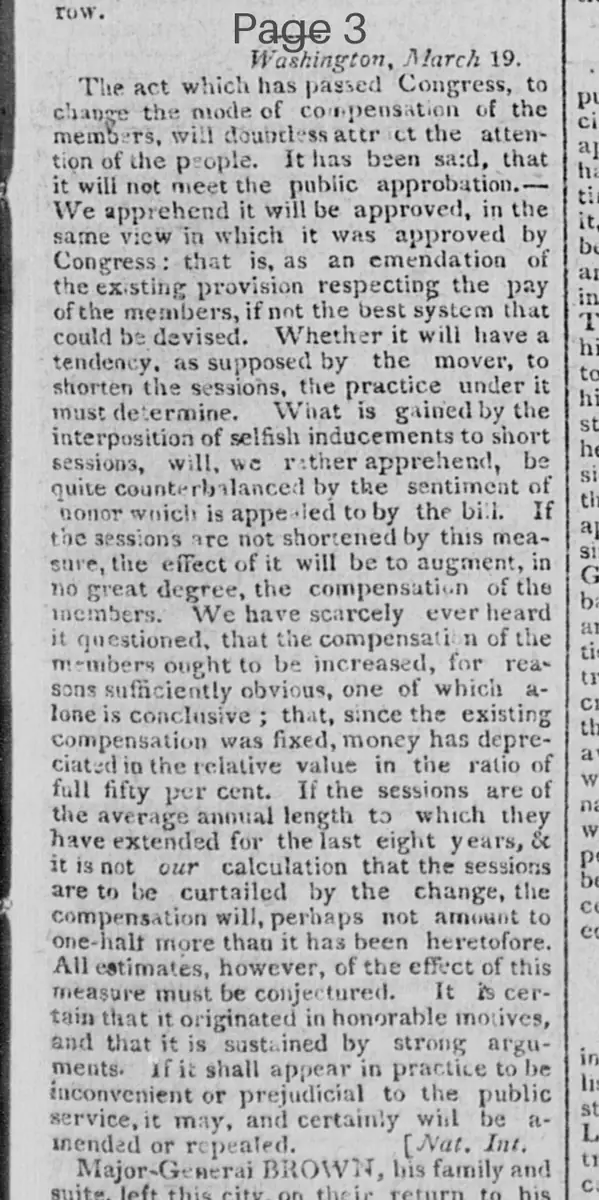
The act which has passed Congress, to change the mode of compensation of the members, will doubtless attract the attention of the people. It has been said, that it will not meet the public approbation.—We apprehend it will be approved, in the same view in which it was approved by Congress: that is, as an amendment of the existing provision respecting the pay of the members, if not the best system that could be devised. Whether it will have a tendency, as supposed by the mover, to shorten the sessions, the practice under it must determine. What is gained by the interposition of selfish inducements to short sessions, will, we rather apprehend, be quite counterbalanced by the sentiment of honor which is appealed to by the bill. If the sessions are not shortened by this measure, the effect of it will be to augment, in no great degree, the compensation of the members. We have scarcely ever heard it questioned, that the compensation of the members ought to be increased, for reasons sufficiently obvious, one of which alone is conclusive; that, since the existing compensation was fixed, money has depreciated in the relative value in the ratio of full fifty per cent. If the sessions are of the average annual length to which they have extended for the last eight years, & it is not our calculation that the sessions are to be curtailed by the change, the compensation will, perhaps not amount to one-half more than it has been heretofore.
All estimates, however, of the effect of this measure must be conjectured. It is certain that it originated in honorable motives, and that it is sustained by strong arguments. If it shall appear in practice to be inconvenient or prejudicial to the public service, it may, and certainly will be amended or repealed.
[Nat. Int.
CONGRESS.
IN SENATE of the U. S.—March 18.
DEBATE ON THE COMPENSATION BILL.
The bill to change the compensation of the members of Congress, having been read the third time—
Mr. Mason of Va. said, he was ever reluctant to differ in opinion from the majority of the Senate—for such a difference of opinion seldom failed to impress him with doubts of the correctness of that which he entertained. But on this occasion he was compelled to oppose the measure under consideration. He regretted that he was not in his place to have stated his objection to this bill at an earlier stage of its progress; for he was aware that, to oppose it at this time, when the sense of the Senate had been fully ascertained and expressed—when its fate was to all appearance determined and known, and when no opposition to it could be available—laid him open to the imputation of vanity or affectation, or perhaps to the suspicion of unworthy motives. But this consideration should not deter him from the discharge of his duty. He felt conscious of the rectitude and purity of his motives; and he believed other gentlemen to be actuated by similar motives.
He would prefer several modifications of the bill: but he had only one insuperable objection to it, which was that it was retrospective, and immediate in its operation. He considered it improper or indelicate (without meaning the least reflection upon any gentleman who advocated it) to vote money out of the treasury into our own pockets: For all useful public purposes he was willing to impose taxes, and to vote money, as liberally as any gentleman. But he considered the object of this bill to be of too mixed and doubtful a character to exempt its advocates entirely from the suspicion of interested and selfish motives. He was very far from imputing such motives to them. But it was not enough to do right. The representatives of the people should so conduct themselves as to be above the suspicion of unworthy motives. He was no jacobin, and he would never act or speak with a single eye to popular approbation and favor. But he respected the opinion of the people, as every public agent should do; and although he would not do wrong to obtain their good opinion, yet he would always act as far as he could, consistently with his duty, in such a way as to meet their approbation. For in a government like ours, particularly, it was in vain to pretend to despise or disregard public opinion: It was not only the tenure by which we held our places, but it was the basis of the government itself. Take from the government that support, and what was now order and beauty, would become despotism, or anarchy and chaos. He should therefore, always respect the opinion of the people, and endeavor to obtain their approbation, as far as he could, without a sacrifice of public duty. He admitted that the compensation of the members ought to be increased: He thought it ought to bear the same proportion to the expenses to which members are now exposed, that it did to their expenses when the law fixing the present rate of compensation passed: and he had no doubt, that the people would approve such an increase—for he had great confidence in their liberality and good sense. But he could not vote for the bill to take effect immediately. He would move to amend it, so as to postpone its operation until the expiration of the term of the present Congress; but he understood that such a motion had already been made and rejected: And as he could not obtain that modification of the bill, he was compelled to vote against it altogether.
Mr. Chase also opposed the passage of the bill, on the grounds already taken against it. He could not consent to legislate in this manner. No person, he believed, had yet computed that the compensation hereafter to be given to the members of Congress would be less than ten dollars per day: whilst Mr. C. computed that it would amount at a fair average estimate to seventeen dollars and a half per day for each day they attended. This government had been many years in operation, and it was not till very lately that complaints had been made that the compensation of the members was insufficient. This he said was an unfortunate time for the discovery, whilst the public debt was unliquidated, many public accounts yet unsettled, many of the patriot soldiers yet unpaid, and taxes continued—was this the proper time to increase the pay of the members to so extravagant a height? Mr. C. was of opinion the compensation of the members ought to be increased, but it ought to be done with prudence and with reference to the justice of the case. &c. The passage of such a bill as this would be justly disapproved by the people. Mr. C. also objected to the bill because defective in its details. That the subject might be maturely considered, he moved to postpone the bill to Monday.
Mr. Harper opposed the postponement, because it was not alleged that information was desired, or that the details of the bill were such as required a long examination to understand it. The subject of the bill was as well understood as it could be by a postponement of any length
Mr. Dana also opposed the postponement. The only argument against it, he believed, was, that the passage of the bill would be unsatisfactory to the people. If the bill was proper in itself, and there was any thing in this terror of the popular disapprobation, it was a strong reason why they should not pause upon it so long as was proposed; for if once seized with a panic on this question, the terror might perhaps by delay become extreme. If this bill were justly dissatisfactory to the people, he said, it might be a reason to pause; but, for his part, he should not like to return and tell his constituents that he was afraid to vote for this bill lest it should be dissatisfactory to them. His constituents, he said, were not opulent, nor yet afflicted by poverty: they lived at less expense than gentlemen could here—but, he said, he should manifest no respect for their discernment, if he were to suppose they could not see why members incurred greater expenses here than were necessary at home; he should shew little respect for their disposition, if he supposed that they wished that the men whom they chose to represent them here, should degrade themselves in order to live upon the compensation allowed them, or should sacrifice their private property in serving the public. It might be expected of public agents to make sacrifices in times of great emergency and national difficulty; but it would be idle, in ordinary times, to call on public men to be patriotic to their own loss and injury. Although, he said, the people of the state which he represented, were not as wealthy as they were in some other parts of the country, he trusted they were not afflicted with that poorness of spirit, that they would deny their representatives a due compensation for their services. He had no hesitation in saying, that the proposed rate of compensation was not too much for any man who has the honor, in fact, to represent the people and state whom he had the honor, in fact, to represent; and, however delicate the enquiry, he would not enter into a contest with his constituents about the correctness of their selection in sending him here. On the whole, he said, he concluded, that it was not only proper to increase the compensation of the members; but, being proper, that it would be popular to vote for the bill. In regard to Mr. Mason's objection that the compensation was to take effect immediately, he said, it would forever exist in regard to this body, some of whom must, whenever a question of change of compensation is agitated, vote on a question affecting their own emoluments. But, he proceeded to shew, this was a question on which the people had themselves decided: the constitution of the U. nited States, when first submitted to the people, contained an article providing that no law, varying the compensation of the Members of Congress, should take effect until an election should intervene—thus preventing the question now raised by the gentleman from Virginia, in regard to this bill. This question was thus presented in solemn form to the people: They did not accept the article, said Mr. D.: it is, therefore, decided by the people, that the Congress may correctly increase the compensation of its members, during the time for which they are elected, &c.
Mr. Mason said, in reply to one of Mr. Dana's observations, that he wished to put off the operation of this bill to the 4th day of March next; when at least a part of the Senate, and the whole of the House of Representatives, would have returned to the people, and would not, without re-election, derive any benefit from the bill, &c. As for those of the Senate, who will remain in office beyond the 4th of March next, he supposed such as those whose terms had not expired. He said that those who chose might avoid voting on the question, under the rule which authorizes any member of the Senate to be excused from voting on a question in which he is personally interested &c.
Mr. Chase complained that his arguments on this subject had not been fairly met and answered, but that gentlemen had flown off to incidental or irrelevant points, &c. The gentleman from Connecticut had insinuated that the people of his state were high-minded men: Mr. Chase said they were also a people of tidy habits—and, he asked, whether they would have ever consented to give their public officers a compensation at the rate of seventeen and a half dollars per day—at a rate of salary, while, during the time of their actual service, would exceed that of the Vice-President of the United States—which he computed thus. Congress would meet on the 1st Monday in December next, and tarry until the 4th day of March; the utmost term of that session would be three months; and it might be less. The compensation for that year would then exceed seventeen dollars per day. 'Would the people resist this, he asked—for, he added, when we legislate in their behalf, we ought to have due reference to the opinion of the people, as far as connected with the principles of justice and reason.
He had no objection to making the compensation somewhat greater, but he wished it to be clearly defined, and not larger relatively than the present compensation was when first fixed. On this bill, it would be granted demands for an increase of compensation from every person in public office within the United States: from every Clerk, &c. at the seat of government. In this and other views, he regarded the bill in its present shape, highly inexpedient.
Mr. Horner rose to defend his vote from the arguments of those opposed to the bill. He was duly sensible, he hoped, of the situation in which members of this house stood in relation to public opinion; but he knew not on this subject what public opinion was. This question was presented to him for decision without that light. There had been a feeling generally prevalent, as far as his information extended, that the present compensation of the members was not sufficient. It had been his conviction that it was better not to agitate this question at the present time; but the proposition had originated in the other house, which was at least as responsible to public opinion as this: and, believing it not objectionable in principle, he felt it his duty to vote for it. If it were an unpopular act, he said, its weight would fall on the shoulders of those who voted for it—it might occasion their removal from the public councils, by which it might be that the public interest might be promoted: if so, he was willing to make the sacrifice. The proposed amount of compensation was perhaps too large: with the ideas on this subject arising from his humble situation in life, had he had the direction of this question, he should not perhaps have fixed it so high; but, he considered the two houses, on this question, like a jury much divided on the subject before them, but obliged to decide upon something On the ground of abstract right, however, without regard to the House of Representatives, he considered it expedient to pass the bill: it might be improved perhaps in detail, but the principle he considered as correct. Whatever appealed to the honorable feelings of the members of Congress could not fail of exciting them to a more earnest discharge of their duty, than a rule of compensation which pays them for each day they attend the public service. As to the idea of the extravagance of the proposed compensation, he denied the fairness of the view in which it had been presented, as well as the correctness of the computation as to the length of the sessions. But not only the mere time of attendance in this house ought to be taken into view, but the interference of the duties of the station with their domestic occupations and arrangements. Mr. R. said he should contradict the character his habits and mode of life had given him, if he were to become an advocate for extravagance; but, on the other hand, he did not, nor did the people, desire to see members living here in a state of privation and suffering If his views of this subject should be disapproved by the people, he was willing to retire from their service, &c.
The question was then taken on postponement, and negatived.
Mr. Mason of Va. then moved to re-commit the bill, with a view to amend it—Negatived, ayes nine.
The question was then taken on the passage of the bill, and decided as follows:
YEAS—Messrs. Barry, Bibb, Brown, Campbell, Condit, Daggett, Dana, Gaillard, Harper, H. G. Hay, Howell, Hunter, Lacock, Morrow, Roberts, Talbot, Tait, Thompson, Turner, Wells, Williams—21.
NAYS—Messrs. Chase, King, Macon, Mason of N. H. Mason of Va. Ruggles, Sanford, Taylor, Tichenor, Varnum, Wilson—11
The question being then on the title of the bill to change the mode of compensation of the members, &c.
Mr. Varnum suggested that the title of the bill would be advantageously amended, by making it a "bill to double the compensation," &c.
Mr. Dana said, if the gentleman desired to move the amendment, that it was a legal opinion, that the title of an act need not necessarily correspond with its contents.
No amendment being moved to the title, it was agreed to.
What sub-type of article is it?
What keywords are associated?
What entities or persons were involved?
Where did it happen?
Domestic News Details
Primary Location
Washington
Event Date
March 18
Key Persons
Outcome
bill passed in senate 21-11 (yeas: barry, bibb, brown, campbell, condit, daggett, dana, gaillard, harper, h. g. hay, howell, hunter, lacock, morrow, roberts, talbot, tait, thompson, turner, wells, williams; nays: chase, king, macon, mason of n. h., mason of va., ruggles, sanford, taylor, tichenor, varnum, wilson). motions to postpone and recommit negatived.
Event Details
Senate debate on bill to change congressional compensation from per diem to session-based pay, increasing it due to currency depreciation. Opponents argued against immediate effect, potential extravagance (up to $17.50/day), and timing amid public debts. Supporters defended necessity, public approval, and constitutional allowance. Originated in House; intended to appeal to honor and possibly shorten sessions.