Thank you for visiting SNEWPapers!
Sign up free
Story
September 14, 1827
The National Republican And Ohio Political Register
Cincinnati, Hamilton County, Ohio
What is this article about?
Article from Black Rock Gazette recounts Robert Fulton's 1807 successful steamboat voyage from New York to Albany, includes his letter to Joel Barlow detailing the trip, and reflects on steam power's impact twenty years later, Fulton's death, and his inventions amid war.
Clipping
OCR Quality
98%
Excellent
Full Text
[From the Black Rock Gazette.]
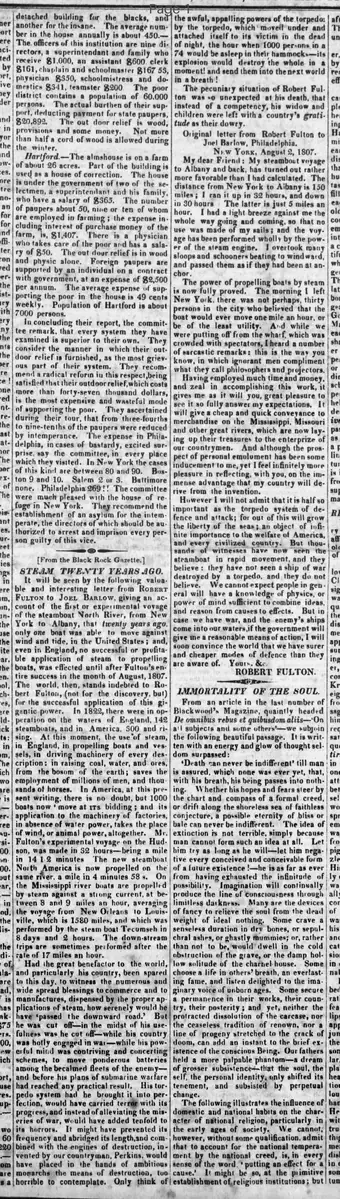
STEAM TWENTY YEARS AGO.
It will be seen by the following valuable and interesting letter from Robert Fulton to Joel Barlow, giving an account of the first or experimental voyage of the steamboat North River, from New York to Albany, that twenty years ago, only one boat was able to move against wind and tide, in the United States; and, even in England, no successful or profitable application of steam to propelling boats, was effected until after Fulton's entire success in the month of August, 1807. The world, then, stands indebted to Robert Fulton, (not for the discovery, but) for the successful application of this gigantic power. In 1822, there were in operation on the waters of England, 142 steamboats, and in America, 300 and rising. At this moment, the use of steam in England, in propelling boats and vessels, in driving machinery of every description: in raising coal, water, and ores, from the bosom of the earth; saves the employment of millions of men, and thousands of horses. In America, at this present writing, there is no doubt, but 1000 boats now move at its bidding; and its application to the machinery of factories, in absence of water power, takes the place of wind, or animal power, altogether. Mr. Fulton's experimental voyage on the Hudson, was made in 32 hours—being a mile in 14 1/2 minutes. The new steamboat North America is now propelled on the same river, a mile in 4 minutes 58 s. On the Mississippi river boats are propelled by steam against a strong current, at between 8 and 9 miles an hour, averaging the voyage from New Orleans to Louisville, which is 1580 miles, and which was performed by the steam boat Tecumseh in 8 days and 2 hours. The down-stream trips are sometimes performed after the rate of 17 miles an hour.
Had the great benefactor to the world, and particularly his country, been spared to this day, to witness the numerous and wide spread blessings to commerce and to manufactures, dispensed by the proper applications of steam, how serenely would he have 'passed the downward road.' But he was cut off in the midst of his usefulness—was he cut off—while his country was hotly engaged in war—while his powerful mind was contriving and concerting schemes, to move ponderous batteries among the becalmed fleets of the enemy—and before his plans of submarine warfare had reached any practical result. His torpedo system had he brought it into perfection, would have carried terror with its progress, and instead of alleviating the miseries of war, would have added tenfold to its horrors. It might have prevented its frequency and abridged its length, and combined with the engines of destruction, invented by our countryman, Perkins, would have placed in the hands of ambitious monarchs the means of destruction, too horrible to contemplate. Only think of the awful, appalling powers of the torpedo: by the torpedo, which moves under and attached itself to its victim in the dead of night, the hour when 1000 persons in a 74 would be asleep in their hammocks—its explosion would destroy the whole in a moment! and send them into the next world in a breath!
The pecuniary situation of Robert Fulton was so unexpected at his death, that instead of a competency, his widow and children were left with a country's gratitude as their dowry.
Original letter from Robert Fulton to Joel Barlow, Philadelphia.
New York, August 2, 1807.
My dear Friend: My steamboat voyage to Albany and back, has turned out rather more favorable than I had calculated. The distance from New York to Albany is 150 miles; I ran it up in 32 hours, and down in 30 hours—The latter is just 5 miles an hour. I had a light breeze against me the whole way going and coming, so that no use was made of my sails; and the voyage has been performed wholly by the power of the steam engine. I overtook many sloops and schooners beating to windward, and passed them as if they had been at anchor.
The power of propelling boats by steam is now fully proved. The morning I left New York, there was not perhaps, thirty persons in the city who believed that the boat would ever move one mile an hour, or be of the least utility. And while we were putting off from the wharf, which was crowded with spectators, I heard a number of sarcastic remarks: this is the way you know, in which ignorant men compliment what they call philosophers and projectors.
Having employed much time and money, and zeal in accomplishing this work, it gives me as it will you, great pleasure to see it so fully answer my expectations. It will give a cheap and quick conveyance to merchandise on the Mississippi, Missouri and other great rivers, which are now laying up their treasures to the enterprize of our countrymen. And although the prospect of personal emolument has been some inducement to me, yet I feel infinitely more pleasure in reflecting, with you, on the immense advantage that my country will derive from the invention.
However I will not admit that it is half so important as the torpedo system of defence and attack; for out of this will grow the liberty of the seas; an object of infinite importance to the welfare of America, and every civilized country. But thousands of witnesses have now seen the steamboat in rapid movement, and they believe: they have not seen a ship of war destroyed by a torpedo, and they do not believe. We cannot expect people in general will have a knowledge of physics, or power of mind sufficient to combine ideas, and reason from causes to effects. But in case we have war, and the enemy's ships come into our waters, if the government will give me a reasonable means of action, I will soon convince the world that we have surer and cheaper modes of defence than they are aware of. Yours, &c.
ROBERT FULTON.
STEAM TWENTY YEARS AGO.
It will be seen by the following valuable and interesting letter from Robert Fulton to Joel Barlow, giving an account of the first or experimental voyage of the steamboat North River, from New York to Albany, that twenty years ago, only one boat was able to move against wind and tide, in the United States; and, even in England, no successful or profitable application of steam to propelling boats, was effected until after Fulton's entire success in the month of August, 1807. The world, then, stands indebted to Robert Fulton, (not for the discovery, but) for the successful application of this gigantic power. In 1822, there were in operation on the waters of England, 142 steamboats, and in America, 300 and rising. At this moment, the use of steam in England, in propelling boats and vessels, in driving machinery of every description: in raising coal, water, and ores, from the bosom of the earth; saves the employment of millions of men, and thousands of horses. In America, at this present writing, there is no doubt, but 1000 boats now move at its bidding; and its application to the machinery of factories, in absence of water power, takes the place of wind, or animal power, altogether. Mr. Fulton's experimental voyage on the Hudson, was made in 32 hours—being a mile in 14 1/2 minutes. The new steamboat North America is now propelled on the same river, a mile in 4 minutes 58 s. On the Mississippi river boats are propelled by steam against a strong current, at between 8 and 9 miles an hour, averaging the voyage from New Orleans to Louisville, which is 1580 miles, and which was performed by the steam boat Tecumseh in 8 days and 2 hours. The down-stream trips are sometimes performed after the rate of 17 miles an hour.
Had the great benefactor to the world, and particularly his country, been spared to this day, to witness the numerous and wide spread blessings to commerce and to manufactures, dispensed by the proper applications of steam, how serenely would he have 'passed the downward road.' But he was cut off in the midst of his usefulness—was he cut off—while his country was hotly engaged in war—while his powerful mind was contriving and concerting schemes, to move ponderous batteries among the becalmed fleets of the enemy—and before his plans of submarine warfare had reached any practical result. His torpedo system had he brought it into perfection, would have carried terror with its progress, and instead of alleviating the miseries of war, would have added tenfold to its horrors. It might have prevented its frequency and abridged its length, and combined with the engines of destruction, invented by our countryman, Perkins, would have placed in the hands of ambitious monarchs the means of destruction, too horrible to contemplate. Only think of the awful, appalling powers of the torpedo: by the torpedo, which moves under and attached itself to its victim in the dead of night, the hour when 1000 persons in a 74 would be asleep in their hammocks—its explosion would destroy the whole in a moment! and send them into the next world in a breath!
The pecuniary situation of Robert Fulton was so unexpected at his death, that instead of a competency, his widow and children were left with a country's gratitude as their dowry.
Original letter from Robert Fulton to Joel Barlow, Philadelphia.
New York, August 2, 1807.
My dear Friend: My steamboat voyage to Albany and back, has turned out rather more favorable than I had calculated. The distance from New York to Albany is 150 miles; I ran it up in 32 hours, and down in 30 hours—The latter is just 5 miles an hour. I had a light breeze against me the whole way going and coming, so that no use was made of my sails; and the voyage has been performed wholly by the power of the steam engine. I overtook many sloops and schooners beating to windward, and passed them as if they had been at anchor.
The power of propelling boats by steam is now fully proved. The morning I left New York, there was not perhaps, thirty persons in the city who believed that the boat would ever move one mile an hour, or be of the least utility. And while we were putting off from the wharf, which was crowded with spectators, I heard a number of sarcastic remarks: this is the way you know, in which ignorant men compliment what they call philosophers and projectors.
Having employed much time and money, and zeal in accomplishing this work, it gives me as it will you, great pleasure to see it so fully answer my expectations. It will give a cheap and quick conveyance to merchandise on the Mississippi, Missouri and other great rivers, which are now laying up their treasures to the enterprize of our countrymen. And although the prospect of personal emolument has been some inducement to me, yet I feel infinitely more pleasure in reflecting, with you, on the immense advantage that my country will derive from the invention.
However I will not admit that it is half so important as the torpedo system of defence and attack; for out of this will grow the liberty of the seas; an object of infinite importance to the welfare of America, and every civilized country. But thousands of witnesses have now seen the steamboat in rapid movement, and they believe: they have not seen a ship of war destroyed by a torpedo, and they do not believe. We cannot expect people in general will have a knowledge of physics, or power of mind sufficient to combine ideas, and reason from causes to effects. But in case we have war, and the enemy's ships come into our waters, if the government will give me a reasonable means of action, I will soon convince the world that we have surer and cheaper modes of defence than they are aware of. Yours, &c.
ROBERT FULTON.
What sub-type of article is it?
Historical Event
Biography
Personal Triumph
What themes does it cover?
Triumph
Exploration
What keywords are associated?
Steamboat
Robert Fulton
Steam Power
Hudson River
Invention
Torpedo
Warfare
What entities or persons were involved?
Robert Fulton
Joel Barlow
Where did it happen?
New York To Albany, Hudson River
Story Details
Key Persons
Robert Fulton
Joel Barlow
Location
New York To Albany, Hudson River
Event Date
August 1807
Story Details
Robert Fulton's letter describes his successful 1807 steamboat voyage from New York to Albany in 32 hours upriver against wind, proving steam propulsion; article reflects on steam's growth, Fulton's death during war, and his torpedo ideas.