Thank you for visiting SNEWPapers!
Sign up free
Editorial
March 6, 1882
National Republican (Washington City
Washington, District Of Columbia
What is this article about?
The editorial criticizes candidates for presidential favor who spread false claims that the President has decided to appoint them, arguing this tactic is absurd, potentially backfires, and undermines their chances. It calls for reform of such practices in newspapers.
Clipping
OCR Quality
95%
Excellent
Full Text
Self-Dooming.
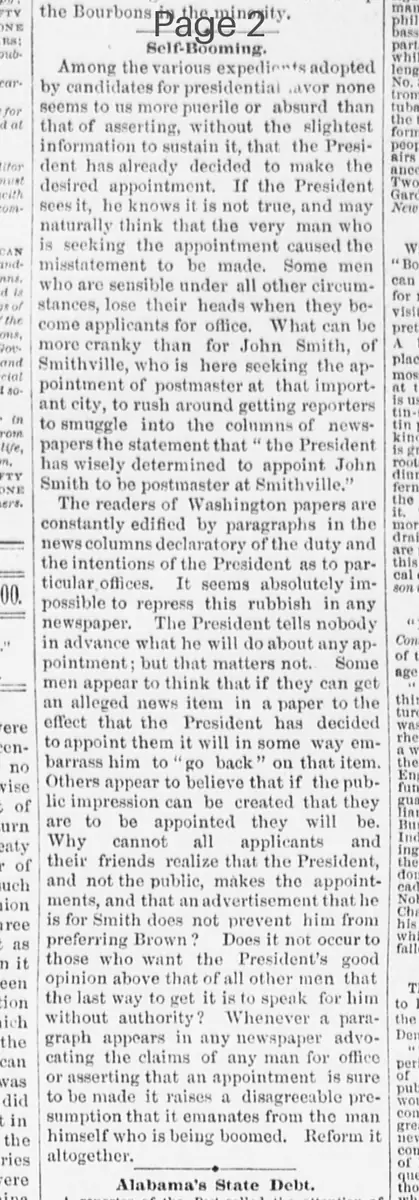
Among the various experiments adopted by candidates for presidential favor none seems to us more puerile or absurd than that of asserting, without the slightest information to sustain it, that the President has already decided to make the desired appointment. If the President sees it, he knows it is not true, and may naturally think that the very man who is seeking the appointment caused the misstatement to be made. Some men who are sensible under all other circumstances, lose their heads when they become applicants for office. What can be more cranky than for John Smith, of Smithville, who is here seeking the appointment of postmaster at that important city, to rush around getting reporters to smuggle into the columns of newspapers the statement that "the President has wiredly determined to appoint John Smith to be postmaster at Smithville."
The readers of Washington papers are constantly edified by paragraphs in the news columns declaratory of the duty and the intentions of the President as to particular offices. It seems absolutely impossible to repress this rubbish in any newspaper. The President tells nobody in advance what he will do about any appointment; but that matters not. Some men appear to think that if they can get an alleged news item in a paper to the effect that the President has decided to appoint them it will in some way embarrass him to "go back" on that item. Others appear to believe that if the public impression can be created that they are to be appointed they will be.
Why cannot all applicants and their friends realize that the President, and not the public, makes the appointments, and that an advertisement that he is for Smith does not prevent him from preferring Brown? Does it not occur to those who want the President's good opinion above that of all other men that the last way to get it is to speak for him without authority? Whenever a paragraph appears in any newspaper advocating the claims of any man for office or asserting that an appointment is sure to be made it raises a disagreeable presumption that it emanates from the man himself who is being boomed. Reform it altogether.
Among the various experiments adopted by candidates for presidential favor none seems to us more puerile or absurd than that of asserting, without the slightest information to sustain it, that the President has already decided to make the desired appointment. If the President sees it, he knows it is not true, and may naturally think that the very man who is seeking the appointment caused the misstatement to be made. Some men who are sensible under all other circumstances, lose their heads when they become applicants for office. What can be more cranky than for John Smith, of Smithville, who is here seeking the appointment of postmaster at that important city, to rush around getting reporters to smuggle into the columns of newspapers the statement that "the President has wiredly determined to appoint John Smith to be postmaster at Smithville."
The readers of Washington papers are constantly edified by paragraphs in the news columns declaratory of the duty and the intentions of the President as to particular offices. It seems absolutely impossible to repress this rubbish in any newspaper. The President tells nobody in advance what he will do about any appointment; but that matters not. Some men appear to think that if they can get an alleged news item in a paper to the effect that the President has decided to appoint them it will in some way embarrass him to "go back" on that item. Others appear to believe that if the public impression can be created that they are to be appointed they will be.
Why cannot all applicants and their friends realize that the President, and not the public, makes the appointments, and that an advertisement that he is for Smith does not prevent him from preferring Brown? Does it not occur to those who want the President's good opinion above that of all other men that the last way to get it is to speak for him without authority? Whenever a paragraph appears in any newspaper advocating the claims of any man for office or asserting that an appointment is sure to be made it raises a disagreeable presumption that it emanates from the man himself who is being boomed. Reform it altogether.
What sub-type of article is it?
Partisan Politics
What keywords are associated?
Presidential Appointments
Office Seeking
False News
Political Intrigue
Applicant Tactics
What entities or persons were involved?
The President
John Smith Of Smithville
Editorial Details
Primary Topic
Criticism Of False Claims About Presidential Appointments
Stance / Tone
Critical Of Applicants' Tactics
Key Figures
The President
John Smith Of Smithville
Key Arguments
Asserting Without Evidence That The President Has Decided On An Appointment Is Puerile And Absurd
Such Claims May Make The President Think The Applicant Caused The Misstatement
Applicants Lose Sense When Seeking Office
Readers Are Edified By False Paragraphs On Presidential Intentions
President Tells Nobody In Advance About Appointments
False News Items Aim To Embarrass The President Or Create Public Impression
President Makes Appointments Regardless Of Public Advertisements
Speaking For The President Without Authority Is The Wrong Way To Gain His Favor
Paragraphs Advocating Appointments Raise Presumption They Come From The Applicant Himself
Need To Reform This Practice Altogether