Thank you for visiting SNEWPapers!
Sign up free
The Illinois Free Trader And Lasalle County Commercial Advertiser
Ottawa, La Salle County County, Illinois
What is this article about?
Correspondence from Springfield, IL, on Jan. 27, 1843, reports on Illinois legislative matters: bank liquidations reducing state debt, appointment of commissioner N.H. Purple, Shawneetown bank closure, internal improvement lands disposal, Illinois Canal bill debates, tax reforms favoring gold/silver, and congressional districting challenges. Praises Democratic efforts for state recovery.
Merged-components note: Continuation of the same correspondence letter to the Free Trader from Springfield.
Clipping
OCR Quality
Full Text
SPRINGFIELD, Jan. 27, 1843.
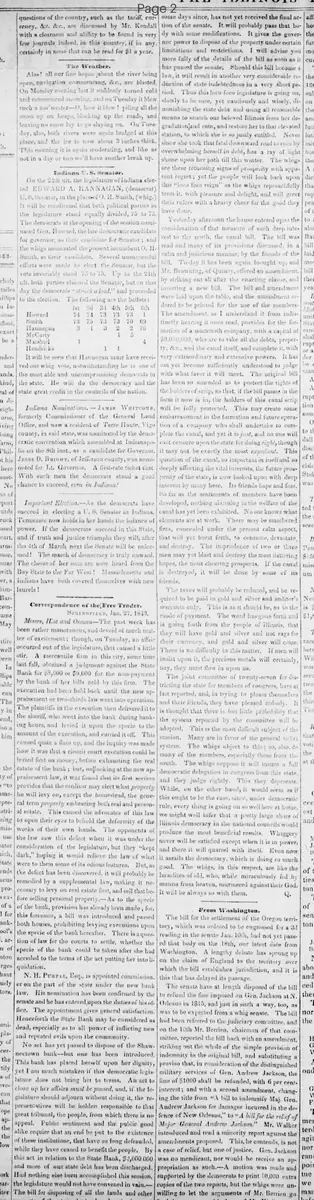
Messrs. Hise and Osman--The past week has been rather monotonous, and devoid of much matter of excitement; though, on Tuesday, an affair occurred out of the legislature, that caused a little stir. A mercantile firm in this city, some time last fall, obtained a judgment against the State Bank for $8,000 or $9,000 for the non-payment by the bank of her bills held by this firm. The execution had been held back until the new appraisement or two-thirds law went into operation. The plaintiffs in the execution then delivered it to the sheriff, who went into the bank during banking hours, and levied it upon the specie to the amount of the execution, and carried it off. This caused quite a flare up, and the inquiry was made how it was that a circuit court execution could be levied first on money, before exhausting the real estate of the bank; but, on looking at the new appraisement law, it was found that its first section provides that the creditor may elect what property he will levy on, except the homestead, the general term property embracing both real and personal estate. This caused the advocates of this law to open their eyes to behold the deformity of the works of their own hands. The opponents of the law saw this defect when it was under the consideration of the legislature, but they "kept dark," hoping it would relieve the law of what were to them some of its odious features. But, as the defect has been discovered, it will probably be remedied by a supplemental law, making it necessary to levy on real estate first, and sell that before selling personal property.--As to the specie of the bank, provision has already been made; for, this forenoon, a bill was introduced and passed both houses, prohibiting levying executions upon the specie of the bank hereafter. There is a question of law for the courts to settle, whether the specie of the bank could be taken after she had acceded to the terms of the act putting her into liquidation.
N. H. Purple, Esq., is appointed commissioner on the part of the state under the new bank law. His nomination has been confirmed by the senate and he has entered upon the duties of his office. The appointment gives general satisfaction. Henceforth the State Bank may be considered as dead, especially as to all power of inflicting new and repeated evils upon the community.
No act has yet passed to dispose of the Shawneetown bank--but one has been introduced. This bank has placed herself upon her dignity. Yet I am much mistaken if this democratic legislature does not bring her to terms. An act to close up her affairs must be passed, and, if the legislature should adjourn without doing it, the representatives will be holden responsible to that great tribunal, the people, from which there is no appeal. Public sentiment and the public good alike require that an end be put to the existence of these institutions, that have so long defrauded, while they have ceased to benefit the people. By this act in relation to the State Bank, $2,000,000 and more of our state debt has been discharged. Had nothing else been accomplished this session, the legislature would not have convened in vain.--The bill for disposing of all the lands and other property of the state obtained under the internal improvement system, which passed the house some days since, has not yet received the final action of the senate. It will probably pass that body with some modifications. It gives the governor power to dispose of the property under certain limitations and restrictions. I will advise you more fully of the details of the bill as soon as it has passed the senate. Should this bill become a law, it will result in another very considerable reduction of state indebtedness in a very short period. Thus this loco foco legislature is going on. Slowly to be sure, yet cautiously and wisely, diminishing the state debt and using all reasonable means to snatch our beloved Illinois from her degradation and ruin, and restore her to that elevated station, to which she is so justly entitled. Never since she took that fatal downward road to ruin by overwhelming herself in debt, has a ray of light shone upon her path till this winter. The whigs see these returning signs of prosperity with apparent regret; yet the people will look back upon this "loco foco reign" as the whigs reproachfully term it, with pleasure and delight, and will greet their rulers with a hearty cheer for the good they have done.
Yesterday afternoon the house entered upon the consideration of that measure of such deep interest to the north, the canal bill. The bill was read and many of its provisions discussed. in a calm and judicious manner, by the friends of the bill. Today it has been again brought up, and Mr. Browning, of Quincy, offered an amendment, by striking out all after the enacting clause, and inserting a new bill. The bill and amendment were laid upon the table, and the amendment ordered to be printed for the use of the members. The amendment, as I understand it from distinctly hearing it once read, provides for the formation of a mammoth company, with a capital of $9,000,000, who are to take all the debts, property, &c., and the canal itself, and complete it, with very extraordinary and extensive powers. It has not yet become sufficiently understood to judge with what favor it will meet. The original bill has been so amended as to protect the rights of the holders of scrip, so that, if the bill passes in the form it now is in, the holders of this canal scrip will be fully protected. This may create some embarrassment in the formation and future operation of a company who shall undertake to complete the canal, and yet it is just, and no one will cast censure upon the state for doing right, though it may not be exactly the most expedient. This question of the canal, so important in itself and so deeply affecting the vital interests, the future prosperity of the state, is now looked upon with deep interest by many here. Its friends hope and fear. So far as the sentiments of members have been developed, nothing alarming to the welfare of the canal has yet been exhibited. No one knows what elements are at work. There may be smothered fires, concealed under the present calm aspect that will yet burst forth, to consume, devastate and destroy. The imprudence of two or three men may yet blast and destroy the most flattering hopes, the most cheering prospects. If the canal is destroyed, it will be done by some of its friends.
The taxes will probably be reduced, and be required to be paid in gold and silver and auditor's warrants only. This is as it should be, as to the mode of payment. The word has gone forth and is going forth from the people of Illinois, that they will have gold and silver and not rags for their currency, and gold and silver will come. There is no difficulty in this matter. If men will insist upon it, the precious metals will certainly--nay, they must flow in upon us.
The joint committee of twenty-seven for districted the state for members of congress, have at last reported, and, in trying to please themselves and their friends, they have pleased nobody. It is thought that there is but little probability that the system reported by the committee will be adopted. This is the most difficult subject of the session. Many are in favor of the general ticket system. The whigs object to this; so, also, do many of the members, especially those from the south. The whigs suppose it will insure a full democratic delegation in congress from this state and they judge rightly. This they deprecate. While, on the other hand, it would seem as if this ought to be the case, since, under democratic rule, every thing is going on so well here at home. we might well infer that a pretty large share of Illinois democracy in the national councils would produce the most beneficial results. Whiggery never will be satisfied except when it is in power, and there it will quarrel with itself. Even now it assails the democracy, which is doing so much good. The whigs, in this respect, are like the Israelites of old, who, while miraculously fed by manna from heaven, murmured against their God. It will be always so with them.
Q.
What sub-type of article is it?
What themes does it cover?
What keywords are associated?
What entities or persons were involved?
Letter to Editor Details
Author
Q.
Recipient
Messrs. Hise And Osman
Main Argument
reports on illinois legislative progress under democratic rule, highlighting bank closures and debt reductions as key achievements restoring state prosperity, while discussing ongoing debates on the canal bill, taxes, and congressional districting.
Notable Details