Thank you for visiting SNEWPapers!
Sign up free
Daily State Sentinel
Indianapolis, Marion County, Indiana
What is this article about?
The Louisville Democrat criticizes a Philadelphia Age article on the children's book 'Oil for Babes,' which propagandizes a biased abolitionist history of the Civil War through dialogues led by 'Uncle William,' filled with lies against Southern figures like Buchanan and Calhoun, aimed at corrupting young minds.
Clipping
OCR Quality
Full Text
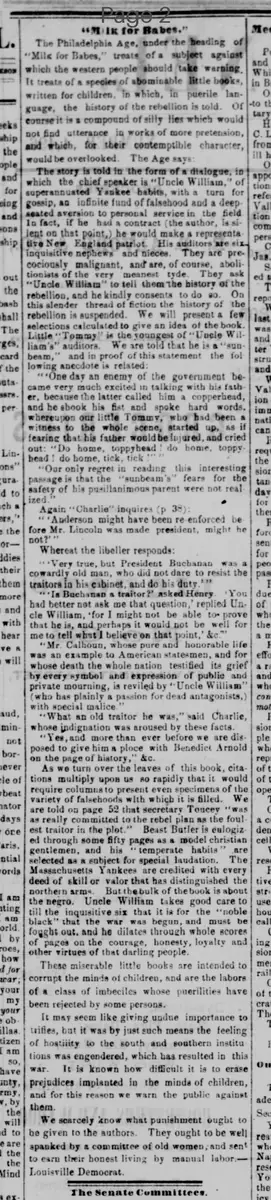
The Philadelphia Age, under the heading of "Oil for Babes," treats of a subject against which the western people should take warning. It treats of a species of abominable little books, written for children, in which, in puerile language, the history of the rebellion is told. Of course it is a compound of silly lies which would not find utterance in works of more pretension, and which, for their contemptible character, would be overlooked. The Age says:
The story is told in the form of a dialogue, in which the chief speaker is "Uncle William," of superannuated Yankee habits, with a turn for gossip, an infinite fund of falsehood and a deep-seated aversion to personal service in the field. In fact, if he had a contract (the author is silent on that point,) he would make a representative New England patriot. His auditors are six inquisitive nephews and nieces. They are precociously malignant, and are, of course, abolitionists of the very meanest type. They ask "Uncle William" to tell them the history of the rebellion, and he kindly consents to do so. On this slender thread of fiction the history of the rebellion is suspended. We will present a few selections calculated to give an idea of the book.
Little "Tommy" is the youngest of "Uncle William's" auditors. We are told that he is a "sunbeam," and in proof of this statement the following anecdote is related:
"One day an enemy of the government became very much excited in talking with his father, because the latter called him a copperhead, and he shook his fist and spoke hard words, whereupon our little Tommy, who had been a witness to the whole scene, started up, as if fearing that his father would be injured, and cried out: "Go home, copperhead: go home, copperhead! go home, tick, tick…"
Our only regret in reading this interesting passage is that the "sunbeam's" fears for the safety of his pusillanimous parent were not realized.
Again "Charlie" inquires (p 38):
"Anderson might have been reinforced before Mr. Lincoln was made president, might he not?"
Whereat the libeler responds:
"Very true, but President Buchanan was a cowardly old man, who did not dare to resist the traitors in his cabinet, and do his duty."
"Is Buchanan a traitor?" asked Henry. "You had better not ask me that question," replied Uncle William, "for I might not be able to prove that he is, and perhaps it would not be well for me to tell what I believe on that point," &c.
"Mr. Calhoun, whose pure and honorable life was an example to American statesmen, and for whose death the whole nation testified its grief by every symbol and expression of public and private mourning, is reviled by "Uncle William" (who has plainly a passion for dead antagonists) with special malice.
"What an old traitor he was," said Charlie, whose indignation was aroused by these facts.
"Yes, and more than ever before we are disposed to give him a place with Benedict Arnold on the page of history," &c.
As we turn over the leaves of this book, citations multiply upon us so rapidly that it would require columns to present even specimens of the variety of falsehoods with which it is filled. We are told on page 52 that secretary Toucey "was as really committed to the rebel plan as the foulest traitor in the plot." Beast Butler is eulogized through some fifty pages as a model christian gentleman, and his "temperate habits" are selected as a subject for special laudation. The Massachusetts Yankees are credited with every deed of skill or valor that has distinguished the northern arms. But the bulk of the book is about the negro. Uncle William takes good care to tell the inquisitive six that it is for the "noble black" that the war was begun, and must be fought out, and he dilates through whole scores of pages on the courage, honesty, loyalty and other virtues of that darling people.
These miserable little books are intended to corrupt the minds of children, and are the labors of a class of imbeciles whose puerilities have been rejected by some persons.
It may seem like giving undue importance to trifles, but it was by just such means the feeling of hostility to the south and southern institutions was engendered, which has resulted in this war. It is known how difficult it is to erase prejudices implanted in the minds of children, and for this reason we warn the public against them.
We scarcely know what punishment ought to be given to the authors. They ought to be well spanked by a committee of old women, and sent to earn their honest living by manual labor.
Louisville Democrat
What sub-type of article is it?
What themes does it cover?
What keywords are associated?
What entities or persons were involved?
Where did it happen?
Story Details
Key Persons
Location
Philadelphia
Story Details
The Louisville Democrat critiques a children's book described in The Philadelphia Age, which uses dialogues between Uncle William and children to propagate abolitionist lies about the Civil War, reviling Southern figures like Buchanan and Calhoun while praising Northern actions and emphasizing the war's cause as emancipation.