Thank you for visiting SNEWPapers!
Sign up free
Kentucky Gazette
Lexington, Fayette County, Kentucky
What is this article about?
Biographical sketch of Mexican general Antonio López de Santa Anna, detailing his early life in Vera Cruz, military career, betrayal of benefactor Gen. Davilla, rise through revolutions, personality, and anecdotes from sieges in Oaxaca.
Clipping
OCR Quality
Full Text
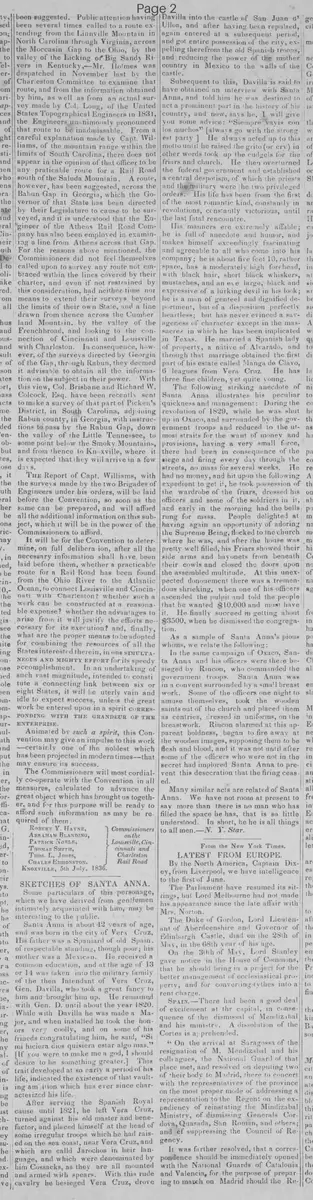
Some particulars of this personage,
which we have derived from gentlemen
intimately acquainted with him, may be
interesting to the public.
Santa Anna is about 42 years of age,
and was born in the city of Vera Cruz.
His father was a Spaniard of old Spain,
of respectable standing, though poor; his
mother was a Mexican. He received a
common education, and at the age of 13
or 14 was taken into the military family
of the then Intendant of Vera Cruz,
Gen. Davilla, who took a great fancy to
him and brought him up. He remained
with Gen. D. until about the year 1820.
While with Davilla he was made a Ma-
jor, and when installed he took the hon-
ors very coolly, and on some of his
friends congratulating him, he said, "Si
mi hiciera dios quisiera estar algo mas."
[If you were to make me a god, I should
desire to be something greater.] This
trait developed at so early a period of his
life, indicated the existence of that vault-
ing ambition which has ever since char-
acterized his life.
After serving the Spanish Royal
cause until 1821, he left Vera Cruz,
turned against his old master and bene-
factor, and placed himself at the head of
some irregular troops which he had rais-
ed on the sea coast, near Vera Cruz, and
which are called Jarochos in their lan-
guage, and which were denominated by
him Cossacks, as they are all mounted
and armed with spears. With this rude
cavalry he besieged Vera Cruz, drove
Davilla into the castle of San Juan de
Ulloa, and after having been repulsed,
again entered at a subsequent period,
and got entire possession of the city, ex-
pelling therefrom the old Spanish troops,
and reducing the power of the mother
country in Mexico to the walls of the
castle.
Subsequent to this, Davilla is said to
have obtained an interview with Santa
Anna, and told him he was destined to
act a prominent part in the history of his
country, and now, says he, I will give
you some advice: "Siempre vayas con
los muchos" [always go with the strong-
est party.] He always acted up to this
motto until he raised the grito (or cry) in
other words took up the cudgels for the
friars and church. He then overturned
the federal government and established
a central despotism, of which the priests
and the military were the two privileged
orders. His life has been from the first
of the most romantic kind, constantly in
revolutions, constantly victorious, until
the last fatal rencontre.
His manners are extremely affable;
he is full of anecdote and humor, and
makes himself exceedingly fascinating
and agreeable to all who come into his
company: he is about five feet 10, rather
spare, has a moderately high forehead,
with black hair, short black whiskers,
mustaches, and an eye large, black and
expressive of a lurking devil in his look;
he is a man of genteel and dignified de-
portment, but of a disposition perfectly
heartless; but has never evinced a sav-
ageness of character except in the mas-
sacres in which he has been implicated
in Texas. He married a Spanish lady
of property, a native of Alvarado, and
through that marriage obtained the first
part of his estate called Manga de Clavo,
6 leagues from Vera Cruz. He has
three fine children, yet quite young.
The following striking anecdote of
Santa Anna illustrates his peculiar
quickness and management: During the
revolution of 1829, while he was shut
up in Oaxaca, and surrounded by the gov-
vernment troops and reduced to the ut-
most straits for the want of money and
provisions, having a very small force,
there had been in consequence of the
siege and firing every day through the
streets, no mass for several weeks. He
had no money, and hit upon the following
expedient to get it, he took possession of
the wardrobe of the friars, dressed his
officers and some of the soldiers in it,
and early in the morning had the bells
rung for mass. People delighted at
having again an opportunity of adoring
the Supreme Being, flocked to the church
where he was, and after the house was
pretty well filled, his Friars showed their
side arms and bayonets from beneath
their cowls and closed the doors upon
the assembled multitude. At this unex-
pected annunciation there was a tremen-
dous shrieking, when one of his officers
ascended the pulpit and told the people
that he wanted $10,000 and must have
it. He finally succeeded in getting about
$3500, when he dismissed the congrega-
tion.
As a sample of Santa Anna's pious
whims, we relate the following:
In the same campaign of Oaxaca, San-
ta Anna and his officers were there be-
sieged by Rincon, who commanded the
government troops. Santa Anna was
in a convent surrounded by a small breast
work. Some of the officers one night to
amuse themselves, took the wooden
saints out of the church and placed them
as sentries, dressed in uniforms, on the
breastwork. Rincon alarmed at this ap-
parent boldness, began to fire away at
the wooden images, supposing them to be
flesh and blood, and it was not until after
some of the officers who were not in the
secret had implored Santa Anna to pre-
vent this desecration that the firing ceas-
ed.
Many similar acts are related of Santa
Anna. We have not room at present to
say more than there is no man who has
filled the space he has, that is so little
understood. In short, he is all things
to all men.—N. Y. Star.
What sub-type of article is it?
What themes does it cover?
What keywords are associated?
What entities or persons were involved?
Where did it happen?
Story Details
Key Persons
Location
Vera Cruz, Mexico; Oaxaca, Mexico
Event Date
About 42 Years Of Age; 1820; 1821; 1829
Story Details
Santa Anna, born in Vera Cruz around 1794, rose from humble beginnings under Gen. Davilla's patronage, betrayed him in 1821 to join independence forces, led revolutions establishing central despotism, known for ambition, affable manners, heartless disposition, and clever tactics like disguising soldiers as friars to extort money during the 1829 Oaxaca siege and using wooden saints as decoys.