Thank you for visiting SNEWPapers!
Sign up free
Imperial Valley Press
El Centro, Imperial County, California
What is this article about?
1939 sugar beet planting program mandates soil conservation practices, with legume rotation exceptions; experts discuss cost reduction, crop improvement, disease resistance, and experiments in Imperial County.
Clipping
OCR Quality
Full Text
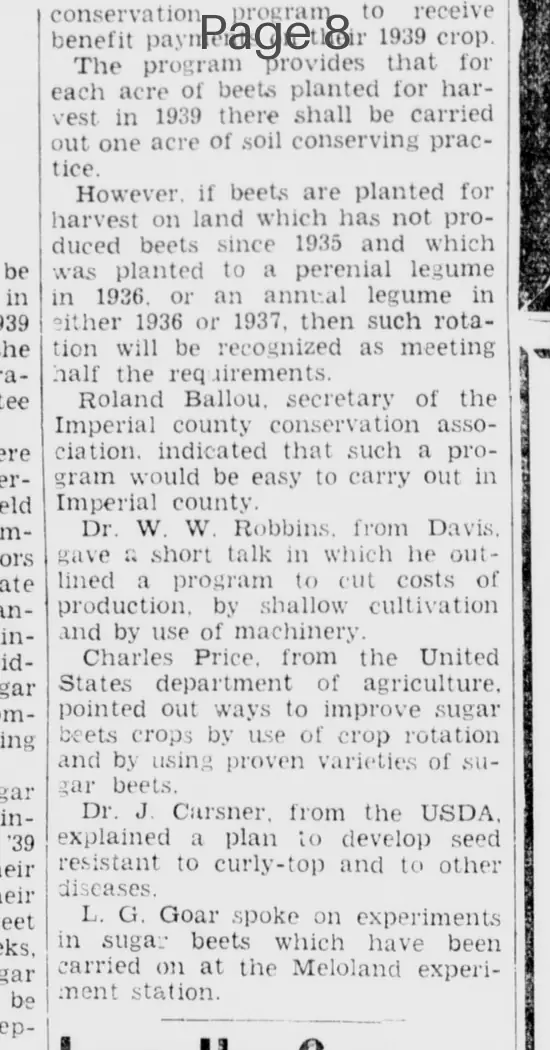
However, if beets are planted for harvest on land which has not produced beets since 1935 and which was planted to a perennial legume in 1936 or an annual legume in either 1936 or 1937, then such rotation will be recognized as meeting half the requirements.
Roland Ballou, secretary of the Imperial county conservation association, indicated that such a program would be easy to carry out in Imperial county.
Dr. W. W. Robbins, from Davis, gave a short talk in which he outlined a program to cut costs of production, by shallow cultivation and by use of machinery.
Charles Price, from the United States department of agriculture, pointed out ways to improve sugar beets crops by use of crop rotation and by using proven varieties of sugar beets.
Dr. J Carsner, from the USDA, explained a plan to develop seed resistant to curly-top and to other diseases.
L. G. Goar spoke on experiments in sugar beets which have been carried on at the Meloland experiment station.
What sub-type of article is it?
What themes does it cover?
What keywords are associated?
What entities or persons were involved?
Where did it happen?
Story Details
Key Persons
Location
Imperial County
Event Date
1939
Story Details
Program requires one acre of soil conserving practice per acre of beets planted for harvest in 1939, with exceptions for rotations involving legumes since 1935. Roland Ballou indicated ease of implementation in Imperial county. Talks by Dr. W. W. Robbins on cost-cutting via cultivation and machinery, Charles Price on improving crops through rotation and varieties, Dr. J Carsner on disease-resistant seed development, and L. G. Goar on experiments at Meloland station.