Thank you for visiting SNEWPapers!
Sign up free
Story
April 20, 1816
Richmond Enquirer
Richmond, Richmond County, Virginia
What is this article about?
Commentary on the Mexican Revolution, noting U.S. apathy despite proximity, contrasting societal conditions with America's founding, praising Mexican resilience per Humboldt, and expressing hope for their republican success against Spanish tyranny without U.S. intervention.
Clipping
OCR Quality
88%
Good
Full Text
FOR THE ENQUIRER.
REVOLUTION IN MEXICO.
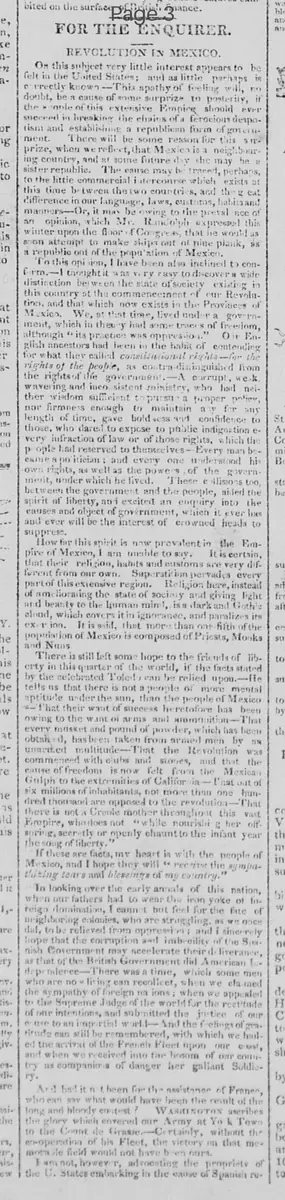
On this subject very little interest appears to be felt in the United States: and as little perhaps is correctly known--This apathy of feeling will, no doubt, be a cause of some surprise to posterity, if the only of this extensive Empire should ever succeed in breaking the chains of a ferocious despotism and establishing a republican form of government. There will be some reason for this surprise, when we reflect, that Mexico is a neighbouring country, and at some future day she may be our sister republic. The cause may be traced, perhaps, to the little commercial intercourse which exists at this time between the two countries, and the great difference in our language, laws, customs, habits and manners--Or, it may be owing to the prevalence of an opinion, which Mr. Randolph expressed this winter upon the floor of Congress, that he would as soon attempt to make ships out of pine plank, as a republic out of the population of Mexico.
To this opinion, I have been also inclined to conform,--I thought it was very easy to discover a wide distinction between the state of society existing in this country at the commencement of our Revolution, and that which now exists in the Provinces of Mexico. We, at that time, lived under a government, which in theory had some traces of freedom, although "its practice was oppression." Our English ancestors had been in the habit of contending for what they called constitutional rights--for the rights of the people, as contra distinguished from the rights of the government.--A corrupt, weak wavering and inconsistent ministry, who had neither wisdom sufficient to pursue a proper policy, nor firmness enough to maintain any for any length of time, gave boldness and confidence to those, who dared to expose to public indignation every infraction of law or of those rights, which the people had reserved to themselves--Every man became a politician: and every one understood his own rights, as well as the powers of the government, under which he lived. These collisions too, between the government and the people, aided the spirit of liberty, and excited an enquiry into the causes and object of government, which it ever has and ever will be the interest of crowned heads to suppress.
How far this spirit is now prevalent in the Empire of Mexico, I am unable to say. It is certain, that their religion, habits and customs are very different from our own. Superstition pervades every part of this extensive region. Religion here, instead of ameliorating the state of society and giving light and beauty to the human mind, is a dark and Gothic cloud, which covers it in ignorance, and paralizes its exertion. It is said, that more than one fifth of the population of Mexico is composed of Priests, Monks and Nuns.
There is still left some hope to the friends of liberty in this quarter of the world, if the facts stated by the celebrated Humboldt, can be relied upon.--He tells us that there is not a people of more mental aptitude under the sun, than the people of Mexico -That their want of success heretofore has been owing to the want of arms and ammunition--That every musket and pound of powder, which has been obtained, has been taken from armed men by an unarmed multitude--That the Revolution was commenced with clubs and stones, and that the cause of freedom is now felt from the Mexican Gulph to the extremities of California --That out of six millions of inhabitants, not more than one hundred thousand are opposed to the revolution --That there is not a Creole mother throughout this vast Empire, who does not "while nourishing her offspring, secretly or openly chant to the infant the song of liberty."
If these are facts, my heart is with the people of Mexico, and I hope they will "receive the sympathizing tears and blessings of my country."
In looking over the early annals of this nation, when our fathers had to wear the iron yoke of foreign domination, I cannot but feel for the fate of neighboring colonies, who are struggling, as we once did, to be relieved from oppression; and I sincerely hope that the corruption and imbecility of the Spanish Government may accelerate their deliverance, as that of the British Government did American Independence--There was a time, which some men who are now living can recollect, when we claimed the sympathy of foreign nations; when we appealed to the Supreme Judge of the world for the rectitude of our intentions, and submitted the justice of our cause to an impartial world--And the rich glow of gratitude can still be remembered, with which we hailed the arrival of the French Fleet upon our coast, and when we received into the bosom of our country as companions of danger her gallant soldiery.
And had it not been for the assistance of France, who can say what would have been the result of the long and bloody contest? Washington ascribes the glory which covered our Army at York Town to the Count de Grasse. Certainly, without the co-operation of his Fleet, the victory on that memorable field would not have been ours.
I am not, however, advocating the propriety of the U. states embarking in the cause of Spanish revolution. We are a young and growing nation, and our policy should be to avoid war as long as possible." I speak in justification of the sympathy which has been sometimes expressed for the persecuted patriots of Mexico. It is their hard fate to live under the government of a stupid, relentless and bigoted tyrant--a monster, who is now engaged in proscribing those who recovered for him his throne --The gallant Castanos, who led the peasantry of Spain against the legions of Bonaparte, has been sent a prisoner to the Barbary Powers!--He has restored the reign of that barbarous superstition, and extinguished the fair gleam of celestial light which had burst upon the human mind --he has rivetted upon Spain again the chains of discord and slavish obedience, and caused the blood which flowed at Saragossa, Tarragona and Salamanca, to be a useless sacrifice. Against such a tyrant may the cause of humanity prevail!
It will receive the prayers and blessings of the wise and good in every quarter of the world.
REVOLUTION IN MEXICO.
On this subject very little interest appears to be felt in the United States: and as little perhaps is correctly known--This apathy of feeling will, no doubt, be a cause of some surprise to posterity, if the only of this extensive Empire should ever succeed in breaking the chains of a ferocious despotism and establishing a republican form of government. There will be some reason for this surprise, when we reflect, that Mexico is a neighbouring country, and at some future day she may be our sister republic. The cause may be traced, perhaps, to the little commercial intercourse which exists at this time between the two countries, and the great difference in our language, laws, customs, habits and manners--Or, it may be owing to the prevalence of an opinion, which Mr. Randolph expressed this winter upon the floor of Congress, that he would as soon attempt to make ships out of pine plank, as a republic out of the population of Mexico.
To this opinion, I have been also inclined to conform,--I thought it was very easy to discover a wide distinction between the state of society existing in this country at the commencement of our Revolution, and that which now exists in the Provinces of Mexico. We, at that time, lived under a government, which in theory had some traces of freedom, although "its practice was oppression." Our English ancestors had been in the habit of contending for what they called constitutional rights--for the rights of the people, as contra distinguished from the rights of the government.--A corrupt, weak wavering and inconsistent ministry, who had neither wisdom sufficient to pursue a proper policy, nor firmness enough to maintain any for any length of time, gave boldness and confidence to those, who dared to expose to public indignation every infraction of law or of those rights, which the people had reserved to themselves--Every man became a politician: and every one understood his own rights, as well as the powers of the government, under which he lived. These collisions too, between the government and the people, aided the spirit of liberty, and excited an enquiry into the causes and object of government, which it ever has and ever will be the interest of crowned heads to suppress.
How far this spirit is now prevalent in the Empire of Mexico, I am unable to say. It is certain, that their religion, habits and customs are very different from our own. Superstition pervades every part of this extensive region. Religion here, instead of ameliorating the state of society and giving light and beauty to the human mind, is a dark and Gothic cloud, which covers it in ignorance, and paralizes its exertion. It is said, that more than one fifth of the population of Mexico is composed of Priests, Monks and Nuns.
There is still left some hope to the friends of liberty in this quarter of the world, if the facts stated by the celebrated Humboldt, can be relied upon.--He tells us that there is not a people of more mental aptitude under the sun, than the people of Mexico -That their want of success heretofore has been owing to the want of arms and ammunition--That every musket and pound of powder, which has been obtained, has been taken from armed men by an unarmed multitude--That the Revolution was commenced with clubs and stones, and that the cause of freedom is now felt from the Mexican Gulph to the extremities of California --That out of six millions of inhabitants, not more than one hundred thousand are opposed to the revolution --That there is not a Creole mother throughout this vast Empire, who does not "while nourishing her offspring, secretly or openly chant to the infant the song of liberty."
If these are facts, my heart is with the people of Mexico, and I hope they will "receive the sympathizing tears and blessings of my country."
In looking over the early annals of this nation, when our fathers had to wear the iron yoke of foreign domination, I cannot but feel for the fate of neighboring colonies, who are struggling, as we once did, to be relieved from oppression; and I sincerely hope that the corruption and imbecility of the Spanish Government may accelerate their deliverance, as that of the British Government did American Independence--There was a time, which some men who are now living can recollect, when we claimed the sympathy of foreign nations; when we appealed to the Supreme Judge of the world for the rectitude of our intentions, and submitted the justice of our cause to an impartial world--And the rich glow of gratitude can still be remembered, with which we hailed the arrival of the French Fleet upon our coast, and when we received into the bosom of our country as companions of danger her gallant soldiery.
And had it not been for the assistance of France, who can say what would have been the result of the long and bloody contest? Washington ascribes the glory which covered our Army at York Town to the Count de Grasse. Certainly, without the co-operation of his Fleet, the victory on that memorable field would not have been ours.
I am not, however, advocating the propriety of the U. states embarking in the cause of Spanish revolution. We are a young and growing nation, and our policy should be to avoid war as long as possible." I speak in justification of the sympathy which has been sometimes expressed for the persecuted patriots of Mexico. It is their hard fate to live under the government of a stupid, relentless and bigoted tyrant--a monster, who is now engaged in proscribing those who recovered for him his throne --The gallant Castanos, who led the peasantry of Spain against the legions of Bonaparte, has been sent a prisoner to the Barbary Powers!--He has restored the reign of that barbarous superstition, and extinguished the fair gleam of celestial light which had burst upon the human mind --he has rivetted upon Spain again the chains of discord and slavish obedience, and caused the blood which flowed at Saragossa, Tarragona and Salamanca, to be a useless sacrifice. Against such a tyrant may the cause of humanity prevail!
It will receive the prayers and blessings of the wise and good in every quarter of the world.
What sub-type of article is it?
Historical Event
What themes does it cover?
Justice
Triumph
Bravery Heroism
What keywords are associated?
Mexican Revolution
Spanish Despotism
American Sympathy
Liberty Struggle
Historical Comparison
What entities or persons were involved?
Mr. Randolph
Humboldt
Washington
Count De Grasse
Castanos
Where did it happen?
Mexico
Story Details
Key Persons
Mr. Randolph
Humboldt
Washington
Count De Grasse
Castanos
Location
Mexico
Story Details
An opinion piece expressing limited American interest in the Mexican Revolution against Spanish despotism, comparing it to the American Revolution, highlighting Mexican people's aptitude for liberty despite superstition, and hoping for their success with international sympathy, while cautioning against U.S. involvement.