Thank you for visiting SNEWPapers!
Sign up free
Alexandria Daily Advertiser
Alexandria, Virginia
What is this article about?
Joseph Brevitt of Baltimore writes on treating croup, a common inflammatory disease in children, emphasizing Christian duty to share knowledge. He describes symptoms, recommends blood-letting to syncope, tartar emetic, calomel, warm baths, blisters, and oxymel of seneca root, reporting success in cases including his own child.
Merged-components note: Merged continuation of medical article on croup across columns on page 2 based on sequential reading order and coherent text flow.
Clipping
OCR Quality
Full Text
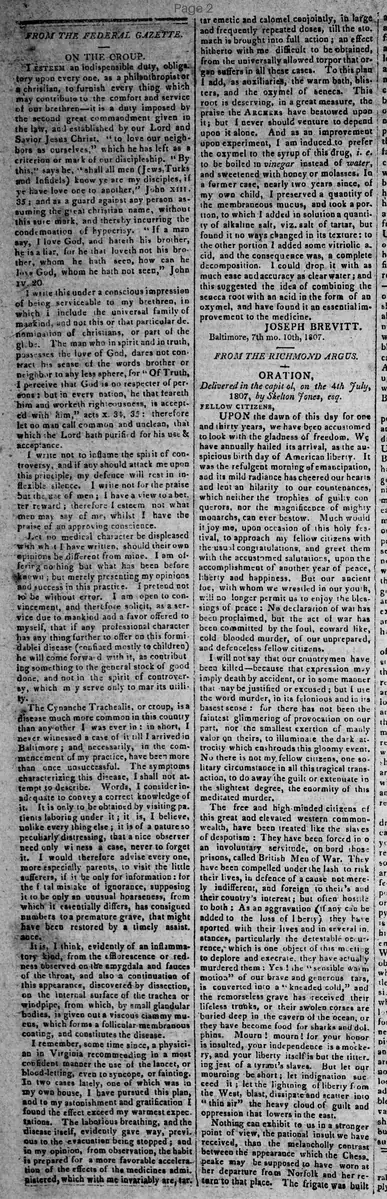
ON THE CROUP.
I esteem an indispensable duty, obligatory upon every one, as a philanthropist or a christian, to furnish every thing which may contribute to the comfort and service of our brethren it is a duty imposed by the second great commandment given in the law, and established by our Lord and Savior Jesus Christ. "to love our neighbours as ourselves," which he has left as a criterion or mark of our discipleship. "By this," says he, shall all men (Jews, Turks and Infidels) know ye are my disciples, if ye have love one to another," John xiii. 35: and as a guard against any person assuming the great christian name, without this sure mark, and thereby incurring the condemnation, of hypocrisy. "If a man say, I love God, and hateth his brother, he is a liar, for he that loveth not his brother, whom he hath seen, how can he love God, whom he hath not seen," John IV.20.
I write this under a conscientious impression of being serviceable to my brethren, in which I include the universal family of mankind, and not this or that particular denomination of christians, or part of the globe. The man who in spirit and in truth, possesses the love of God, dares not contract his sense of the words brother or neighbour to any less sphere, for "Of a truth, I perceive that God is no respecter of persons: but in every nation, he that feareth him and worketh righteousness, is accepted with him." acts x. 34, 35: therefore let no man call common and unclean, that which the Lord hath purified for his use & acceptance.
I write not to rouse the spirit of controversy, and if any should attack me upon this principle, my defence will rest in inflexible silence. I write not for the praise but the hate of men; I have a view to a better reward; therefore I esteem not what men may say of me, whilst I have the praise of an approving conscience.
Let no medical character be displeased with what I have written, should their own opinions be different from mine. I am offering nothing but what has been before known; but merely presenting my opinions and success in this practice. I pretend not to be without error. I am open to convincement, and therefore solicit, as a service due to mankind and a favor offered to myself, that if any professional character has any thing further to offer on this formidable disease (confined mostly to children) he will come forward with it, as contributing something to the general stock of good done. and not in the spirit of controversy, which may serve only to mar its utility.
The Cynanche Trachealis, or croup, is a disease much more common in this country than any other I was ever in : in short, I never witnessed a case of it till I arrived in Baltimore; and necessarily, in the commencement of my practice, have been more than once unsuccessful. The symptoms characterizing this disease, I shall not attempt to describe. Words, I consider inadequate to convey a correct knowledge of it. It is only to be obtained by visiting patients laboring under it ; it is, I believe, unlike every thing else ; it is of a nature so peculiarly distressing, that a nice observer need only witness a case, never to forget it. I would therefore advise every one, more especially parents, to visit the little sufferers, if it be only for information : for the fatal mistake of ignorance, supposing it to be only an unusual hoarseness, from which it essentially differs, has consigned numbers to a premature grave, that might have been restored by a timely assistance.
It is, I think, evidently of an inflammatory kind from the efflorescence or redness observed on the amygdala and fauces of the throat, and also a continuation of this appearance, discovered by dissection, on the internal surface of the trachea or windpipe, from which, by small glandular bodies, is given out a viscous clammy mucus, which forms a follicular membranous coating, and constitutes the disease.
I remember, some time since, a physician in Virginia recommending in a most confident manner the use of the lancet, or blood-letting, even to syncope, or fainting: In two cases lately, one of which was in my own house, I have pursued this plan, and to my astonishment and gratification I found the effect exceed my warmest expectations. The laborious breathing, and the disease itself, evidently gave way, previous to the evacuation being stopped ; and in my opinion, from observation, the habit is prepared for a more favorable acceleration of the effects of the medicines administered, which with me invariably are, tartar emetic and calomel conjointly, in large and frequently repeated doses, till the stomach is brought into full action ; an effect hitherto with me difficult to be obtained. from the universally allowed torpor that organ suffers in all these cases. To this plan I add, as auxiliaries, the warm bath, blisters, and the oxymel of seneca. This root is deserving, in a great measure, the praise the Americans have bestowed upon it; but I never should venture to depend upon it alone. And as an improvement upon experiment,-I am induced to prefer the oxymel to the syrup of this drug, i. e. to be boiled in vinegar instead of water. and sweetened with honey or molasses: In a former case, nearly two years since, of my own child, I preserved a quantity of the membraneous mucus, and took a portion, to which I added in solution a quantity of alkaline salt, viz. salt of tartar, but found it no ways changed in its texture: to the other portion I added some vitriolic acid, and the consequence was, a complete decomposition. I could drop it with as much ease and accuracy as clear water; and this suggested the idea of combining the seneca root with an acid in the form of an oxymel, and have found it an essential improvement to the medicine.
JOSEPH BREVITT.
Baltimore, 7th mo. 10th, 1807.
What sub-type of article is it?
What themes does it cover?
What keywords are associated?
What entities or persons were involved?
Where did it happen?
Story Details
Key Persons
Location
Baltimore
Event Date
7th Mo. 10th, 1807
Story Details
Joseph Brevitt shares his experiences and successful treatment for croup using blood-letting, tartar emetic, calomel, warm baths, blisters, and oxymel of seneca root, framed as a Christian duty to aid humanity, based on cases including his own child.