Thank you for visiting SNEWPapers!
Sign up free
Literary
November 14, 1857
Muscatine Weekly Journal
Muscatine, Muscatine County, Iowa
What is this article about?
A wealthy, educated lawyer marries a beautiful but illiterate rural woman from Vermont, initially valuing her simplicity over intellect. On their honeymoon, her ignorance embarrasses him, leading him to arrange private education for her. She improves rapidly, becoming a suitable companion and earning respect.
Clipping
OCR Quality
80%
Good
Full Text
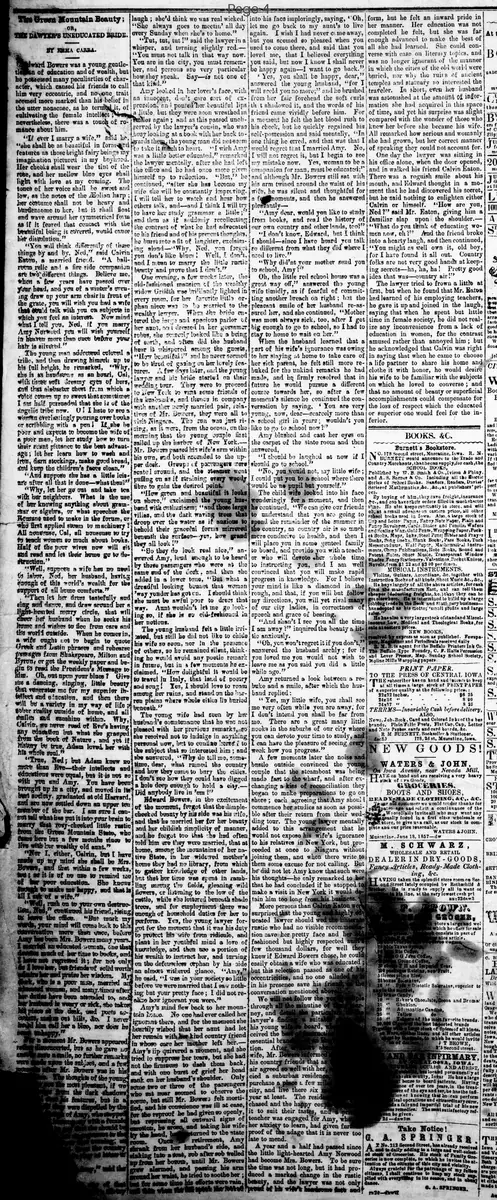
The Green Mountain Beauty:
The Lawyer's Uneducated Bride.
By FANNIE CARTER.
Edward Bowers was a young, genteel man of education and of wealth, but he possessed many peculiarities of character, which caused his friends to call him very eccentric, and one trait seemed more marked than his belief in the utter nonsense, as he termed it, of cultivating the female intellect; nevertheless, there was a touch of romance about him.
"If ever I marry a wife," said he, "she shall be as beautiful in form and features as those bright fairy beings my imagination pictured in my boyhood. Her cheeks shall wear the tint of the rose, and her mellow blue eyes shall light with love at my coming. The tones of her voice shall be sweet and low, as the notes of the Eolian harp; her costume shall not be heavy and burdensome to her, but it shall float and wave around her symmetrical form as if it feared that contact with the beautiful being it covered, would cause her dissolution."
"You will think differently of these things by and by, Ned," said Calvin Eaton, a married friend. "A ball-room belle and a fireside companion are two different things. Believe me, when a few years have passed over your head, and you of a winter's evening draw up your arm chair in front of the grate, you will wish you had a wife that could talk with you on subjects in which you feel an interest. Now mind what I tell you, Ned, if you marry Amy Norwood you will wish yourself in heaven more than once before your hair is silvered."
The young man addressed colored a little, and then drawing himself up to his full height, he remarked. "Why, she is as handsome as a houri, Cal, with those soft dreamy eyes of hers, and that alabaster cheek from which a voice comes up so sweet that sometimes I am half persuaded that she is of the angelic tribe now. Oh! I hate to see a woman everlastingly pouring over books or scribbling with a pen! If she be poor and expects to become the wife of a poor man, let her study how to turn their scanty pittance to the best advantage; let her learn how to wash and iron, darn stockings, make good bread, and keep the children's faces clean,"
"And suppose she has a little leisure after all that is done—what then?"
"Why, let her go out and take tea with her neighbors. What is the use of her knowing anything about grammar or algebra, or what speeches the Romans used to make in the forum, or who first applied steam to machinery? All nonsense, Cal, all nonsense to try to teach women so much about books. Half of the poor wives now will sit and read and let their home go to destruction."
"Well, suppose a wife has no need to labor, Ned, her husband, having enough of this world's wealth for the support of all home comforts."
"Then let her dress tastefully and sing and dance, and draw around her a light-hearted merry circle, that will cheer her husband when he seeks his home and wishes to flee from care and the world outside. When he comes in, a wife ought not to begin to quote Greek and Latin phrases and rehearse passages from Shakespeare, Milton and Byron, or get the weekly paper and begin to read the President's Message to him. Oh, out upon your blues! Give me a dancing, singing, little beauty that venerates me for my superior intellect and education, and then there will be a variety in my way of life; as sober reality outside of home, and all smiles and sunshine within. Why, Calvin, we never read of Eve having any education but what she grasped from the book of Nature, and yet if history be true, Adam loved her with his whole soul."
"True, Ned; but Adam knew no more than Eve—their intellects and educations were equal, but it is not so with you and Amy. You have been brought up in a city, and moved in its best society, graduated at old Harvard, and are now settled down an upper ten member of the bar. I am sure I can't tell what has put it into your brain to marry that rosy-cheeked little rustic from the Green Mountain State, who came here but a few months ago to live with her wealthy old aunt."
"Nor I, either, Calvin, but I have made up my mind she shall be Mrs. Bowers and that within a few weeks, too, and it is of no use to remind me of her poor education. She knows enough to make me happy, and that is all I ask of a wife."
"Well, rush on to your own destruction," continued his friend, rising to leave the office. "But mark my word, your mind will come back to this conversation more than once, before Amy has been Mrs. Bowers many years."
and educated woman, one that devotes much of her time to books, and has not regretted it; for not only her husband loved her, but friends of solid worth have made her praise her wisdom. My own wife, who is a poor man, married an educated woman, and many times after business have been attended to, and husband in worry or sick, she takes place at the desk, and posts accounts, makes out bills, etc. I never heard him call her a blue, nor does she laugh; she'd think we was real wicked.
"She always goes to meetin' all day every Sunday when she's to home."
"Tut, tut, tut!" said the lawyer in a whisper, and turning slightly red.— "You must not talk in that way now. You are in the city, you must remember, and persons are very particular how they speak. Say—is not one of that kind."
Amy looked in her lover's face, with an innocent, don't care sort of expression, and pouted her beautiful lips a little, but they were soon wreathed in smiles again; all this passed unobserved by the lawyer's cousin, who was busy looking at a book: with her back to take it much to heart. "I wish Amy was a little better educated," remarked the lawyer mentally, after she had left the office and he had once more given himself up to reflection. "But," he continued, "after she has become my wife she will be constantly improving. I will tell her to watch and hear how others talk, and—and I think I will try to have her study grammar a little;" and then as if suddenly recollecting the contrast of what he had advocated to his friend and of his present thoughts, he burst into a fit of laughter, exclaiming aloud—“Why, Ned, you forget you don't like blues! Well, I don't, and I mean to marry the little rustic beauty and prove that I don't."
One evening, a few weeks later, the old-fashioned mansion of the wealthy widow Griffith was brilliantly lighted in every room, for her favorite little orphan niece was to be married to the wealthy lawyer. When the bride entered the large and spacious parlor of her aunt, one dressed in her gossamer robes, she scarcely looked like a being of earth, and often did the husband hear it whispered among the guests, "How beautiful;" and he never seemed to be tired of gazing on his love, features, A few days later, and the young pair started on their wedding tour. They were to proceed to New York, visit some friends of the bridegroom's, and then in company with another merry married pair, relatives of Mr. Dotery, their particular friends, to visit Niagara. The sun was just rising, as it were, from the ocean, on the morning that the young couple first sailed up the harbor of New York.— Mr. Bowers passed his wife's arm within his own, and both ascended to the upper deck. Groups of passengers were seated around, and the steamer went gliding on as it straining every nerve to gain the desired point.
"How green and beautiful it looks on shore," exclaimed the young husband with enthusiasm; "and those large villas, and the dark waving trees that droop over the water as if anxious to behold their graceful forms mirrored beneath the surface—yes, how grand they all look!"
"Oh they do look real nice," answered Amy, loud enough to be heard by those passengers who were at the same end of the deck, and then she added in a lower tone, "But what a dreadful looking bonnet that woman way yonder has got on. I should think she must be awful poor to dress that way. Aunt wouldn't let me go looking so, if she is so old-fashioned in her notions."
The young husband felt a little irritated, but still he did not like to chide his wife so soon, nor in the presence of others, so he remained silent, thinking he would avoid any poetic remarks in future, but in a few moments he exclaimed. "How delightful it would be to travel in Italy, that land of poetry and song! Yes, I should love to roam among her ruins, and stand on the barren plains where whole cities lie buried beneath."
The young wife had seen by her husband's countenance that he was not pleased with her previous remarks, so she resolved not to indulge in anything personal on, but to confine herself to the subject that so interested him: and she answered, "Why do tell me, sometime, dear, what ruined the country and how they came to bury the cities. I don't see how they could have digged a hole deep enough to hold a city.— Did anybody live in 'em?"
Edward Bowers, in the excitement of the moment, forgot that the dimple-cheeked beauty by his side was his wife, and that he married her for her beauty and her childish simplicity of manner, and he forgot too that she had often told him ere they were married, that at home, among the mountains of her native State, in her widowed mother's home they had no library, from which to gather knowledge of other lands, but that her time was spent in rambling among the woods, gleaning wild flowers, or listening to the low of the cattle, while she loitered beneath shade trees, and for employment there was enough of household duties for her to perform. Yes, the young lawyer forgot for the moment that it was his duty to protect his wife from ridicule, and plant in her youthful mind a love of knowledge, and then use a portion of his wealth to instruct her, and turning on the defenseless orphan by his side an almost withered glance, "Amy," he said, "I was in your society so little before we were married that I saw nothing but your pretty face; I did not realize how ignorant you woman"
Amy's mind flew back to her mountain home. No one had ever called her ignorant there—her kind country friends
again. I wish I had never come away, but you seemed so pleased when you used to come there, and said that you loved me, that I believed everything you said, but now I know I shall never be happy again—I want to go back."
"Yes, you shall be happy, dear," answered the young husband, "for I will scold you no more;" and he brushed from her fair forehead the soft curls that shadowed it, and the words of his friend came vividly before him. For a moment he felt the hot blood rush to his cheek, but he quickly regained his self-possession and said mentally, "In one thing he erred, and that was that I would regret that I married Amy. No, I will not regret it, but I begin to see my mistake now. Yes, woman to be a companion for man, must be educated;" and although Mr. Bowers still sat with his arm twined around the waist of his wife, he was silent and thoughtful for a few moments, and then he answered pleasantly—
"Amy dear, would you like to study from books, and read the history of our own country and other lands, too?"
"I don't know, Edward, but I think I should—since I have heard you talk so different from what they did where I used to live."
"Why didn't your mother send you to school, Amy?"
"Oh, the little red school house was a great way off," answered the young wife timidly, as if fearful of committing another breach of etiquette; but the pleasant smile of her husband re-assured her, and she continued, "Mother was most always sick, too, after I got big enough to go to school, so I had to stay to home to wait on her."
When the husband learned that a part of his wife's ignorance was owing to her staying at home to take care of her sick parent, he felt still more rebuked for the unkind remarks he had made, and he firmly resolved that in future he would pursue a different course towards her, so after a few moment's silence he continued the conversation by saying, "You are very young, now, dear—scarcely more than a school girl in years; wouldn't you like to go to school now?"
Amy blushed and cast her eyes on the carpet of the state room and then answered.
"I should be laughed at now if I should go to school."
"No, you would not, my little wife; I could put you to a school where there would be no pupil but yourself."
The child wife looked into his face wonderingly for a moment, and then he continued, "we can give our friends to understand that you are going to spend the remainder of the summer in the country, as country air is so much more conducive to health, and then I will place you in some genteel family to board, and provide you with a teacher who will devote her whole time to instructing you, and I am well convinced that you will make rapid progress in knowledge. For I believe your mind is like a diamond in the rough, and that, if you will but follow my directions, you will yet rival many of our city ladies, in correctness of speech and grace of bearing."
"And shan't I see you all the time I am away?" inquired the beauty a little anxiously.
"Oh, you won't regret it if you don't," answered the husband archly; for if you loved me you would not wish to leave me as you said you did a little while ago."
Amy returned a look between a rebuke and a smile, after which the husband replied:
"Yes, my little wife, you shall see me very often while you are away, for I don't intend you shall be far from me. There are a great many little nooks in the suburbs of our city where you can devote your time to study, and I can have the pleasure of seeing every week how you progress."
A few moments later the noise and bustle outside convinced the young couple that the steamboat was being made fast to the wharf, and after exchanging a kiss of reconciliation they began to make preparations to go on shore; each agreeing that Amy should commence her studies as soon as possible during their wedding tour. The young lawyer mentally added to this arrangement that he would not expose his wife's ignorance to his relatives in New York, but proceeded at once to Niagara without joining them, and when there write to them some excuse for not calling. But he did not let Amy know that such were his thoughts—he only remarked to her that he had concluded if he stopped to make a visit in New York it would detain him too long from his business.
More persons than Calvin Eaton were surprised that the young and highly educated lawyer should wed the illiterate rustic who had no visible recommendation save her pretty face and her old-fashioned but highly respected aunt's few thousand dollars, for well they knew if Edward Bowers chose, he could easily obtain a wife who was educated but this selection passed as one of his eccentricities, and no one alluded to in his presence save his friend,**
conversation mentioned
We will not follow the young couple through all the minutiae of their tour, but he felt an inward pride in her manner. Her education was not completed he felt, but she was far enough advanced to make the best of all she had learned. She could converse with ease on literary topics, and was no longer ignorant of the manner in which the cities of the old world were buried, nor why the ruins of ancient temples and statuary so interested the traveler. In short, even her husband was astonished at the amount of information she had acquired in this space of time, and yet his surprise was slight compared with the wonder of those who knew her before she became his wife. All remarked how serious and womanly she had grown, but her correct manner of speaking they could not account for.
One day the lawyer was sitting in his office alone, when the door opened, and in walked his friend Calvin Eaton. There was a roguish smile about his mouth, and Edward thought in a moment that he had discovered his secret, but he said nothing to enlighten either Calvin or himself. "How are you, Ned?" said Mr. Eaton, giving him a familiar slap upon the shoulder.— "What do you think of educating women now, eh?" And the friend broke into a hearty laugh, and then continued, "You might as well own it, old boy, for I have found it all out. Country folks are not very good hands at keeping secrets—ha, ha, ha! Pretty good idea that was country air!"
The lawyer tried to frown a little at first, but when he found that Mr. Eaton had learned of his employing teachers, he gave it up and joined in the laugh, saying that when he spent but little time in female society, he did not realize any inconvenience from a lack of education in women, for the contrast amused rather than annoyed him; but he acknowledged that Calvin was right in saying that when he came to choose a life partner to share his home and clothe it with honor, he would desire his wife to be familiar with the subjects on which he loved to converse; and that no amount of beauty or superficial accomplishments could compensate for the loss of respect which the educated or superior one would feel for the inferior.
it to suit their tastes, and a teacher was engaged for Amy, who, with her anxiety to learn, had given further proof of the adage that it is never too late to mend.
A year and a half had passed since the little light-hearted Amy Norwood had become Mrs. Bowers. To be sure the time was not long, but it had produced a marked change in the rustic beauty, and the lawyer was not only
The Lawyer's Uneducated Bride.
By FANNIE CARTER.
Edward Bowers was a young, genteel man of education and of wealth, but he possessed many peculiarities of character, which caused his friends to call him very eccentric, and one trait seemed more marked than his belief in the utter nonsense, as he termed it, of cultivating the female intellect; nevertheless, there was a touch of romance about him.
"If ever I marry a wife," said he, "she shall be as beautiful in form and features as those bright fairy beings my imagination pictured in my boyhood. Her cheeks shall wear the tint of the rose, and her mellow blue eyes shall light with love at my coming. The tones of her voice shall be sweet and low, as the notes of the Eolian harp; her costume shall not be heavy and burdensome to her, but it shall float and wave around her symmetrical form as if it feared that contact with the beautiful being it covered, would cause her dissolution."
"You will think differently of these things by and by, Ned," said Calvin Eaton, a married friend. "A ball-room belle and a fireside companion are two different things. Believe me, when a few years have passed over your head, and you of a winter's evening draw up your arm chair in front of the grate, you will wish you had a wife that could talk with you on subjects in which you feel an interest. Now mind what I tell you, Ned, if you marry Amy Norwood you will wish yourself in heaven more than once before your hair is silvered."
The young man addressed colored a little, and then drawing himself up to his full height, he remarked. "Why, she is as handsome as a houri, Cal, with those soft dreamy eyes of hers, and that alabaster cheek from which a voice comes up so sweet that sometimes I am half persuaded that she is of the angelic tribe now. Oh! I hate to see a woman everlastingly pouring over books or scribbling with a pen! If she be poor and expects to become the wife of a poor man, let her study how to turn their scanty pittance to the best advantage; let her learn how to wash and iron, darn stockings, make good bread, and keep the children's faces clean,"
"And suppose she has a little leisure after all that is done—what then?"
"Why, let her go out and take tea with her neighbors. What is the use of her knowing anything about grammar or algebra, or what speeches the Romans used to make in the forum, or who first applied steam to machinery? All nonsense, Cal, all nonsense to try to teach women so much about books. Half of the poor wives now will sit and read and let their home go to destruction."
"Well, suppose a wife has no need to labor, Ned, her husband, having enough of this world's wealth for the support of all home comforts."
"Then let her dress tastefully and sing and dance, and draw around her a light-hearted merry circle, that will cheer her husband when he seeks his home and wishes to flee from care and the world outside. When he comes in, a wife ought not to begin to quote Greek and Latin phrases and rehearse passages from Shakespeare, Milton and Byron, or get the weekly paper and begin to read the President's Message to him. Oh, out upon your blues! Give me a dancing, singing, little beauty that venerates me for my superior intellect and education, and then there will be a variety in my way of life; as sober reality outside of home, and all smiles and sunshine within. Why, Calvin, we never read of Eve having any education but what she grasped from the book of Nature, and yet if history be true, Adam loved her with his whole soul."
"True, Ned; but Adam knew no more than Eve—their intellects and educations were equal, but it is not so with you and Amy. You have been brought up in a city, and moved in its best society, graduated at old Harvard, and are now settled down an upper ten member of the bar. I am sure I can't tell what has put it into your brain to marry that rosy-cheeked little rustic from the Green Mountain State, who came here but a few months ago to live with her wealthy old aunt."
"Nor I, either, Calvin, but I have made up my mind she shall be Mrs. Bowers and that within a few weeks, too, and it is of no use to remind me of her poor education. She knows enough to make me happy, and that is all I ask of a wife."
"Well, rush on to your own destruction," continued his friend, rising to leave the office. "But mark my word, your mind will come back to this conversation more than once, before Amy has been Mrs. Bowers many years."
and educated woman, one that devotes much of her time to books, and has not regretted it; for not only her husband loved her, but friends of solid worth have made her praise her wisdom. My own wife, who is a poor man, married an educated woman, and many times after business have been attended to, and husband in worry or sick, she takes place at the desk, and posts accounts, makes out bills, etc. I never heard him call her a blue, nor does she laugh; she'd think we was real wicked.
"She always goes to meetin' all day every Sunday when she's to home."
"Tut, tut, tut!" said the lawyer in a whisper, and turning slightly red.— "You must not talk in that way now. You are in the city, you must remember, and persons are very particular how they speak. Say—is not one of that kind."
Amy looked in her lover's face, with an innocent, don't care sort of expression, and pouted her beautiful lips a little, but they were soon wreathed in smiles again; all this passed unobserved by the lawyer's cousin, who was busy looking at a book: with her back to take it much to heart. "I wish Amy was a little better educated," remarked the lawyer mentally, after she had left the office and he had once more given himself up to reflection. "But," he continued, "after she has become my wife she will be constantly improving. I will tell her to watch and hear how others talk, and—and I think I will try to have her study grammar a little;" and then as if suddenly recollecting the contrast of what he had advocated to his friend and of his present thoughts, he burst into a fit of laughter, exclaiming aloud—“Why, Ned, you forget you don't like blues! Well, I don't, and I mean to marry the little rustic beauty and prove that I don't."
One evening, a few weeks later, the old-fashioned mansion of the wealthy widow Griffith was brilliantly lighted in every room, for her favorite little orphan niece was to be married to the wealthy lawyer. When the bride entered the large and spacious parlor of her aunt, one dressed in her gossamer robes, she scarcely looked like a being of earth, and often did the husband hear it whispered among the guests, "How beautiful;" and he never seemed to be tired of gazing on his love, features, A few days later, and the young pair started on their wedding tour. They were to proceed to New York, visit some friends of the bridegroom's, and then in company with another merry married pair, relatives of Mr. Dotery, their particular friends, to visit Niagara. The sun was just rising, as it were, from the ocean, on the morning that the young couple first sailed up the harbor of New York.— Mr. Bowers passed his wife's arm within his own, and both ascended to the upper deck. Groups of passengers were seated around, and the steamer went gliding on as it straining every nerve to gain the desired point.
"How green and beautiful it looks on shore," exclaimed the young husband with enthusiasm; "and those large villas, and the dark waving trees that droop over the water as if anxious to behold their graceful forms mirrored beneath the surface—yes, how grand they all look!"
"Oh they do look real nice," answered Amy, loud enough to be heard by those passengers who were at the same end of the deck, and then she added in a lower tone, "But what a dreadful looking bonnet that woman way yonder has got on. I should think she must be awful poor to dress that way. Aunt wouldn't let me go looking so, if she is so old-fashioned in her notions."
The young husband felt a little irritated, but still he did not like to chide his wife so soon, nor in the presence of others, so he remained silent, thinking he would avoid any poetic remarks in future, but in a few moments he exclaimed. "How delightful it would be to travel in Italy, that land of poetry and song! Yes, I should love to roam among her ruins, and stand on the barren plains where whole cities lie buried beneath."
The young wife had seen by her husband's countenance that he was not pleased with her previous remarks, so she resolved not to indulge in anything personal on, but to confine herself to the subject that so interested him: and she answered, "Why do tell me, sometime, dear, what ruined the country and how they came to bury the cities. I don't see how they could have digged a hole deep enough to hold a city.— Did anybody live in 'em?"
Edward Bowers, in the excitement of the moment, forgot that the dimple-cheeked beauty by his side was his wife, and that he married her for her beauty and her childish simplicity of manner, and he forgot too that she had often told him ere they were married, that at home, among the mountains of her native State, in her widowed mother's home they had no library, from which to gather knowledge of other lands, but that her time was spent in rambling among the woods, gleaning wild flowers, or listening to the low of the cattle, while she loitered beneath shade trees, and for employment there was enough of household duties for her to perform. Yes, the young lawyer forgot for the moment that it was his duty to protect his wife from ridicule, and plant in her youthful mind a love of knowledge, and then use a portion of his wealth to instruct her, and turning on the defenseless orphan by his side an almost withered glance, "Amy," he said, "I was in your society so little before we were married that I saw nothing but your pretty face; I did not realize how ignorant you woman"
Amy's mind flew back to her mountain home. No one had ever called her ignorant there—her kind country friends
again. I wish I had never come away, but you seemed so pleased when you used to come there, and said that you loved me, that I believed everything you said, but now I know I shall never be happy again—I want to go back."
"Yes, you shall be happy, dear," answered the young husband, "for I will scold you no more;" and he brushed from her fair forehead the soft curls that shadowed it, and the words of his friend came vividly before him. For a moment he felt the hot blood rush to his cheek, but he quickly regained his self-possession and said mentally, "In one thing he erred, and that was that I would regret that I married Amy. No, I will not regret it, but I begin to see my mistake now. Yes, woman to be a companion for man, must be educated;" and although Mr. Bowers still sat with his arm twined around the waist of his wife, he was silent and thoughtful for a few moments, and then he answered pleasantly—
"Amy dear, would you like to study from books, and read the history of our own country and other lands, too?"
"I don't know, Edward, but I think I should—since I have heard you talk so different from what they did where I used to live."
"Why didn't your mother send you to school, Amy?"
"Oh, the little red school house was a great way off," answered the young wife timidly, as if fearful of committing another breach of etiquette; but the pleasant smile of her husband re-assured her, and she continued, "Mother was most always sick, too, after I got big enough to go to school, so I had to stay to home to wait on her."
When the husband learned that a part of his wife's ignorance was owing to her staying at home to take care of her sick parent, he felt still more rebuked for the unkind remarks he had made, and he firmly resolved that in future he would pursue a different course towards her, so after a few moment's silence he continued the conversation by saying, "You are very young, now, dear—scarcely more than a school girl in years; wouldn't you like to go to school now?"
Amy blushed and cast her eyes on the carpet of the state room and then answered.
"I should be laughed at now if I should go to school."
"No, you would not, my little wife; I could put you to a school where there would be no pupil but yourself."
The child wife looked into his face wonderingly for a moment, and then he continued, "we can give our friends to understand that you are going to spend the remainder of the summer in the country, as country air is so much more conducive to health, and then I will place you in some genteel family to board, and provide you with a teacher who will devote her whole time to instructing you, and I am well convinced that you will make rapid progress in knowledge. For I believe your mind is like a diamond in the rough, and that, if you will but follow my directions, you will yet rival many of our city ladies, in correctness of speech and grace of bearing."
"And shan't I see you all the time I am away?" inquired the beauty a little anxiously.
"Oh, you won't regret it if you don't," answered the husband archly; for if you loved me you would not wish to leave me as you said you did a little while ago."
Amy returned a look between a rebuke and a smile, after which the husband replied:
"Yes, my little wife, you shall see me very often while you are away, for I don't intend you shall be far from me. There are a great many little nooks in the suburbs of our city where you can devote your time to study, and I can have the pleasure of seeing every week how you progress."
A few moments later the noise and bustle outside convinced the young couple that the steamboat was being made fast to the wharf, and after exchanging a kiss of reconciliation they began to make preparations to go on shore; each agreeing that Amy should commence her studies as soon as possible during their wedding tour. The young lawyer mentally added to this arrangement that he would not expose his wife's ignorance to his relatives in New York, but proceeded at once to Niagara without joining them, and when there write to them some excuse for not calling. But he did not let Amy know that such were his thoughts—he only remarked to her that he had concluded if he stopped to make a visit in New York it would detain him too long from his business.
More persons than Calvin Eaton were surprised that the young and highly educated lawyer should wed the illiterate rustic who had no visible recommendation save her pretty face and her old-fashioned but highly respected aunt's few thousand dollars, for well they knew if Edward Bowers chose, he could easily obtain a wife who was educated but this selection passed as one of his eccentricities, and no one alluded to in his presence save his friend,**
conversation mentioned
We will not follow the young couple through all the minutiae of their tour, but he felt an inward pride in her manner. Her education was not completed he felt, but she was far enough advanced to make the best of all she had learned. She could converse with ease on literary topics, and was no longer ignorant of the manner in which the cities of the old world were buried, nor why the ruins of ancient temples and statuary so interested the traveler. In short, even her husband was astonished at the amount of information she had acquired in this space of time, and yet his surprise was slight compared with the wonder of those who knew her before she became his wife. All remarked how serious and womanly she had grown, but her correct manner of speaking they could not account for.
One day the lawyer was sitting in his office alone, when the door opened, and in walked his friend Calvin Eaton. There was a roguish smile about his mouth, and Edward thought in a moment that he had discovered his secret, but he said nothing to enlighten either Calvin or himself. "How are you, Ned?" said Mr. Eaton, giving him a familiar slap upon the shoulder.— "What do you think of educating women now, eh?" And the friend broke into a hearty laugh, and then continued, "You might as well own it, old boy, for I have found it all out. Country folks are not very good hands at keeping secrets—ha, ha, ha! Pretty good idea that was country air!"
The lawyer tried to frown a little at first, but when he found that Mr. Eaton had learned of his employing teachers, he gave it up and joined in the laugh, saying that when he spent but little time in female society, he did not realize any inconvenience from a lack of education in women, for the contrast amused rather than annoyed him; but he acknowledged that Calvin was right in saying that when he came to choose a life partner to share his home and clothe it with honor, he would desire his wife to be familiar with the subjects on which he loved to converse; and that no amount of beauty or superficial accomplishments could compensate for the loss of respect which the educated or superior one would feel for the inferior.
it to suit their tastes, and a teacher was engaged for Amy, who, with her anxiety to learn, had given further proof of the adage that it is never too late to mend.
A year and a half had passed since the little light-hearted Amy Norwood had become Mrs. Bowers. To be sure the time was not long, but it had produced a marked change in the rustic beauty, and the lawyer was not only
What sub-type of article is it?
Prose Fiction
What themes does it cover?
Moral Virtue
Social Manners
What keywords are associated?
Female Education
Uneducated Bride
Rustic Beauty
Marriage
Personal Growth
What entities or persons were involved?
By Fannie Carter.
Literary Details
Title
The Green Mountain Beauty: The Lawyer's Uneducated Bride.
Author
By Fannie Carter.
Key Lines
"If Ever I Marry A Wife," Said He, "She Shall Be As Beautiful In Form And Features As Those Bright Fairy Beings My Imagination Pictured In My Boyhood."
"Oh! I Hate To See A Woman Everlastingly Pouring Over Books Or Scribbling With A Pen!"
"Yes, Woman To Be A Companion For Man, Must Be Educated;"