Thank you for visiting SNEWPapers!
Sign up free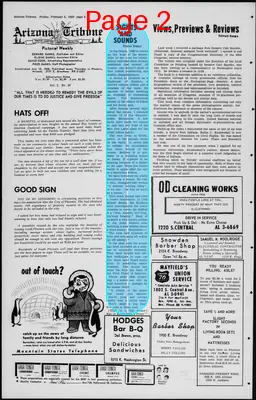
Story
February 5, 1960
Arizona Tribune
Phoenix, Maricopa County, Arizona
What is this article about?
Eloise Banks' article celebrates 1960 as the Year of the Mouse in the Orient, highlighting mice's cultural, historical, and scientific significance, from fables and poetry to research and space ventures, challenging negative stereotypes.
Clipping

OCR Quality
100%
Excellent
Full Text
SIGHTS AND SOUNDS
Eloise Banks
In the Orient, 1960 is known as the Year of the Mouse.
This is the year for intelligence, calm and other mousey attributes that abound. Of course, one doesn't think of this rodent possessing any worthy characteristics.
A mouse is pictured as a frightener of females, a shrewd cheese robber and a creature of the night. He appears in fables needling an elephant or tormenting tigers.
The bewhiskered animal is the object of Tabby and her feline pals.
After musing several days about the mouse, I checked volume 15 of the Encyclopedia Britannica. A few facts have made me reason to call this the Year of the Mus (the Latin name for the small rodent family).
The mus lives in fields, nests, in the ground, holes in the walls, in eaves and in cellars. No civilization has been devoid of the mouse. Believe it or not, there is a waltzing mouse in Japan. It appears to be dancing because of a defect in its ears. When the mouse walks it spins after its tail in a dancelike motion.
We have borrowed the words describing a mouse. We call a thin, straggled-hair woman "a mousey looking thing", or we say, "he was as quiet as a mouse."
This small animal has been a poetic inspiration. In 1785 Robert Burns, the Scottish bard immortalized the lowly creature in verse. He dubbed it a "wee, sleekit, cow'ring, tim'rous beastie." Many of us quote a well known phrase of his poem without ever realizing it was written about a mere mouse. Remember— "The best laid schemes of mice and men gang aft a-gley (go oft astray)."
In the past year the mouse has been elevated as a member of scientific research. They have helped men perfect medicines to cure our ills. Some have found ironic glory in practicing space ventures.
The mouse has risen far from the days of the Pied Piper of Hamelin.
Throw away that mouse trap - a better one will be built tomorrow - perhaps by the mouse itself.
"A mouse in the house
Can scare your spouse.
She'll jump and scream
Maybe tear a nylon seam.
Don't start a big fuss,
It's only a little mus,
(That is a tiny mouse)
Who is better than a louse."
Eloise Banks
In the Orient, 1960 is known as the Year of the Mouse.
This is the year for intelligence, calm and other mousey attributes that abound. Of course, one doesn't think of this rodent possessing any worthy characteristics.
A mouse is pictured as a frightener of females, a shrewd cheese robber and a creature of the night. He appears in fables needling an elephant or tormenting tigers.
The bewhiskered animal is the object of Tabby and her feline pals.
After musing several days about the mouse, I checked volume 15 of the Encyclopedia Britannica. A few facts have made me reason to call this the Year of the Mus (the Latin name for the small rodent family).
The mus lives in fields, nests, in the ground, holes in the walls, in eaves and in cellars. No civilization has been devoid of the mouse. Believe it or not, there is a waltzing mouse in Japan. It appears to be dancing because of a defect in its ears. When the mouse walks it spins after its tail in a dancelike motion.
We have borrowed the words describing a mouse. We call a thin, straggled-hair woman "a mousey looking thing", or we say, "he was as quiet as a mouse."
This small animal has been a poetic inspiration. In 1785 Robert Burns, the Scottish bard immortalized the lowly creature in verse. He dubbed it a "wee, sleekit, cow'ring, tim'rous beastie." Many of us quote a well known phrase of his poem without ever realizing it was written about a mere mouse. Remember— "The best laid schemes of mice and men gang aft a-gley (go oft astray)."
In the past year the mouse has been elevated as a member of scientific research. They have helped men perfect medicines to cure our ills. Some have found ironic glory in practicing space ventures.
The mouse has risen far from the days of the Pied Piper of Hamelin.
Throw away that mouse trap - a better one will be built tomorrow - perhaps by the mouse itself.
"A mouse in the house
Can scare your spouse.
She'll jump and scream
Maybe tear a nylon seam.
Don't start a big fuss,
It's only a little mus,
(That is a tiny mouse)
Who is better than a louse."
What sub-type of article is it?
Curiosity
Animal Story
What themes does it cover?
Nature
Moral Virtue
Triumph
What keywords are associated?
Year Of The Mouse
Cultural Stereotypes
Robert Burns Poem
Scientific Research
Waltzing Mouse
What entities or persons were involved?
Eloise Banks
Robert Burns
Where did it happen?
Orient, Japan
Story Details
Key Persons
Eloise Banks
Robert Burns
Location
Orient, Japan
Event Date
1960
Story Details
Article discusses the cultural, historical, and scientific attributes of mice, elevating their status in the Year of the Mouse, referencing fables, Burns' poetry, Britannica facts, and modern research.