Thank you for visiting SNEWPapers!
Sign up free
Story
January 29, 1903
The Bossier Banner
Benton, Bellevue, Bossier County, Louisiana
What is this article about?
Farmer L. W. Colvin shares a DIY method for building wire and picket fences using simple planks and anchors, as a cost-effective alternative to patented devices, ensuring straight wires and neat work.
Clipping
OCR Quality
98%
Excellent
Full Text
Home-Made Arrangement That Does the Work as Well as Any Patented Device.
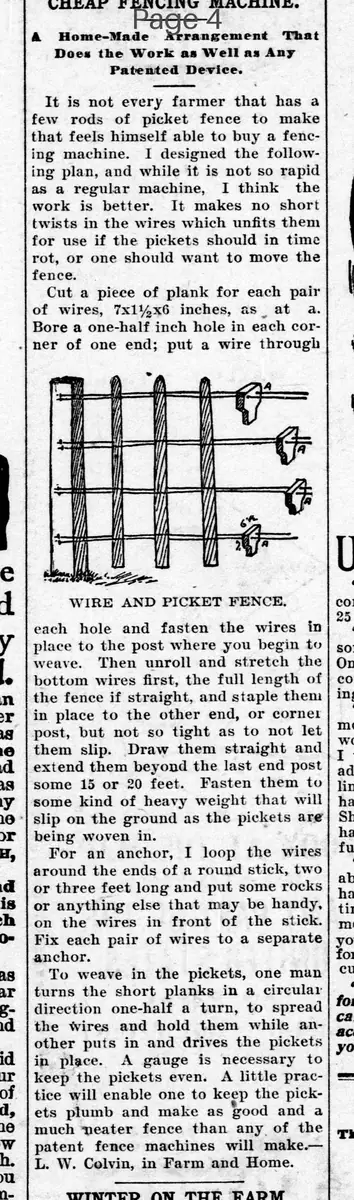
It is not every farmer that has a few rods of picket fence to make that feels himself able to buy a fencing machine. I designed the following plan, and while it is not so rapid as a regular machine, I think the work is better. It makes no short twists in the wires which unfits them for use if the pickets should in time rot, or one should want to move the fence.
Cut a piece of plank for each pair of wires, 7x1½x6 inches, as at a. Bore a one-half inch hole in each corner of one end; put a wire through each hole and fasten the wires in place to the post where you begin to weave. Then unroll and stretch the bottom wires first, the full length of the fence if straight, and staple them in place to the other end, or corner post, but not so tight as to not let them slip. Draw them straight and extend them beyond the last end post some 15 or 20 feet. Fasten them to some kind of heavy weight that will slip on the ground as the pickets are being woven in.
For an anchor, I loop the wires around the ends of a round stick, two or three feet long and put some rocks or anything else that may be handy, on the wires in front of the stick. Fix each pair of wires to a separate anchor.
To weave in the pickets, one man turns the short planks in a circular direction one-half a turn, to spread the wires and hold them while another puts in and drives the pickets in place. A gauge is necessary to keep the pickets even. A little practice will enable one to keep the pickets plumb and make as good and a much neater fence than any of the patent fence machines will make.--L. W. Colvin, in Farm and Home.
WIRE AND PICKET FENCE.
It is not every farmer that has a few rods of picket fence to make that feels himself able to buy a fencing machine. I designed the following plan, and while it is not so rapid as a regular machine, I think the work is better. It makes no short twists in the wires which unfits them for use if the pickets should in time rot, or one should want to move the fence.
Cut a piece of plank for each pair of wires, 7x1½x6 inches, as at a. Bore a one-half inch hole in each corner of one end; put a wire through each hole and fasten the wires in place to the post where you begin to weave. Then unroll and stretch the bottom wires first, the full length of the fence if straight, and staple them in place to the other end, or corner post, but not so tight as to not let them slip. Draw them straight and extend them beyond the last end post some 15 or 20 feet. Fasten them to some kind of heavy weight that will slip on the ground as the pickets are being woven in.
For an anchor, I loop the wires around the ends of a round stick, two or three feet long and put some rocks or anything else that may be handy, on the wires in front of the stick. Fix each pair of wires to a separate anchor.
To weave in the pickets, one man turns the short planks in a circular direction one-half a turn, to spread the wires and hold them while another puts in and drives the pickets in place. A gauge is necessary to keep the pickets even. A little practice will enable one to keep the pickets plumb and make as good and a much neater fence than any of the patent fence machines will make.--L. W. Colvin, in Farm and Home.
WIRE AND PICKET FENCE.
What sub-type of article is it?
Curiosity
Personal Triumph
What themes does it cover?
Triumph
What keywords are associated?
Homemade Fence
Wire Picket Fence
Fencing Machine
Farming Invention
What entities or persons were involved?
L. W. Colvin
Story Details
Key Persons
L. W. Colvin
Story Details
L. W. Colvin describes a homemade method using planks, wires, and weights to weave picket fences, which he claims produces better results than patented machines without short twists in the wires.