Thank you for visiting SNEWPapers!
Sign up free
The Potters Herald
East Liverpool, Columbiana County, Ohio
What is this article about?
Amid rising unemployment and factory job declines in New York, Pennsylvania, and Connecticut, Harry A. Bullis of General Mills urges business to create more jobs for economic health, emphasizing marketing's role in distributing increased production.
Clipping
OCR Quality
Full Text
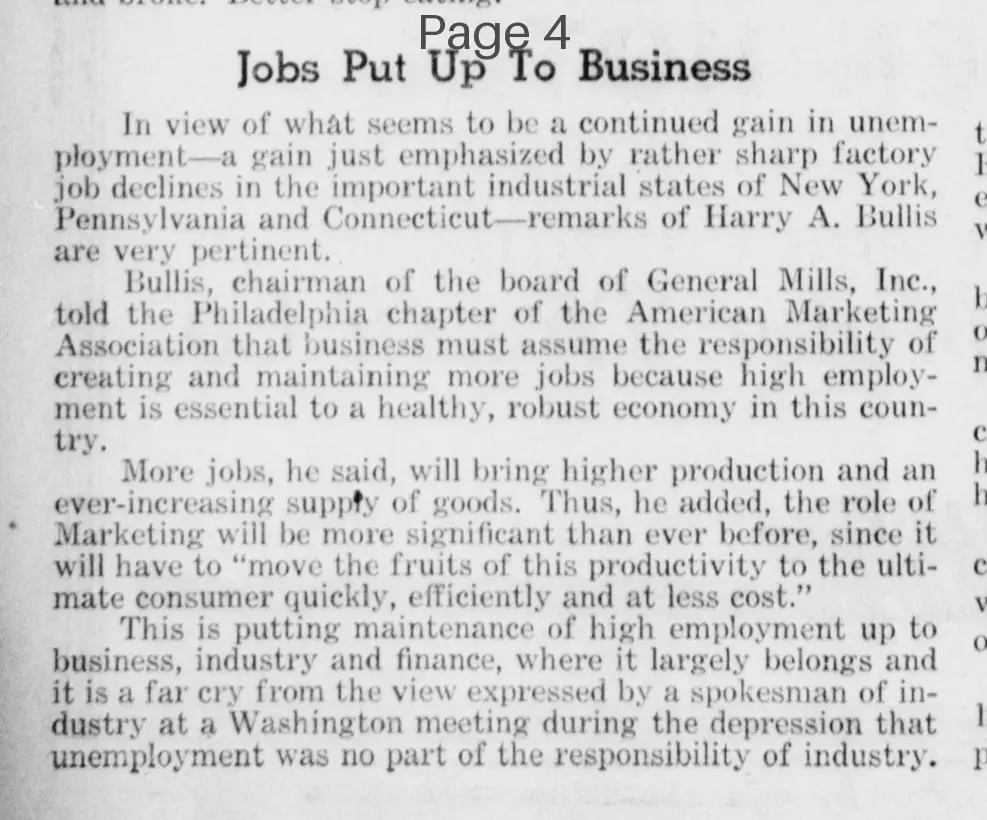
In view of what seems to be a continued gain in unemployment—a gain just emphasized by rather sharp factory job declines in the important industrial states of New York, Pennsylvania and Connecticut—remarks of Harry A. Bullis are very pertinent.
Bullis, chairman of the board of General Mills, Inc., told the Philadelphia chapter of the American Marketing Association that business must assume the responsibility of creating and maintaining more jobs because high employment is essential to a healthy, robust economy in this country.
More jobs, he said, will bring higher production and an ever-increasing supply of goods. Thus, he added, the role of Marketing will be more significant than ever before, since it will have to "move the fruits of this productivity to the ultimate consumer quickly, efficiently and at less cost."
This is putting maintenance of high employment up to business, industry and finance, where it largely belongs and it is a far cry from the view expressed by a spokesman of industry at a Washington meeting during the depression that unemployment was no part of the responsibility of industry.
What sub-type of article is it?
What keywords are associated?
What entities or persons were involved?
Where did it happen?
Domestic News Details
Primary Location
Philadelphia
Key Persons
Event Details
Harry A. Bullis, chairman of the board of General Mills, Inc., told the Philadelphia chapter of the American Marketing Association that business must assume the responsibility of creating and maintaining more jobs because high employment is essential to a healthy, robust economy. He stated that more jobs will bring higher production and an increasing supply of goods, making the role of marketing more significant to move productivity to consumers quickly, efficiently, and at less cost. This contrasts with a previous view from an industry spokesman during the depression that unemployment was not industry's responsibility.