Thank you for visiting SNEWPapers!
Sign up free
Story
December 3, 1949
Courier Herald
Kennewick, Pasco, Benton County, Franklin County, Washington
What is this article about?
Article based on Lt. Gen. Walter Bedell Smith's accounts of life in Soviet Russia as U.S. ambassador, detailing exorbitant food prices, scarce goods, and harsh conditions contrasting with American abundance, underscoring Russia's underdeveloped consumer industry.
Clipping
OCR Quality
98%
Excellent
Full Text
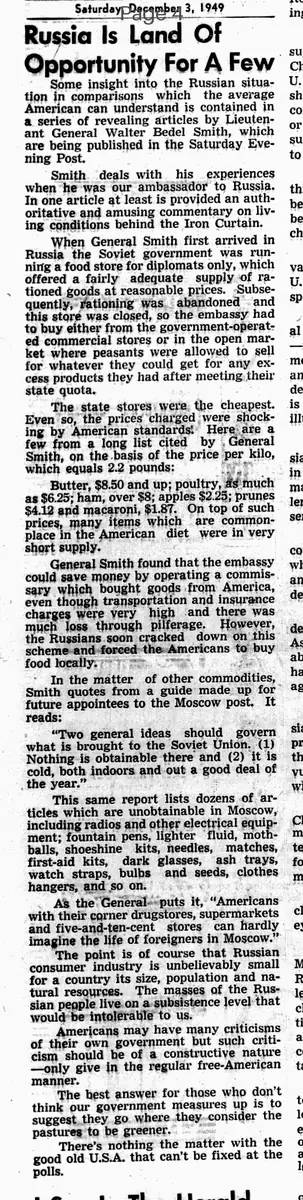
Russia Is Land Of Opportunity For A Few
Some insight into the Russian situation in comparisons which the average American can understand is contained in a series of revealing articles by Lieutenant General Walter Bedel Smith, which are being published in the Saturday Evening Post.
Smith deals with his experiences when he was our ambassador to Russia.
In one article at least is provided an authoritative and amusing commentary on living conditions behind the Iron Curtain.
When General Smith first arrived in Russia the Soviet government was running a food store for diplomats only, which offered a fairly adequate supply of rationed goods at reasonable prices. Subsequently, rationing was abandoned and this store was closed, so the embassy had to buy either from the government-operated commercial stores or in the open market where peasants were allowed to sell for whatever they could get for any excess products they had after meeting their state quota.
The state stores were the cheapest. Even so, the prices charged were shocking by American standards! Here are a few from a long list cited by General Smith, on the basis of the price per kilo, which equals 2.2 pounds:
Butter, $8.50 and up; poultry, as much as $6.25; ham, over $8; apples $2.25; prunes $4.12 and macaroni, $1.87. On top of such prices, many items which are commonplace in the American diet were in very short supply.
General Smith found that the embassy could save money by operating a commissary which bought goods from America, even though transportation and insurance charges were very high and there was much loss through pilferage. However, the Russians soon cracked down on this scheme and forced the Americans to buy food locally.
In the matter of other commodities, Smith quotes from a guide made up for future appointees to the Moscow post. It reads:
"Two general ideas should govern what is brought to the Soviet Union. (1) Nothing is obtainable there and (2) it is cold, both indoors and out a good deal of the year."
This same report lists dozens of articles which are unobtainable in Moscow, including radios and other electrical equipment; fountain pens, lighter fluid, mothballs, shoeshine kits, needles, matches, first-aid kits, dark glasses, ash trays, watch straps, bulbs and seeds, clothes hangers, and so on.
As the General puts it, "Americans with their corner drugstores, supermarkets and five-and-ten-cent stores can hardly imagine the life of foreigners in Moscow."
The point is of course that Russian consumer industry is unbelievably small for a country its size, population and natural resources. The masses of the Russian people live on a subsistence level that would be intolerable to us.
Americans may have many criticisms of their own government but such criticism should be of a constructive nature—only give in the regular free-American manner.
The best answer for those who don't think our government measures up is to suggest they go where they consider the pastures to be greener.
There's nothing the matter with the good old U.S.A. that can't be fixed at the polls.
Some insight into the Russian situation in comparisons which the average American can understand is contained in a series of revealing articles by Lieutenant General Walter Bedel Smith, which are being published in the Saturday Evening Post.
Smith deals with his experiences when he was our ambassador to Russia.
In one article at least is provided an authoritative and amusing commentary on living conditions behind the Iron Curtain.
When General Smith first arrived in Russia the Soviet government was running a food store for diplomats only, which offered a fairly adequate supply of rationed goods at reasonable prices. Subsequently, rationing was abandoned and this store was closed, so the embassy had to buy either from the government-operated commercial stores or in the open market where peasants were allowed to sell for whatever they could get for any excess products they had after meeting their state quota.
The state stores were the cheapest. Even so, the prices charged were shocking by American standards! Here are a few from a long list cited by General Smith, on the basis of the price per kilo, which equals 2.2 pounds:
Butter, $8.50 and up; poultry, as much as $6.25; ham, over $8; apples $2.25; prunes $4.12 and macaroni, $1.87. On top of such prices, many items which are commonplace in the American diet were in very short supply.
General Smith found that the embassy could save money by operating a commissary which bought goods from America, even though transportation and insurance charges were very high and there was much loss through pilferage. However, the Russians soon cracked down on this scheme and forced the Americans to buy food locally.
In the matter of other commodities, Smith quotes from a guide made up for future appointees to the Moscow post. It reads:
"Two general ideas should govern what is brought to the Soviet Union. (1) Nothing is obtainable there and (2) it is cold, both indoors and out a good deal of the year."
This same report lists dozens of articles which are unobtainable in Moscow, including radios and other electrical equipment; fountain pens, lighter fluid, mothballs, shoeshine kits, needles, matches, first-aid kits, dark glasses, ash trays, watch straps, bulbs and seeds, clothes hangers, and so on.
As the General puts it, "Americans with their corner drugstores, supermarkets and five-and-ten-cent stores can hardly imagine the life of foreigners in Moscow."
The point is of course that Russian consumer industry is unbelievably small for a country its size, population and natural resources. The masses of the Russian people live on a subsistence level that would be intolerable to us.
Americans may have many criticisms of their own government but such criticism should be of a constructive nature—only give in the regular free-American manner.
The best answer for those who don't think our government measures up is to suggest they go where they consider the pastures to be greener.
There's nothing the matter with the good old U.S.A. that can't be fixed at the polls.
What sub-type of article is it?
Biography
Historical Event
Curiosity
What themes does it cover?
Misfortune
Social Manners
What keywords are associated?
Russia Living Conditions
Food Prices
Iron Curtain
Moscow Shortages
Ambassador Experiences
What entities or persons were involved?
Walter Bedell Smith
Where did it happen?
Russia, Moscow
Story Details
Key Persons
Walter Bedell Smith
Location
Russia, Moscow
Story Details
Lieutenant General Walter Bedell Smith shares experiences from his time as U.S. ambassador to Russia, highlighting high food prices, shortages of goods, and poor living conditions behind the Iron Curtain compared to American standards, emphasizing the subsistence level of Russian masses.