Thank you for visiting SNEWPapers!
Sign up free
Story
March 1, 1836
Rutland Herald
Rutland, Rutland County, Vermont
What is this article about?
A woman's narrative explains her marriage to an unattractive but kind and amiable man, highlighting how his goodness fosters lasting love and happiness over superficial beauty.
Clipping
OCR Quality
95%
Excellent
Full Text
Miscellany.
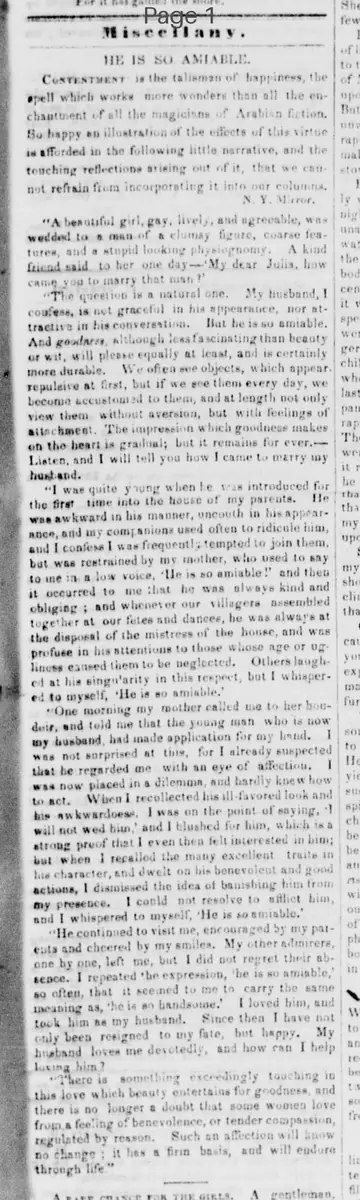
HE IS SO AMIABLE.
Contentment is the talisman of happiness, the spell which works more wonders than all the enchantment of all the magicians of Arabian fiction. No happy an illustration of the effects of this virtue is afforded in the following little narrative, and the touching reflections arising out of it, that we can not refrain from incorporating it into our columns. N. Y. Merc.
"A beautiful girl, gay, lively, and agreeable, was wedded to a man of a clumsy figure, coarse features, and a stupid looking physiognomy. A kind friend said to her one day—'My dear Julia, how came you to marry that man?'
"The question is a natural one. My husband, I confess, is not graceful in his appearance, nor attractive in his conversation. But he is so amiable. And goodness, although less fascinating than beauty or wit, will please equally at least, and is certainly more durable. We often see objects, which appear repulsive at first, but if we see them every day, we become accustomed to them, and at length not only view them without aversion, but with feelings of attachment. The impression which goodness makes on the heart is gradual; but it remains for ever.— Listen, and I will tell you how I came to marry my husband.
"I was quite young when he was first introduced for the first time into the house of my parents. He was awkward in his manner, uncouth in his appearance, and my companions used often to ridicule him, and I confess I was frequently tempted to join them. but was restrained by my mother, who used to say to me in a low voice, 'He is so amiable!' and then it occurred to me that he was always kind and obliging; and whenever our villagers assembled together at our fetes and dances, he was always at the disposal of the mistress of the house, and was profuse in his attentions to those whose age or ugliness caused them to be neglected. Others laughed at his singularity in this respect, but I whispered to myself, 'He is so amiable.'
"One morning my mother called me to her boudoir, and told me that the young man who is now my husband, had made application for my hand. I was not surprised at this, for I already suspected that he regarded me with an eye of affection. I was now placed in a dilemma, and hardly knew how to act. When I recollected his ill-favored look and his awkwardness, I was on the point of saying, 'I will not wed him,' and I blushed for him, which is a strong proof that I even then felt interested in him: but when I recalled the many excellent traits in his character, and dwelt on his benevolent and good actions, I could not resolve to afflict him, and I whispered to myself, 'He is so amiable.'
"He continued to visit me, encouraged by my parents and cheered by my smiles. My other admirers, one by one, left me, but I did not regret their absence. I repeated the expression, 'he is so amiable,' so often, that it seemed to me to carry the same meaning as, 'he is so handsome.' I loved him, and took him as my husband. Since then I have not only been resigned to my fate, but happy. My husband loves me devotedly, and how can I help loving him?
There is something exceedingly touching in this love which beauty entertains for goodness, and there is no longer a doubt that some women love from a feeling of benevolence, or tender compassion, regulated by reason. Such an affection will know no change; it has a firm basis, and will endure through life."
HE IS SO AMIABLE.
Contentment is the talisman of happiness, the spell which works more wonders than all the enchantment of all the magicians of Arabian fiction. No happy an illustration of the effects of this virtue is afforded in the following little narrative, and the touching reflections arising out of it, that we can not refrain from incorporating it into our columns. N. Y. Merc.
"A beautiful girl, gay, lively, and agreeable, was wedded to a man of a clumsy figure, coarse features, and a stupid looking physiognomy. A kind friend said to her one day—'My dear Julia, how came you to marry that man?'
"The question is a natural one. My husband, I confess, is not graceful in his appearance, nor attractive in his conversation. But he is so amiable. And goodness, although less fascinating than beauty or wit, will please equally at least, and is certainly more durable. We often see objects, which appear repulsive at first, but if we see them every day, we become accustomed to them, and at length not only view them without aversion, but with feelings of attachment. The impression which goodness makes on the heart is gradual; but it remains for ever.— Listen, and I will tell you how I came to marry my husband.
"I was quite young when he was first introduced for the first time into the house of my parents. He was awkward in his manner, uncouth in his appearance, and my companions used often to ridicule him, and I confess I was frequently tempted to join them. but was restrained by my mother, who used to say to me in a low voice, 'He is so amiable!' and then it occurred to me that he was always kind and obliging; and whenever our villagers assembled together at our fetes and dances, he was always at the disposal of the mistress of the house, and was profuse in his attentions to those whose age or ugliness caused them to be neglected. Others laughed at his singularity in this respect, but I whispered to myself, 'He is so amiable.'
"One morning my mother called me to her boudoir, and told me that the young man who is now my husband, had made application for my hand. I was not surprised at this, for I already suspected that he regarded me with an eye of affection. I was now placed in a dilemma, and hardly knew how to act. When I recollected his ill-favored look and his awkwardness, I was on the point of saying, 'I will not wed him,' and I blushed for him, which is a strong proof that I even then felt interested in him: but when I recalled the many excellent traits in his character, and dwelt on his benevolent and good actions, I could not resolve to afflict him, and I whispered to myself, 'He is so amiable.'
"He continued to visit me, encouraged by my parents and cheered by my smiles. My other admirers, one by one, left me, but I did not regret their absence. I repeated the expression, 'he is so amiable,' so often, that it seemed to me to carry the same meaning as, 'he is so handsome.' I loved him, and took him as my husband. Since then I have not only been resigned to my fate, but happy. My husband loves me devotedly, and how can I help loving him?
There is something exceedingly touching in this love which beauty entertains for goodness, and there is no longer a doubt that some women love from a feeling of benevolence, or tender compassion, regulated by reason. Such an affection will know no change; it has a firm basis, and will endure through life."
What sub-type of article is it?
Romance
Biography
What themes does it cover?
Love
Moral Virtue
What keywords are associated?
Amiable Husband
Marriage Choice
Goodness Over Beauty
Lasting Love
Moral Reflection
What entities or persons were involved?
Julia
Her Husband
Her Mother
Story Details
Key Persons
Julia
Her Husband
Her Mother
Story Details
A beautiful young woman, influenced by her mother's praise of his amiability, marries an awkward and unattractive man for his kind and obliging nature, leading to a devoted and happy marriage that values goodness over beauty.