Thank you for visiting SNEWPapers!

Sign up free
Page thumbnail for The Daily Morning Journal And Courier
Foreign News June 17, 1899 Event 1 of 2

The Daily Morning Journal And Courier

New Haven, New Haven County, Connecticut

What is this article about?

The proposed new German bill against strikes, laid before the Reichstag, prescribes penal servitude only in exceptional cases where acts of intimidation or incitement lead to strikes or lock-outs endangering the empire's security or life/property. Culprits face up to three years, ringleaders up to five years. It widens the definition of offenses related to association and intimidation, extending penalties to one year's imprisonment or 1,000 marks fine. Professional strike-agitators face three months' imprisonment. Picketing is included as physical force. Employers and employed can agree on employment categories.

Clipping
OCR Quality

100% Excellent

Full Text

This is Event 1 of 2. The full text below covers all events in this component.

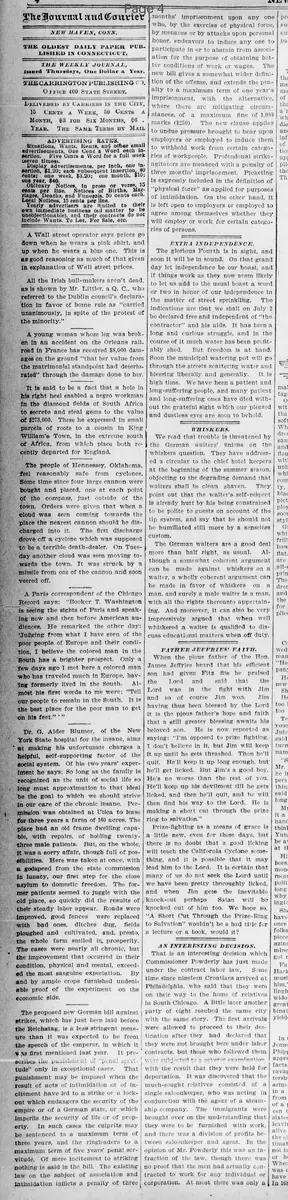
The proposed new German bill against strikes, which has just been laid before the Reichstag, is a less stringent measure than it was expected to be from the speech of the emperor, in which it was first mentioned last year. It prescribes the punishment of "penal servitude" only in exceptional cases. That punishment may be imposed when the result of acts of intimidation or of incitement have led to a strike or a lock-out which endangers the security of the empire or of a German state, or which imperils the security of life or of property. In such cases the culprits may be sentenced to a maximum term of three years, and the ringleaders to a maximum term of five years' penal servitude. Of mere incitement to striking nothing is said in the bill. The existing law on the subject of association and intimidation inflicts a penalty of three months' imprisonment upon any one who, by the exercise of physical force, by menaces or by attacks upon personal honor, endeavors to induce any one to participate in or to abstain from association for the purpose of obtaining better conditions of work or wages. The new bill gives a somewhat wider definition of the offense, and extends the penalty to a maximum term of one year's imprisonment, with the alternative, where there are mitigating circumstances, of a maximum fine of 1,000 marks ($250). The new clause applies to undue pressure brought to bear upon employers or employed to induce them to withhold work from certain categories of workpeople. Professional strike-agitators are menaced with a penalty of three months' imprisonment. Picketing is expressly included in the definition of "physical force" as applied for purposes of intimidation. On the other hand, it is left open to employers or employed to agree among themselves whether they will employ or work for certain categories of persons.

What sub-type of article is it?

Political Economic

What keywords are associated?

German Bill Anti Strike Legislation Reichstag Penal Servitude Strike Agitators Picketing Intimidation

What entities or persons were involved?

Emperor

Where did it happen?

Germany

Foreign News Details

Primary Location

Germany

Key Persons

Emperor

Event Details

The proposed new German bill against strikes, laid before the Reichstag, prescribes penal servitude only in exceptional cases where acts of intimidation or incitement lead to strikes or lock-outs endangering the empire's security or life/property. Culprits face up to three years, ringleaders up to five years. It widens the definition of offenses related to association and intimidation, extending penalties to one year's imprisonment or 1,000 marks fine. Professional strike-agitators face three months' imprisonment. Picketing is included as physical force. Employers and employed can agree on employment categories.

Are you sure?